Carboxymethyl Cellulose (CMC) Micron Powder for Li-ion Battery Anode Materials
- SKU:
- NG08BE0309
- Shipping:
- Calculated at Checkout

Description
100 grams/62 €
500 grams/248 €
1000 grams/432 €
Product Overview of Carboxymethyl Cellulose (CMC)
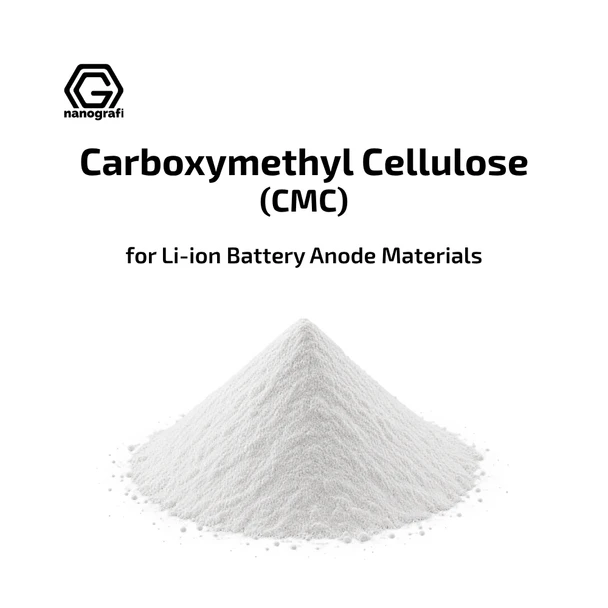
Carboxymethyl Cellulose (CMC) Micron Powder is a high-purity, cellulose-derived polymer material with a purity of ≥99.5%, designed for research and development of lithium-ion battery anode formulations. Supplied as a white powder, this material exhibits a viscosity of 7,000–10,000 mPa·s in a 2% aqueous solution, a degree of substitution of 0.6–0.9, and a pH range of 6.0–8.5.
CMC is widely used as a water-based binder and rheology modifier in lithium-ion battery electrode manufacturing. Its thickening and binding characteristics help control slurry viscosity, support the dispersion of active materials, and contribute to electrode coating uniformity. It is commonly investigated in graphite-based and silicon-containing anode formulations, often in combination with styrene-butadiene rubber (SBR) binders.
As a water-processable polymer additive, CMC supports research into aqueous electrode processing and alternative binder systems. Its effectiveness depends on electrode composition, binder concentration, slurry preparation conditions, and electrochemical testing parameters.
Technical Properties of Carboxymethyl Cellulose (CMC)
|
Appearance |
White powder |
|
Viscosity (2% aqueous solution) |
7000~10000 mpa.s |
|
Purity |
≧99.5% |
|
Water Content |
≦10% |
|
Substituting degree |
0.6~0.9 |
|
PH |
6.0~8.5 |
|
Heavy metal (pb) |
≦15 ppm |
|
Fe |
≦40 ppm |
|
As |
≦2 ppm |
|
CAS Number |
9004-32-4 |
Applications of Carboxymethyl Cellulose (CMC)
- Lithium-Ion Battery Anodes: Used as a binder and thickening agent in graphite-based and silicon-containing anode formulations.
- Aqueous Electrode Slurry Preparation: Supports viscosity adjustment and slurry consistency in water-based electrode manufacturing processes.
- CMC/SBR Binder Systems: Used in combination with styrene-butadiene rubber (SBR) to investigate electrode adhesion, flexibility, and mechanical integrity.
- Graphite Electrode Processing: Applied in research involving graphite particle dispersion, slurry stability, and electrode coating uniformity.
- Silicon-Based Anode Research: Investigated as a polymer binder for silicon-containing electrodes to help accommodate mechanical stresses associated with volume changes during cycling.
- Battery Electrode Coating: Used in electrode slurry formulations for coating processes involving copper current collectors.
- Advanced Battery Materials Research: Studied in the development and optimization of water-based binder systems for rechargeable lithium-ion batteries.
Storage Conditions of Carboxymethyl Cellulose (CMC)
Store in a tightly closed container in a cool, dry, and well-ventilated area. Protect from moisture, excessive humidity, and contamination to help maintain powder quality and consistency. Avoid generating airborne dust during handling. Refer to the product-specific Safety Data Sheet (SDS) for detailed storage and handling requirements.
Related Products
Related Products

Lithium Titanium Oxide (Li4Ti5O12) Micron Powder for Li-ion Battery Anode (LTO)

Styrene-Butadiene Rubber (SBR) Binder for Li-ion Battery Anode Materials

High Capacity and High Purity Graphite Micron Powder for Li-ion Battery