
Graphene Oxide
Graphene oxide (GO) is an oxygen-rich, water-dispersible form of graphene, valued for its tunable chemistry, large surface area, and easy processing.
Nanografi supplies high-quality graphene oxide in powder and dispersion forms for energy, composites, biomedical, and sensing applications, all at competitive prices with worldwide shipping.
- Product
- Qty in Cart
- Quantity
- Price
- Subtotal
-
POPULAR


Graphene Oxide, 2-5 Layer, Dia: 4,5 µm
€140.005 gram: 140 €25 gram: 650 €100 gram: 1660 €500 gram: 4950 €1000 gram: 8640 €NG01GO0102€140.00 -


Single Layer Graphene Oxide, Purity: 99.5 %
€340.005 gram: 340 €25 gram: 1180 €100 gram: 2850 €500 gram: 6450 €1000 gram: 9980 € &nbsNG01GO0101€340.00 -


Graphene Oxide Water Dispersion, Purity: 99.5%, Dark Brown Liquid, GO: 0.8 wt%
€18.0030 ml: 18 €60 ml: 29 € 120 ml: 48NG01GO0501€18.00 -

Reduced Graphene Oxide Water Dispersion, Purity: 99.5%, rGO: 2.0 wt%
€168.0025 ml :168 €100 ml: 507 €500 ml: 762 €1000 ml: 961 € Contact us for taiNG04EO0729€168.00 -

Graphene Oxide Water Dispersion, Purity 99.5%, Dark Brown Liquid, GO: 2.0 wt%
€35.0025 ml: 35 €100 ml: 89 €500 ml: 225 €1000 ml: 374 € Contact us for tailored quotesNG04EO0717€35.00
What is graphene oxide?
Graphene oxide (GO) is a single or few layer sheet of carbon atoms carrying hydroxyl, epoxy and carboxyl groups on its surface. It is made by oxidising graphite and exfoliating the resulting graphite oxide, which is why it disperses in water without surfactants. GO is electrically insulating until it is reduced to reduced graphene oxide (rGO). See how graphite becomes graphene oxide.
Graphene oxide grades at Nanografi
All grades below are produced and stocked by Nanografi. Values are taken from each product page; full specifications and MSDS files are on the product pages.
Powders
| Product | Purity | Layers | Flake / particle size | Oxygen content | Price from |
|---|---|---|---|---|---|
| Graphene Oxide, 2-5 Layer NG01GO0102 |
99.5% | 2-5 | 4.5 µm average | 25-40% | €140 / 5 g |
| Single Layer Graphene Oxide NG01GO0101 |
99.5% | 1 (1.1 ± 0.2 nm) | Not specified | 30.90% (C 68.55%) | €340 / 5 g |
| Reduced Graphene Oxide (rGO) NG01RGO0101 |
99% | 2-5 | 1-10 µm particle | Reduced | €270 / 5 g |
| rGO-TEPA, amine functionalised NG10GNPW0957 |
C 71.6 at%, N 13.8 at% | Not specified | 7 µm average | 11.2 at% | €145 / 1 g |
Water dispersions
| Product | Concentration | Purity | Thickness | Flake size | Price from |
|---|---|---|---|---|---|
| GO Water Dispersion NG01GO0501 |
0.8 wt% | 99.5+% | 0.4-1.1 nm | 1-5 µm | €18 / 30 ml |
| GO Water Dispersion NG04EO0717 |
2.0 wt% | 99.5% | 0.5-1.3 nm | 2.0-6.0 µm | €35 / 25 ml |
| rGO Water Dispersion NG04EO0729 |
2.0 wt% | 99.5% | 0.5-2 nm | 1-5 µm | €168 / 25 ml |
Specific surface area: 800-1600 m²/g for the 0.8 wt% GO dispersion and 1562 m²/g for the rGO dispersion. All dispersions can be diluted with deionised water.
Not sure which grade fits your process? Single layer GO gives the highest surface chemistry per gram, few layer GO is more robust during handling, and the water dispersions remove the dispersion step from your workflow.
Graphene oxide vs reduced graphene oxide
| Property | Graphene oxide (GO) | Reduced graphene oxide (rGO) |
|---|---|---|
| How it is made | Oxidation of graphite, then exfoliation | Chemical, thermal or electrochemical reduction of GO |
| Oxygen groups | High: hydroxyl, epoxy, carboxyl | Mostly removed, some residual oxygen and defects |
| Electrical behaviour | Insulating | Conductive |
| Water dispersibility | Disperses without surfactant | Limited, usually supplied as a stabilised dispersion |
| Typical use | Membranes, coatings, sensors, composites, biomedical research | Electrodes, conductive composites, supercapacitors, batteries |
| Nanografi grades | Powder and 0.8 / 2.0 wt% dispersions | rGO powder, rGO dispersion, rGO-TEPA |
More detail: graphene oxide vs reduced graphene oxide and rGO properties and synthesis.
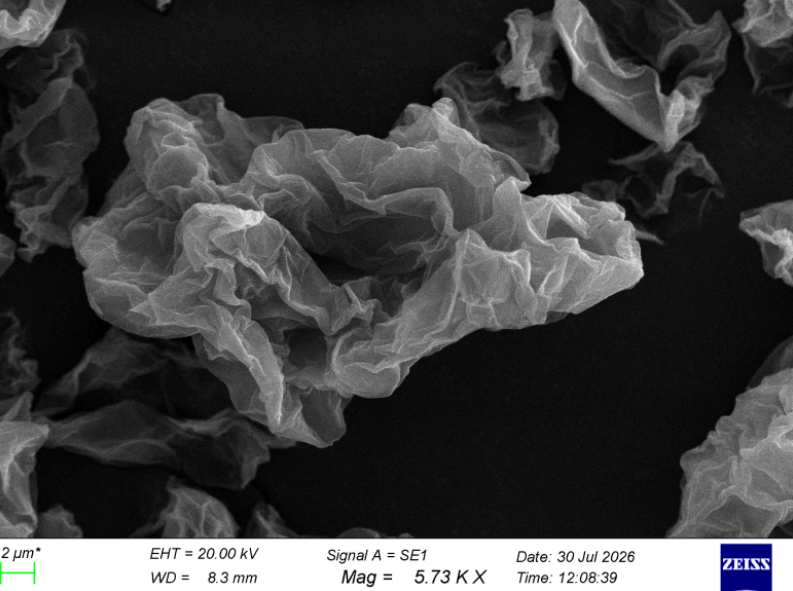
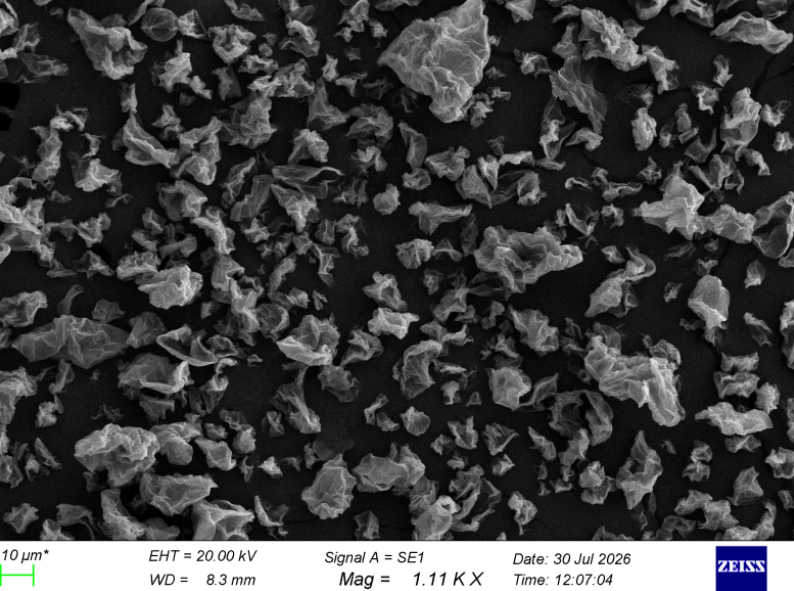
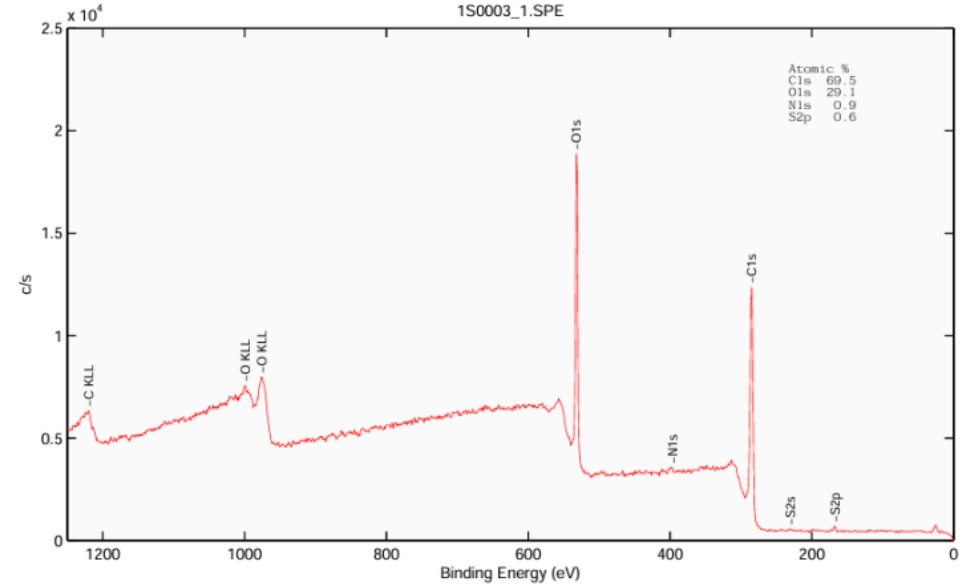
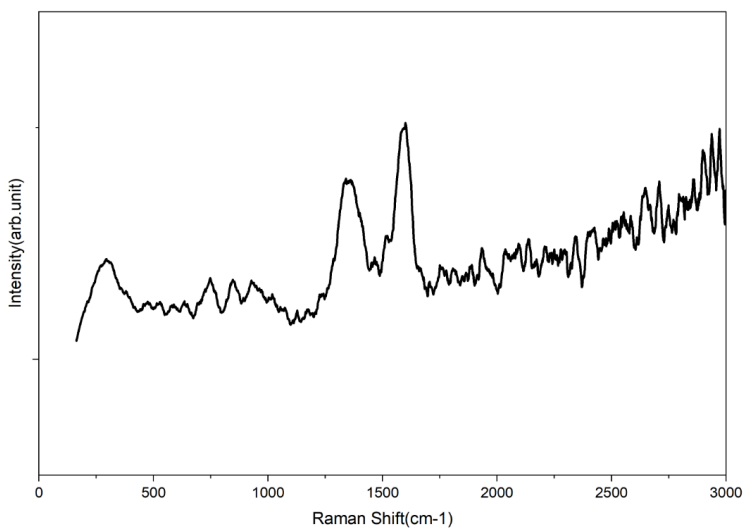
Characterization: SEM, XPS and Raman
Every batch is characterised before shipping. The images below are from Graphene Oxide, 2-5 Layer, Dia: 4.5 µm (NG01GO0102).
How to disperse graphene oxide in water
- Weigh the powder and add it to deionised water at the concentration your process needs. GO is hydrophilic, so no surfactant is required.
- Stir first. Mechanical stirring hydrates the flakes without breaking them.
- Finish with short bath sonication cycles. Long or aggressive sonication reduces flake size, so use the shortest cycle that gives a homogeneous, dark brown liquid.
- Check for sediment after resting. A stable GO dispersion stays uniform and shows no settled solid.
- Keep the container closed and away from light, and redisperse briefly before use.
If you would rather skip this step, order a ready to use dispersion: 0.8 wt% or 2.0 wt%. Both can be diluted with deionised water.
Applications of graphene oxide
- Polymer and ceramic composites: oxygen groups bond with the matrix and improve mechanical strength, barrier properties and thermal stability.
- Water treatment and membranes: GO adsorbs heavy metals and organic pollutants and forms the building block of GO membranes. See graphene oxide for heavy metal sensing.
- Energy storage: GO is used as a precursor and scaffold in lithium ion battery and supercapacitor electrodes, usually after reduction to rGO.
- Coatings and surface modification: anti corrosion and barrier coatings, and surface treatments that improve wetting and adhesion.
- Sensors and actuators: tunable surface chemistry for chemical and biological sensors. See graphene oxide actuators.
- Biomedical research: drug delivery carriers, biosensing platforms and antibacterial studies.
Background reading: why graphene oxide leads the graphene industry.
Published research using Nanografi graphene oxide
Nanografi graphene oxide is cited in 66 peer reviewed publications indexed by Bioz, which rates the product 93 out of 100. Recent examples:
- Ugurlu, M.; Sari, F. Water sorption and bond strength of graphene oxide-added universal adhesives. BMC Oral Health, 2026. doi:10.1186/s12903-026-08360-0
- Flasz, B. et al. Response to multigenerational graphene oxide exposure in Acheta domesticus strains selected for longevity. Scientific Reports, 2026. doi:10.1038/s41598-026-37623-7
- Nagy, L. et al. Resorcinol-formaldehyde carbon gels containing thermally reduced graphene oxide as Li-air battery cathodes. Journal of Energy Storage, 2026. doi:10.1016/j.est.2026.124225
- Mergen, Ö. B.; Arda, E. A comprehensive optical band-gap investigation of GO-MWCNT reinforced CMC/PVP bionanocomposites. Journal of Materials Science: Materials in Electronics, 2026. doi:10.1007/s10854-026-17312-x
- Fombona-Pascual, A. et al. Membrane-free polymer-based faradaic deionization system for enhanced desalination. Environmental Science & Technology, 2026. doi:10.1021/acs.est.6c00876
- Orak, A.; Elitaş, M.; Kalyon, A. Manufacturing optimization and mechanical performance evaluation of graphene/glass fiber reinforced hybrid composite lattice structures via SLA. International Journal of Precision Engineering and Manufacturing, 2026. doi:10.1007/s12541-026-01490-z
Graphene oxide price
Prices are per package. Contact us for quantities above 1 kg or for a formal quotation.
| Powder | 5 g | 25 g | 100 g | 500 g | 1000 g |
|---|---|---|---|---|---|
| GO, 2-5 Layer | €140 | €650 | €1,660 | €4,950 | €8,640 |
| Single Layer GO | €340 | €1,180 | €2,850 | €6,450 | €9,980 |
| rGO, 2-5 layers | €270 | €935 | €2,270 | €5,450 | €9,640 |
| Dispersion | Package sizes and prices |
|---|---|
| GO dispersion, 0.8 wt% | 30 ml €18 • 60 ml €29 • 120 ml €48 • 500 ml €115 • 1000 ml €162 |
| GO dispersion, 2.0 wt% | 25 ml €35 • 100 ml €89 • 500 ml €225 • 1000 ml €374 |
| rGO dispersion, 2.0 wt% | 25 ml €168 • 100 ml €507 • 500 ml €762 • 1000 ml €961 |
Frequently asked questions
What is graphene oxide used for?
Graphene oxide is used in polymer and ceramic composites, water treatment and membranes, battery and supercapacitor electrodes, anti corrosion and barrier coatings, chemical and biological sensors, and biomedical research such as drug delivery and antibacterial studies.
What is the difference between graphene oxide and reduced graphene oxide?
Graphene oxide is highly oxidised, disperses in water and is electrically insulating. Reduced graphene oxide has most of those oxygen groups removed, which makes it conductive but harder to disperse. Choose GO for surface chemistry and processability, rGO for conductivity.
Is graphene oxide dispersible in water?
Yes. The hydroxyl, epoxy and carboxyl groups make GO hydrophilic, so it disperses in water and polar solvents without a surfactant. Nanografi also supplies ready to use water dispersions at 0.8 wt% and 2.0 wt%, both of which can be diluted.
Should I choose single layer or few layer graphene oxide?
Single layer GO (99.5%, about 1.1 nm thick) gives the highest accessible surface and is used where monolayer behaviour matters, for example thin films and membranes. Few layer GO (2-5 layers, 4.5 µm flakes) is more robust in handling and is the usual choice for composites and bulk processing.
What is the oxygen content of Nanografi graphene oxide?
The 2-5 layer grade has an oxygen content of 25 to 40%. Elemental analysis of the single layer grade gives 30.90% oxygen and 68.55% carbon, and the 2.0 wt% dispersion gives 31.02% oxygen and 68.75% carbon.
How much does graphene oxide cost?
Graphene oxide powder starts at €140 for 5 g of the 2-5 layer grade and €340 for 5 g of the single layer grade. Water dispersions start at €18 for 30 ml. Bulk pricing down to 1 kg is listed above, and larger volumes are quoted on request.
Do you provide technical documents and safety data sheets?
Yes. Each product page carries its technical properties and an MSDS under the Technical Documents tab. Certificates of analysis for a specific batch are available on request.
Do you ship worldwide and can I order a sample?
Yes, Nanografi ships worldwide. The smallest package sizes, 5 g for powders and 25 to 30 ml for dispersions, are suitable for evaluation before a larger order. Contact us for a quotation on research or industrial quantities.
Buy graphene oxide from Nanografi
Nanografi produces graphene oxide and reduced graphene oxide in powder and water dispersion form, with characterisation data on every product page and worldwide shipping. Browse the grades above or contact our team with your specification.