
Transistor - Effect MXene Membranes
Introduction
Material science is undergoing a revolutionary transition from passive and static components to active and intelligent systems capable of instantaneous response to external stimuli. While traditional membranes have functioned as fixed filters for years, recent studies shifted this paradigm. MXene-based membranes can now behave as ionic transistors.
MXenes derive their crystallographic foundations from a family of triple-layered ceramics called MAX phases, defined by the general formula Mn+1AXn. The fundamental step in the production process—the selective chemical etching of the "A" element layers—leaves behind atomic-level 2D sheets that possess metallic conductivity and are equipped with surface functional groups (Figure 1).
For more technical details regarding the structure and synthesis processes of MAX phases, you can refer to our article titled "MXene Synthesis and Characterization”.
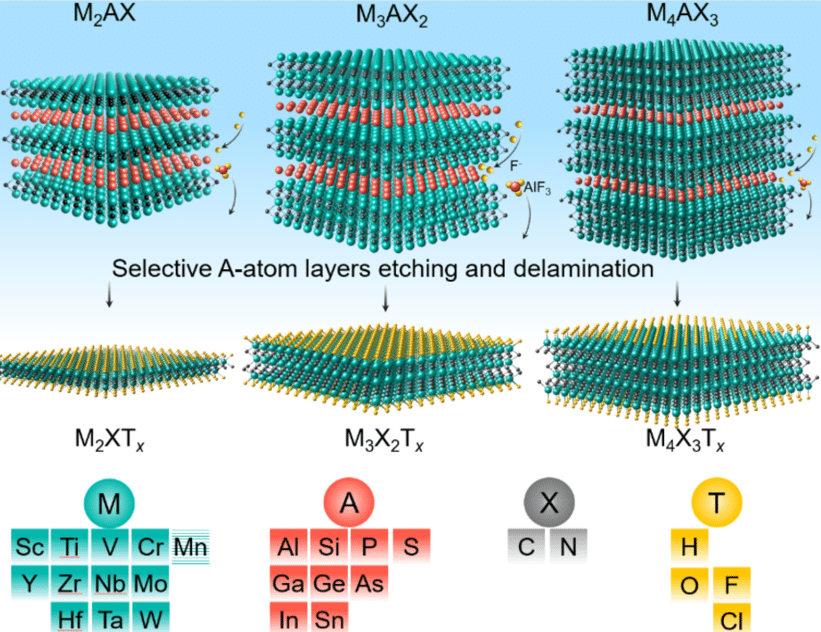
Figure 1. Synthesis process of 2D MXene nanosheets with functional surface groups from a layered MAX phase precursor via the selective etching method (Hong et al., 2020).
The stacking of these high-quality materials in lamellar form creates organized nano-channels at the sub-nanometer scale for ion transport. Data in the literature reveal that the working principle of these channels is based on Donnan equilibrium principles and the electrostatic interactions of ions with surface charges. Unlike traditional membranes, these structures—owing to their conductive character—can manipulate the electrical double layer within the channels during operation through an externally applied gate voltage.
Operando Control: Transition from Static to Dynamic
In traditional membrane technologies, channel sizes (d-spacing) and surface properties are permanently fixed during the production stage. This means that filtration performance remains a static parameter that cannot be intervened with during operation. However, recent studies conducted by expert researchers have shattered this established paradigm by proving that a gate voltage applied to conductive MXene layers can modulate ion and neutral solution permeability in real-time.
The most striking aspect of this discovery was confirmed through operando Wide-Angle X-Ray Scattering (WAXS) measurements. This change in permeability does not stem from a mechanical narrowing of the physical distance between layers, but rather from a purely electrical control mechanism. Experts liken this situation to controlling water flowing through a garden hose using a valve or managing the flow by stepping on the hose. The system modulates the molecular transport rate in real-time by utilizing the electrical potential difference between the solution reservoir and the conductive MXene layers. Unlike passive separation systems, how this ion flow is controlled by an electrical 'gate' voltage is schematized in Figure 2. The high electrical conductivity of the MXene material allows the applied electric field to instantaneously change the molecular transport efficiency.
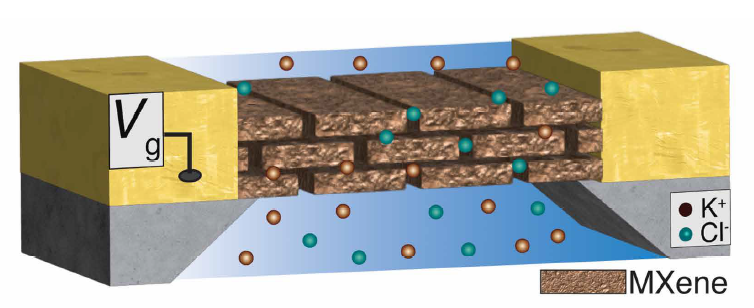
Figure 2. Schematic representation of the MXene transistor membrane setup and the electrical control mechanism of ion transport (Pendse et al., 2025).
Through this transistor-like behavior, MXene membranes evolve from being mere passive filters into digital ionic faucets capable of switching molecular flow on and off during operation. This capability paves the way for the real-time optimization of processes such as water purification, drug delivery, and the separation of critical rare earth elements with a level of precision previously considered technically impossible.
Donnan Equilibrium and Ionic Barrier Management
The technical success of the system relies on manipulating the transport mechanism within MXene channels via Donnan Equilibrium. MXene surfaces possess a natural negative charge due to chemical terminations originating from the production process. While this potential difference formed at the membrane-solution interface only passively affects ion transport in traditional systems, it transforms into an active control center in this next-generation transistor architecture. By applying a gate voltage to the conductive MXene body, researchers have successfully directly altered the height of the electrostatic barrier at the channel entrance.
The pore-level modeling in Figure 3 schematizes the Donnan Equilibrium (DE) regions formed at the interface between MXene layers and solution reservoirs, illustrating how the applied voltage (Vg) transforms this barrier into an active control hub. When the negative potential is increased, the rejection capacity of the ionic channels reaches its maximum, restricting the flow; modulating the voltage, however, instantaneously releases the transport path of the ions like a gate. This mechanism liberates separation technologies from passive filtration based solely on molecular size, elevating them to a level of charge-based and programmable selectivity. Thus, the membrane functions as an intelligent barrier capable of deciding within seconds which ion passes through and at what speed.
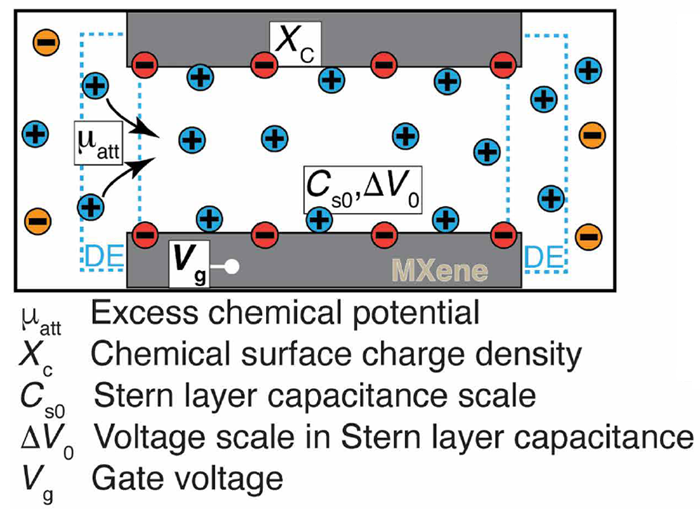
Figure 3. Schematic model of ion transport in a MXene transistor channel controlled by Donnan Equilibrium (DE) and gate voltage (Vg) (Pendse et al., 2025).
AC Voltage Regime and Self-Pumping Effect
One of the most visionary engineering outcomes of the research is the dramatic increase observed in ion transport rates under a low-frequency alternating current (AC) regime. Unlike traditional static (DC) voltage applications, AC oscillations within specific frequency ranges transform ion mobility within the membrane from a passive leak into an active flow.
This phenomenon is explained by a unique mechanism identified in the literature as diffuso-osmotic flow oscillations, where ions are pushed across the membrane as if by a mechanical pump. The periodic reversal of the electrical field mobilizes the electrical double layer within the MXene channels, triggering the transport of ions at speeds that exceed natural diffusion limits. Experts emphasize that this self-pumping structure enables ultra-fast filtration without the need for an external pressure source or mechanical driving force. This innovation is considered a revolutionary step toward developing high-efficiency molecular transport and precision separation systems that minimize energy consumption.
Sustainable Water-Energy Nexus and Future Vision
The concept of the "water-energy nexus," which expresses the mutual interdependence between water and energy management, has gained a practical application area through recently developed ionic control mechanisms. The ability of MXene membranes to manage ion transport with the precision of a transistor not only optimizes water purification processes but also directly serves osmotic power generation processes, where energy is harvested from the mixing of solutions with different salinity levels.
In particular, combining ionic selectivity in sub-nanometer artificial channels with a voltage-controlled gate mechanism brings efficiency to a new dimension in strategic mining operations, such as lithium separation. As shown in Figure 4, the transport rate of lithium (Li+) ions gains significant momentum as the frequency of the applied AC gate voltage increases, rising above traditional limits.
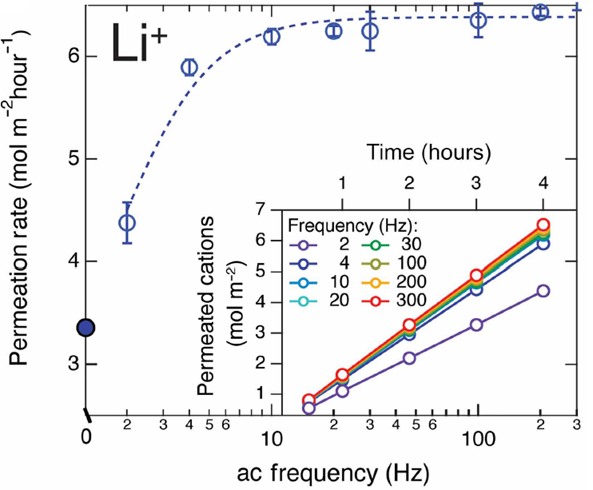
Figure 4. Increase in lithium ion transport rate as a function of AC gate voltage frequency (Pendse et al., 2025).
Furthermore, the light-triggerable transport properties of these materials and their high structural stability in the aqueous phase indicate that they will be the cornerstone of future self-powering smart desalination platforms. The ionic selectivity ratios, which form the technical foundation of this vision, can be precisely modulated with the applied AC frequency for different ion pairs, as demonstrated in Figure 5.
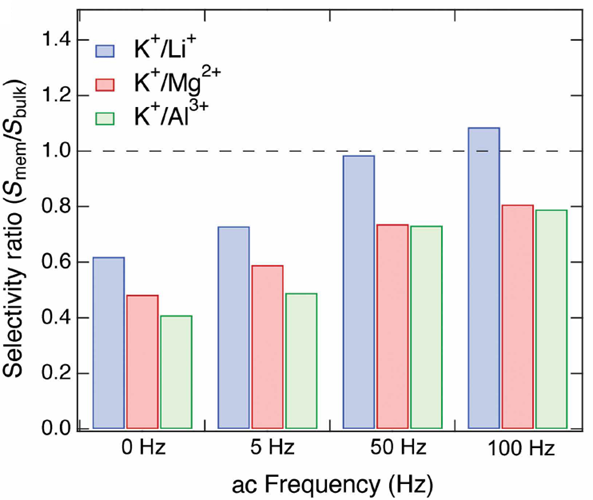
Figure 5. Selectivity ratios for different ion mixtures as a function of the applied gate voltage frequency (Pendse et al., 2025).
Conclusion
The transformation of MXene membranes from static filters into dynamic ionic transistors—controllable by external stimuli such as voltage, light, and AC fields—heralds a new era in materials science. This technology offers a vast range of applications, from increasing energy efficiency in water treatment systems to the precise separation of rare earth elements and even programmable drug delivery systems within the body. In particular, the self-pumping effect achieved with low-frequency AC currents provides a revolutionary foundation for sustainable engineering solutions by reducing the reliance on external pressure systems.
These innovations, which will serve as the cornerstone of future intelligent separation platforms, can only be realized with materials possessing high purity and optimized surface chemistry. At Nanografi, we continue to provide the high-quality MXene and MAX phase solutions required for researchers and industrial stakeholders to transition these next-generation technologies from the laboratory to the field. These dynamic systems, pushing the boundaries of science, will soon redefine global standards in water and energy management.
To find out more, you can read Mxenes and MAX Phases
References
Hong, W., Wyatt, B. C., Nemani, S. K., & Anasori, B. (2020). Double transition-metal MXenes: Atomistic design of two-dimensional carbides and nitrides. MRS Bulletin, 45(10), 850–861. https://doi.org/10.1557/mrs.2020.251
Pendse, A., Yennemadi, A. V., Ferron, T. J., van Buuren, A., VahidMohammadi, A., Zhang, T., Gogotsi, Y., Bazant, M. Z., & Noy, A. (2025). Dynamic control of molecular transport MXene transistor membranes. Science Advances, 11(51). https://doi.org/10.1126/sciadv.adx6361
Li, D., Zheng, W., Ghorbani-Asl, M., Scheiter, J., Sobczak, K., Kretschmer, S., Polčák, J., Jadhao, P. H., Michałowski, P. P., Yu, R., Zhang, J., Liu, J., Du, J., Guo, Q., Zschech, E., Šikola, T., Bonn, M., Pérez, N., Nielsch, K., … Feng, X. (2026). Triphasic synthesis of MXenes with uniform and controlled halogen terminations. Nature Synthesis. https://doi.org/10.1038/s44160-025-00970-w
Kang, S., Jeong, J., Ryu, H. J., Park, G., & Kim, S. (2026). Carbon nanotube sandpaper for atomic-precision surface finishing. Advanced Composites and Hybrid Materials, 9(1). https://doi.org/10.1007/s42114-025-01608-3
Macha, M., Marion, S., Nandigana, V. V. R., & Radenovic, A. (2019). 2D materials as an emerging platform for nanopore-based power generation. Nature Reviews Materials, 4(9), 588–605. https://doi.org/10.1038/s41578-019-0126-z
Lim, Y. J., Goh, K., & Wang, R. (2022). The coming of age of water channels for separation membranes: from biological to biomimetic to synthetic. Chemical Society Reviews, 51(11), 4537–4582. https://doi.org/10.1039/d1cs01061a
Lao, J., Lv, R., Gao, J., Wang, A., Wu, J., & Luo, J. (2018). Aqueous Stable Ti3C2 MXene Membrane with Fast and Photoswitchable Nanofluidic Transport. ACS Nano, 12(12), 12464–12471. https://doi.org/10.1021/acsnano.8b06708
Shen, J., Liu, G., Han, Y., & Jin, W. (2021). Artificial channels for confined mass transport at the sub-nanometre scale. Nature Reviews Materials, 6(4), 294–312. https://doi.org/10.1038/s41578-020-00268-7
Recent Posts
-
MXene vs Graphene: Which Material Performs Better?
Two-dimensional materials continue to redefine how advanced systems are designed for energy storage, …9th Apr 2026 -
The Growing Role of MXene in Advanced Energy Storage Systems
Fast charging alone is no longer enough. Today’s energy storage systems are expected to combine high …2nd Apr 2026 -
From Filler to Function: Graphite as a Next-Gen Catalyst
What if the future of fuel cells did not depend on rare and expensive metals like platinum? As the d …27th Mar 2026