
Carbon Nanotube Sponges, Size: 10 mm x 10 mm, Thickness: 1-2 mm

- SKU:
- NG01CNTS0101
- Shipping:
- Calculated at Checkout

Description
1 piece / 141 €
5 pieces / 528 €
Please contact us for quotes on larger quantities !
Carbon Nanotube Sponges
Size: 10 mm x 10 mm, Thickness: 1-2 mm
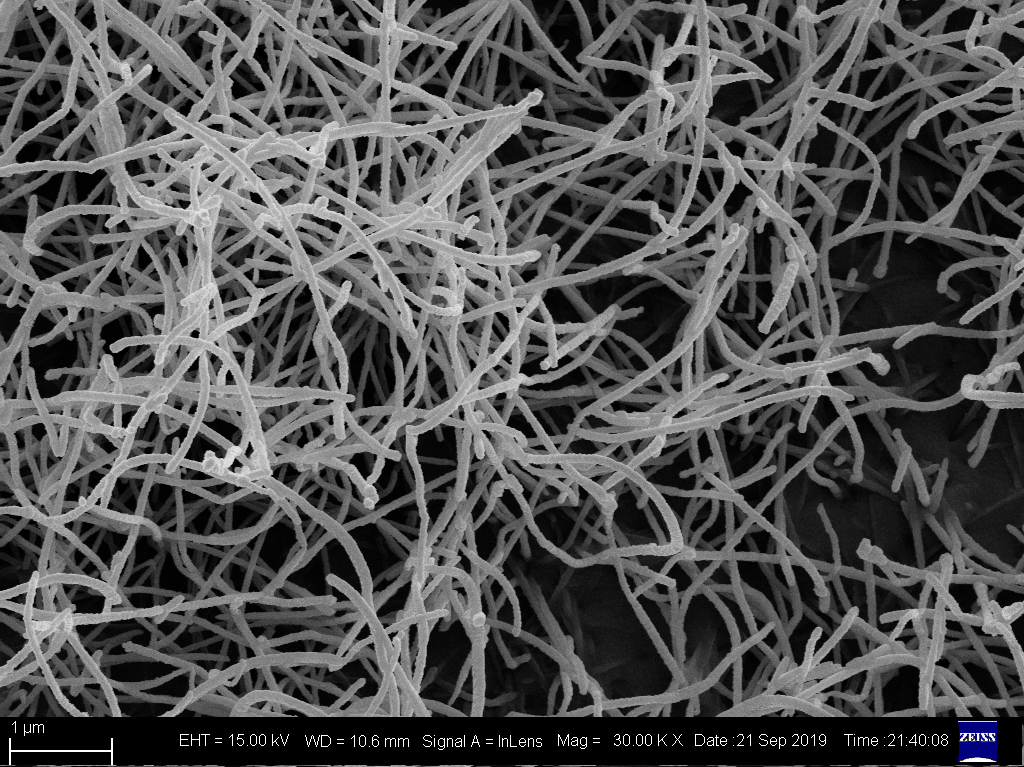
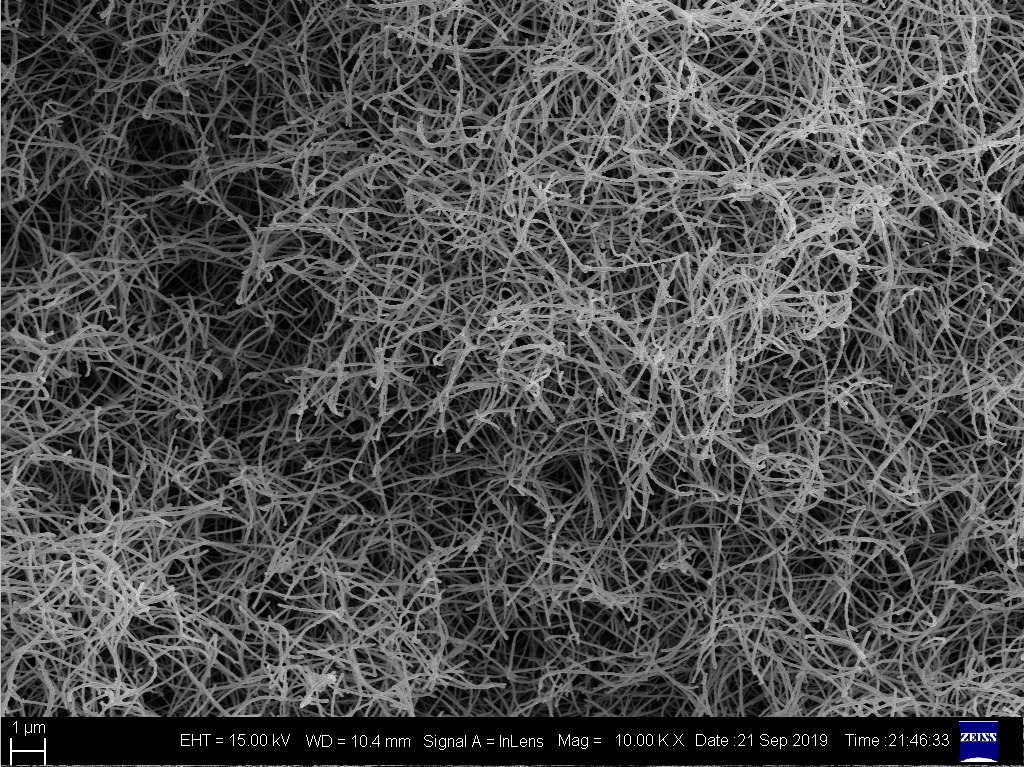
Carbon Nanotube Sponge is characterized by a highly uniform and interconnected 3D structure, engineered to offer a unique combination of exceptional mechanical strength and low density. Thanks to its high porosity and robust framework, this material serves as an efficient agent for the filtration and absorption of diverse pollutants, including fertilizers, pesticides, and pharmaceuticals. Beyond environmental remediation, its versatile architecture makes it an ideal candidate for energy storage applications, acting as a stable catalyst carrier or a reinforcing phase in high-efficiency composite materials. Designed for consistency and performance, our CNT sponge provides a high-surface-area solution for demanding industrial and research-based material challenges.
SEM Images
Applications
- Advanced Water Filtration: Physical removal of organic pollutants, oil residues, and micro-scale impurities from aqueous systems through its highly porous architecture.
- High-Surface-Area Catalyst Support: Providing an expansive internal surface area to facilitate efficient catalyst loading and optimization of reaction kinetics in chemical processes.
- Lightweight Structural Reinforcement: Integration into polymers, epoxies, and other matrices to enhance mechanical strength and structural integrity without significantly increasing total weight.
- Energy Storage Research: Serving as a high-conductivity, porous electrode component or scaffold in the development of next-generation batteries and supercapacitors.
- Electromagnetic Shielding: Utilization as a lightweight, conductive shielding layer to prevent signal interference in sensitive electronic devices.
- Thermal Management: Application as a high-performance heat dissipator or thermal interface material for managing heat loads in precision electronic components.
FAQ
FAQ About Carbon Nanotube Sponges, 10 × 10 mm, 1–2 mm Thick
1) What form does this product take?
It is a self-supporting three-dimensional monolith, not a powder or a dispersion. The nanotubes form a highly uniform interconnected framework with high porosity and low density, supplied as a cut piece measuring 10 × 10 mm with a thickness of 1–2 mm. That means it can be handled with tweezers, placed directly into a flow cell or test rig, and removed intact — which is the whole point of the format.
2) Why use a sponge rather than dispersed nanotubes?
Because recovery and reuse become trivial. Dispersed nanotubes must be filtered or centrifuged out of a treated fluid, which is slow and incomplete. A monolithic sponge is lifted out, and its structure survives the cycle. For adsorption and filtration studies this changes the experiment from a batch measurement into a repeatable one, and it removes the risk of nanomaterial carry-over into the treated stream.
3) What can it adsorb?
The product page reports efficient filtration and absorption of diverse pollutants including fertilisers, pesticides and pharmaceuticals, along with organic pollutants, oil residues and micro-scale impurities from aqueous systems. The mechanism is physical capture within the porous architecture combined with the affinity of the graphitic surface for organic species, so performance depends on the pollutant's hydrophobicity as much as on the sponge itself.
4) Which size and thickness should I order?
Nanografi supplies this sponge in several footprints and in two thickness bands, 1–2 mm and 3–4 mm. Footprint should match the cross-section of the cell or holder it will sit in, while thickness sets the contact path length and therefore residence time in a flow application. The 1–2 mm band suits thin-cell and low-pressure-drop configurations; thicker pieces give more capacity per unit face area. The range is listed under carbon nanotube sponges.
5) Can it be used as an electrode?
Yes — it is described as a high-conductivity, porous electrode component or scaffold for next-generation batteries and supercapacitors. The advantage over a coated electrode is that the conductive network and the porous structure are the same object, so no binder is required and no binder-derived resistance is introduced. The trade-off is that areal loading is fixed by the monolith rather than tunable by coating thickness.
6) What non-environmental applications does it serve?
Reported uses include high-surface-area catalyst support, lightweight structural reinforcement in polymers and epoxies, electromagnetic shielding as a conductive lightweight layer, and thermal management as a heat dissipator or thermal interface material. The unifying property across these is a continuous conductive framework at very low density — a combination a packed powder cannot provide. Further background is given in carbon nanotube (CNT) sponges.
7) How is it supplied and priced?
The sponges are sold by the piece, at 1 piece and 5 piece quantities for this size, with larger quantities quoted on request. Because each piece is a discrete component rather than a bulk material, ordering normally follows from how many test cells or devices are being built. Other geometries in the same family are available if a different footprint fits the fixture better.
Related Products
Related Products

Carbon Nanotube Sponges, Size: 50 mm x 10 mm, Thickness: 1-2 mm

Carbon Nanotube Sponges, Size: 10 mm x 10 mm, Thickness: 3-4 mm

Carbon Nanotube Sponges, Size: 50 mm x 10 mm, Thickness: 3-4 mm
Carbon Nanotube Sponges, Size: 20 mm x 20 mm, Thickness: 1-2 mm
