
Aluminum Oxide (Al2O3) Micron Powder, Purity: 99.5+%, Size: 1-10 μm
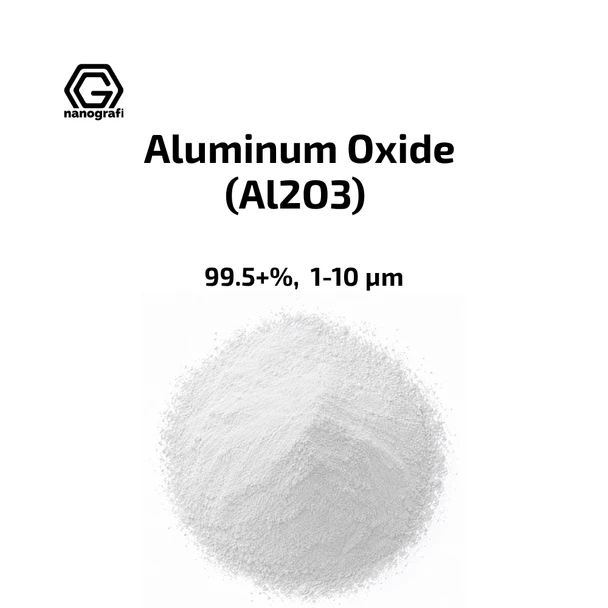
- SKU:
- NG04EO072301
- Shipping:
- Calculated at Checkout

Description
5 kg/495 €
Please contact us for quotes on larger quantities !!!
Product Overview
Technical Properties
|
Purity |
99.5+% |
||
|
Particle Size |
1-10 μm |
||
|
Crystal Structure |
α-Al2O3 (Trigonal/Hexagonal) |
||
|
Spesific Gravity |
3.96 g/cm3 |
||
|
Hardness (Knoop100) |
2150 |
||
|
Pour Density |
0.9-1.1 g/cm3 |
||
|
CAS No |
1344-28-1 |
||
|
Chemical Composition |
SiO2 |
Fe2O3 |
Na2O |
|
0.02% |
0.02% |
0.35% |
Applications
- Precision Grinding and Abrasives: Used in the precision grinding of high-speed steels and heat-sensitive alloys. The material’s high friability ensures a "cool cutting" process by constantly exposing fresh sharp edges, preventing thermal damage to the workpiece.
- Bonded Abrasive Tools: Widely utilized in the manufacturing of vitrified grinding wheels, segments, and internal grinding wheels. Its low soda and silica content allows for the production of the whitest and most stable vitrified wheels possible.
- Surface Finishing and Polishing: It is ideal for fine lapping and polishing applications where dimensional accuracy is critical.
- Refractory and Industrial Materials: Functions as a synthetic raw material for high-performance refractory and industrial applications. Its alpha alumina phase and high specific gravity provide excellent structural integrity at elevated temperatures.
FAQ
FAQ About Aluminum Oxide (Al2O3) Micron Powder, 99.5+% Purity, 1-10 µm
1) Why is alpha-phase alumina relevant for abrasive applications?
Alpha-alumina combines high hardness, chemical stability and thermal resistance, which makes it suitable for abrasive and surface-finishing processes. Nanografi's 1-10 µm Aluminum Oxide Micron Powder is an alpha-phase grade designed for applications where controlled material removal and dimensional accuracy are important.
2) Why is this alumina grade suitable for precision grinding?
The 1-10 µm particle range and high hardness support fine abrasive action, while the material's friability allows fresh cutting edges to be exposed as particles fracture under mechanical stress. This makes the grade relevant for precision grinding of high-speed steels and heat-sensitive alloys.
3) What does “cool cutting” mean for this aluminum oxide powder?
Cool cutting refers to abrasive behavior that helps limit excessive heat generation at the workpiece surface during grinding. The friable structure of this alumina grade continually exposes new sharp edges, which can support efficient cutting while reducing thermal distortion in heat-sensitive materials.
4) Can this Aluminum Oxide Micron Powder be used for lapping and polishing?
Yes. Fine lapping and polishing are among the intended applications. The 1-10 µm size range makes the material relevant where controlled surface refinement and dimensional precision are required.
5) Is this grade suitable for vitrified grinding wheels and bonded abrasives?
Yes. Nanografi lists vitrified grinding wheels, segments and internal grinding wheels among the main application areas. The alpha-alumina phase, high hardness and controlled impurity profile are relevant when formulating bonded abrasive systems.
6) Why are soda and silica levels important in alumina used for bonded abrasive tools?
Sodium and silica content can influence ceramic bonding behavior, color and consistency in vitrified abrasive systems. This grade contains 0.35% Na2O and 0.02% SiO2, parameters that can be considered when comparing alumina powders for white or dimensionally stable bonded tools.
7) When should a 1-10 µm alumina powder be selected instead of a coarser grade?
A 1-10 µm grade is generally more suitable when fine material removal, smoother surface finish and tighter dimensional control are required. Coarser alumina powders may be more appropriate for more aggressive abrasion or applications where higher removal rates are prioritized.
8) How can this grade be compared with other Aluminum Oxide Micron Powders?
Comparison should focus on particle size, alpha or fused structure, purity, hardness and the target finishing process. Nanografi's range of aluminum oxide micron powders includes additional particle sizes and fused grades for different abrasive and industrial requirements.
9) When would a fused alumina grade be a better alternative?
Fused alumina can be preferred when the process specifically requires fused abrasive characteristics or a different particle-size distribution. Researchers and formulators can compare this material with Nanografi's 10 µm fused aluminum oxide powder or other fused alumina options according to the required cutting and finishing behavior.
10) Can this aluminum oxide powder be used in refractory formulations?
Yes. Refractory and high-temperature industrial materials are among the listed applications. The alpha-alumina phase and high specific gravity make the grade relevant where thermal stability and structural integrity at elevated temperatures are required.
11) When should alumina nanopowder be considered instead of micron powder?
Alumina nanopowder may be preferred when much higher surface area, nanoscale interfaces or thin-film integration are required, while micron powder is generally better suited to abrasive, polishing and bulk ceramic applications. Nanografi also offers aluminum oxide nanoparticle grades for nanoscale material development.
12) Where can related metal oxide micron powders be compared?
Researchers working with alumina and other oxide powders can explore Nanografi's broader selection of metal oxide micron powders to compare materials by chemistry, particle size and intended application.
Related Products
Related Products

Aluminum Oxide (Al2O3) Micron Powder, Purity: 99.5+%, Size: 12-40 μm

Aluminum Oxide (Al2O3) Micron Powder, Purity: 99.5+%, Size: 850-1180 μm

Aluminum Oxide (Al2O3) Micron Powder, Purity: 99.5+%, Size: 150-212 μm

Aluminum Oxide (Al2O3) Micron Powder, Purity: 99.5+%, Size: 5-25 μm
