
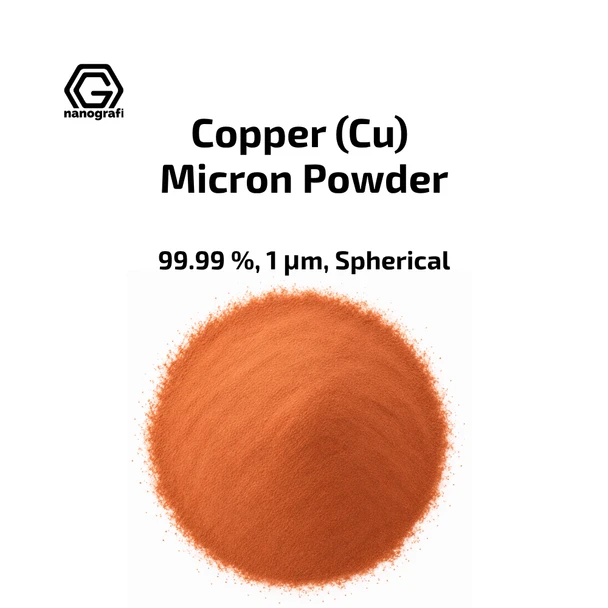
Copper (Cu) Micron Powder, Purity: 99.99 %, Size: 1 µm, Spherical
- SKU:
- NG01EM1304
- Shipping:
- Calculated at Checkout

Description
25 grams/82 €
100 grams/182 €
500 grams/434 €
1000 grams/622 €
Please contact us for quotes on larger quantities !!!
Product Overview
CAS: 7440-50-8
Technical Properties:
|
PURITY |
99.99 % |
|
PARTICLE SIZE |
1 µm |
|
CAS |
7440-50-8 |
|
DENSITY |
8.94 g/cm³ |
|
BOILING POINT |
2595 °C |
|
MELTING POINT |
1083 °C |
|
COEFF. OF EXPANSION @ 20ºC |
16.42 x 10⁻⁶ |
|
MOHS HARDNESS @ 20ºC |
3 |
|
ELECTRIC CONDUCTANCE |
0.593 microhm-1 |
|
CRYSTAL STRUCTURE |
Cubic, Face Centered |
|
FORM |
Spherical |
|
APPLICATIONS |
Aerospace, Alloys, Colorants, Electronics, Inks, Paints, Pigments |
FAQ
FAQ About Copper (Cu) Micron Powder, 99.99% Purity, 1 µm, Spherical
1) Why is spherical morphology important when selecting a 1 µm copper powder?
Spherical particles can support more uniform packing and more predictable powder flow than highly irregular particles. For Nanografi's 1 µm Copper Micron Powder, the spherical form should be considered together with particle size, purity and the processing method when evaluating the material for conductive formulations or powder-based manufacturing.
2) Can Nanografi Copper Micron Powder be used in conductive inks and pastes?
Yes. Inks are listed among the application areas for this copper grade, and copper powders are widely used where electrical conductivity is required in printed or coated systems. Final performance depends on particle loading, binder chemistry, dispersion quality, curing conditions and oxidation control.
3) Is the 1 µm copper powder suitable for electronic material development?
Yes. Electronics is one of the listed application areas. Its 1 µm particle size, spherical morphology and high copper purity make the material relevant for research involving conductive components, pastes, coatings and other electronic formulations.
4) How should this 1 µm copper grade be compared with coarser spherical copper powders?
Particle size is one of the main comparison criteria because it affects surface area, packing behavior, sintering conditions and formulation rheology. Researchers requiring coarser material can compare this grade with Nanografi's coarser spherical copper powder option or other available copper micron grades.
5) Why is copper purity important in conductive formulations?
High copper purity helps reduce the contribution of unwanted metallic or non-metallic impurities that may affect electrical behavior, thermal response or processing consistency. Nanografi specifies 99.99% purity for this 1 µm spherical copper grade.
6) Can this copper powder be evaluated for alloy-development research?
Yes. Alloys are among the listed application areas. Copper micron powder can be introduced into alloy-development studies where particle size, purity and thermal-processing conditions are important design parameters.
7) Is this material relevant for thermal-management or heat-transfer formulations?
Copper is widely selected for applications where thermal transport is important. For powder-based formulations, the final thermal behavior depends not only on the copper itself but also on particle loading, interparticle contact, matrix chemistry and processing conditions.
8) Can the 1 µm copper powder be used in paints, pigments or functional coatings?
Yes. Paints, pigments and colorants are listed among the application areas. The material can be evaluated where copper content, metallic appearance or conductive functionality is required in a coating system, subject to formulation compatibility and oxidation management.
9) When should copper micropowder be selected instead of copper nanopowder?
Micropowder may be preferred when lower surface reactivity, easier handling or micron-scale packing behavior is required, while nanopowder provides much higher surface area and different sintering behavior. Researchers can compare both formats through Nanografi's spherical copper nanopowder option.
10) Where can related elemental metal powders be compared?
Researchers comparing copper with other metallic micron powders can explore Nanografi's broader range of elemental micron powders, including aluminum, nickel, iron, silicon and other metal grades with different particle sizes and purities.
11) Where can broader micron-scale powder options be reviewed?
Nanografi's microparticle materials portfolio includes elemental metals, oxides, compounds and conductive powders for electronics, energy, coatings and materials research.
12) Where can published studies using Nanografi materials be reviewed?
Researchers can browse published studies featuring Nanografi materials to review examples of advanced materials used in academic and technical research.
Related Products
Related Products
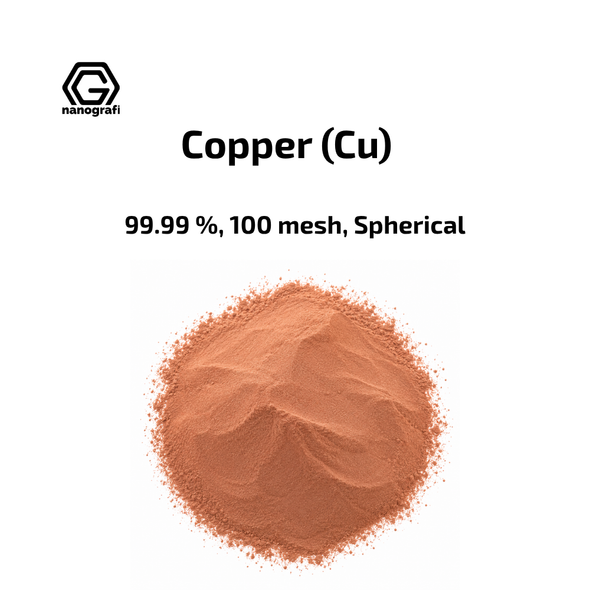
Copper (Cu) Micron Powder, Purity: 99.99 %, Size: 100 mesh, Spherical
Indium (In) Micron Powder, Purity:99.99%, APS:1-5 µm, Spherical
Silver (Ag) Micron Powder, Purity: 99.99 %, Size: 3 µm

Germanium (Ge) Micron Powder, Purity: 99.99 %, Size: 5 µm
