
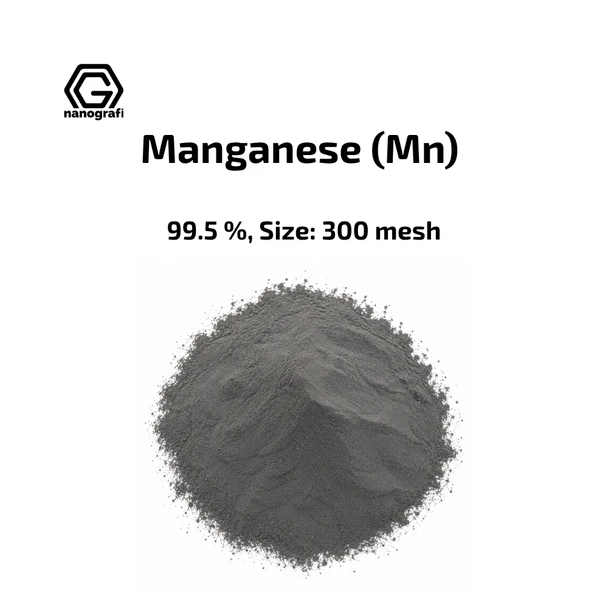
Manganese (Mn) Micron Powder, Purity: 99.5 %, Size: 300 mesh
- SKU:
- NG01EM2004
- Shipping:
- Calculated at Checkout

Description
25 grams/54 €
100 grams/117 €
500 grams/306 €
1000 grams/487 €
Technical Properties of Manganese (Mn) Micron Powder, 99.5 %, 300 mesh:
| Purity | 99.5% | |||||
| Size | 300 mesh | |||||
| Elemental Analysis | Se (%) | S(%) | C(%) | P(%) | Fe(%) | Si(%) |
| 0.05 | 0.02 | 0.01 | 0.002 | 0.03 | 0.004 |
Applications of Manganese (Mn) Micron Powder, 99.5 %, 300 mesh:
Manganese micron powder, with its finely tuned particle size and intrinsic properties, including high strength, corrosion resistance, magnetic behavior, and catalytic activity, serves as a versatile material across multiple advanced technology sectors. Its ability to enhance mechanical, electrical, and chemical performance makes it indispensable in energy systems, alloy engineering, electronics, and environmental technologies. Below is a summary of its key application domains:
- Steel & Alloy Engineering Acts as a critical alloying element in steel and non-ferrous metal production, improving tensile strength, wear resistance, and structural durability. Widely used in construction-grade steels, stainless alloys, and high-performance automotive components.
- Battery & Energy Storage Incorporated into lithium-ion, alkaline, and zinc-carbon batteries to enhance energy density, cycle stability, and charge-discharge efficiency. Manganese-based cathodes (e.g., LiMn₂O₄) are known for thermal stability and cost-effectiveness in large-scale energy storage.
- Electronics & Magnetics Used in magnetic storage devices and semiconductors due to its ferromagnetic and conductive properties. Supports the fabrication of spintronic components and magnetic shielding materials.
- Catalysis & Chemical Processing Functions as a catalyst in oxidation reactions, petrochemical refining, and hydrogen production. Manganese oxides (MnOx) are particularly effective in oxygen evolution reactions (OER) for water splitting technologies.
- Ceramics & Pigments Added to ceramic glazes and pigments to impart unique coloration and thermal resistance. Also used in high-temperature coatings and decorative materials.
- Biomedical Applications Emerging use in drug delivery systems, MRI contrast agents, and wound healing platforms due to its biocompatibility and redox activity. Manganese-based nanoparticles are being explored for angiogenesis and ischemic therapy.
- Environmental & Safety Technologies Utilized in gas sensors and pollutant detection systems. Manganese oxides contribute to catalytic degradation of VOCs and heavy metals in water and air purification setups.
- Aerospace & Automotive Materials Integrated into high-performance alloys for aerospace and automotive sectors, offering enhanced heat resistance, mechanical strength, and weight optimization.
FAQ
Frequently Asked Questions About Manganese (Mn) Micron Powder, 300 Mesh
1. What is manganese micron powder used for?
Manganese (Mn) micron powder is investigated for alloy development, powder metallurgy, advanced materials processing, and the preparation of manganese-containing compounds. Manganese is an important alloying element in steel and selected non-ferrous alloys, where it can influence mechanical properties and processing behavior. The suitability of this 99.5% purity, 300 mesh grade depends on the manufacturing method, impurity limits, and powder characteristics. Explore NANOGRAFi's Manganese Micron Powder collection for product information.
2. What does 300 mesh mean for manganese powder particle size?
A 300 mesh designation refers to a fine sieve classification, with a nominal opening of approximately 48 micrometers under commonly used US sieve standards. If a powder is specified as passing 300 mesh, its particles are expected to pass through the corresponding sieve. However, mesh size alone does not establish the average particle diameter or full particle size distribution. Researchers should consult the product's technical documentation when precise particle dimensions are required.
3. Can manganese micron powder be used in steel and alloy manufacturing?
Manganese is widely used as an alloying element in steel production because it can influence strength, hardenability, and processing characteristics. It also contributes to the control of sulfur-related effects in steelmaking. Elemental manganese powder may be investigated in selected alloy preparation and powder metallurgy processes, although suitability depends on the required composition, processing atmosphere, and consolidation method. Researchers can explore NANOGRAFi's Elemental Micron Powders for complementary alloying materials.
4. What is the difference between manganese metal powder and manganese dioxide powder?
Manganese metal powder consists primarily of elemental manganese (Mn), while manganese dioxide (MnO2) is an oxidized manganese compound. Their chemical reactivity, electrical behavior, and application requirements differ significantly. Elemental manganese is relevant to alloying and precursor research, whereas MnO2 is widely investigated for electrochemical electrodes, catalysis, and pigments. Researchers can compare this product with Manganese Dioxide (MnO2) Micron Powder, 200 Mesh.
5. Is manganese micron powder suitable for lithium-ion battery research?
Manganese is an important constituent of several battery electrode materials, including lithium manganese oxide and nickel-manganese-cobalt oxide cathode compositions. However, elemental manganese powder is not interchangeable with these finished cathode compounds. This grade may be investigated as a precursor in selected materials synthesis routes, subject to the required reaction chemistry and impurity specifications. Researchers studying manganese-based oxides can also explore Manganese Oxide (Mn2O3) Nanopowder, 28 nm.
6. Can manganese powder be used in powder metallurgy and metal composites?
Manganese powder can be investigated as an alloying constituent in selected powder metallurgy formulations and metal-matrix composites. Its incorporation may influence phase formation, mechanical properties, and sintering behavior. However, manganese oxidation, powder distribution, and interactions with other constituents must be controlled during processing. The final performance depends on composition, consolidation conditions, and microstructure. NANOGRAFi's Microparticles category includes additional materials for comparative formulation research.
7. Does manganese micron powder oxidize when exposed to air?
Yes. Elemental manganese is chemically reactive and can develop surface oxides when exposed to oxygen and moisture. Oxidation behavior depends on particle size, surface condition, temperature, and storage environment. Surface oxidation may influence processing and chemical reactions, particularly when metallic manganese content is important. Researchers should minimize unnecessary exposure to moisture and follow the supplier's recommended storage conditions.
8. Can manganese metal powder be used to prepare manganese oxide materials?
Elemental manganese can serve as a starting material for selected chemical synthesis routes involving manganese-containing compounds. Depending on the reaction conditions, different manganese oxidation states and oxide phases may be obtained. These products are not chemically interchangeable, and phase identification is important for application-specific research. Researchers investigating magnetic manganese-containing oxides can compare Mn2O3 Nanopowder with other manganese-based materials available from NANOGRAFi.
9. How should 300 mesh manganese powder be stored and handled safely?
Manganese micron powder should be stored in a tightly sealed container under clean, dry conditions, following the product-specific Safety Data Sheet (SDS). Fine manganese powders may present fire or combustible dust hazards under certain conditions, and airborne manganese dust can pose inhalation risks. Handling should minimize dust generation and exposure to ignition sources. Suitable ventilation, protective equipment, and appropriate powder-handling procedures are essential. Researchers should avoid uncontrolled contact with incompatible substances and consult the SDS before processing.
Related Products
Related Products

Beryllium (Be) Micron Powder, Purity: 99.5+%, Size: -100 mesh

Titanium (Ti) Micron Powder, Purity: 99.5+%, Size: 325 mesh

Ytterbium (Yb) Micron Powder, Purity: 99.5 %, Size: 325 mesh

Thulium (Tm) Micron Powder, Purity: 99.5 %, Size: 325 mesh
