
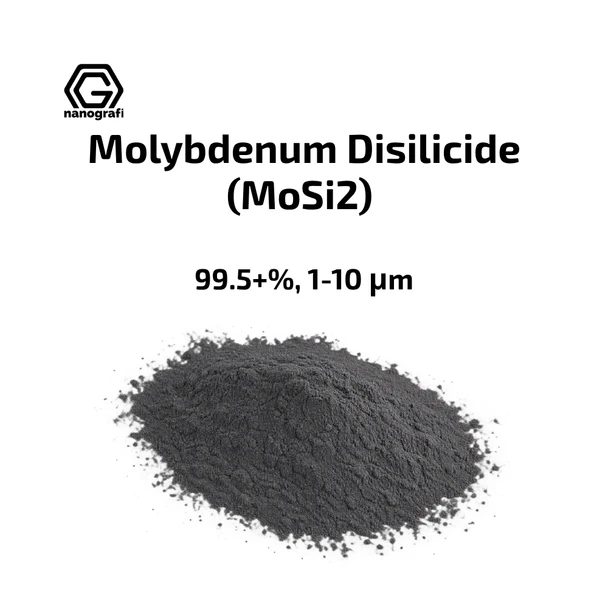
Molybdenum Disilicide (MoSi2) Micron Powder, Purity: 99.5+%, Size: 1-10 µm
- SKU:
- NG04CO1201
- Shipping:
- Calculated at Checkout

Description
1 gram/18 €
5 grams/30 €
25 grams/57 €
100 grams/160 €
500 grams/606 €
1000 grams/1081 €
Technical Properties of Molybdenum Disilicide (MoSi2) Micron Powder Purity: 99.5+%, Size: 1-10 µm
| Purity (%) | 99.95 | |||||
| Average Particle Size (µm) | 1-3 | |||||
| Color | black | |||||
| Density (g/cm3) | .4,9 | |||||
| Melting Point (°C) | 1185.0 | |||||
| Morphology | irregular | |||||
| Elemental Analysis (%) | Al | Fe | Ca | Cu | Mn | Co |
| 0.002 | 0.003 | 0.001 | 0.01 | 0.01 | 0.002 |
Applications of Molybdenum Disilicide (MoSi2) Micron Powder Purity: 99.5+%, Size: 1-10 µm
Molybdenum disulfate nanoparticles has excellent friction, large active surface area, more adsorption capacity, high reactivity, catalytic properties.
It can be used in lubricant, and composite applications and as a conductive filler. It can be also used for prepration of special materials, difficult to
mantain equipments, and catalytic materials. Molybdenum disulfate nanoparticles can be used as a catalyst for coal liquefaction.
FAQ
Frequently Asked Questions About Molybdenum Disilicide (MoSi2) Micron Powder, 99.5+% Purity, 1-10 µm
1. What is molybdenum disilicide (MoSi2) micron powder used for?
Molybdenum disilicide (MoSi2) is an electrically conductive refractory silicide investigated for high-temperature heating elements, oxidation-resistant coatings, advanced ceramic composites, and specialized electronic applications. Its combination of high-temperature stability and oxidation resistance makes it relevant to demanding thermal environments. However, final component performance depends on material composition, processing, density, and operating conditions. Explore NANOGRAFi's Molybdenum Disilicide Micron Powder collection for related product information.
2. Why is MoSi2 used in high-temperature heating elements?
MoSi2 is widely used in resistance heating elements because it combines electrical conductivity with the ability to form a protective silica-rich surface layer in suitable oxidizing environments. Commercial MoSi2-based heating elements can operate at very high temperatures, depending on their composition, geometry, and atmosphere. However, loose MoSi2 powder cannot be used directly as a finished heating element without appropriate fabrication and qualification. Researchers can explore NANOGRAFi's Compound Micron Powders for complementary refractory materials.
3. How does molybdenum disilicide resist oxidation at high temperatures?
MoSi2 can develop a silica-rich protective layer when exposed to oxygen at elevated temperatures. Under suitable conditions, this layer reduces further oxygen transport and helps protect the underlying material from continued oxidation. Oxidation resistance is influenced by temperature, atmosphere, surface condition, and exposure duration. MoSi2 may also experience accelerated oxidation or pesting in certain intermediate-temperature conditions. Consequently, oxidation performance should be evaluated under the intended service environment rather than assumed across all temperatures.
4. What is the difference between molybdenum disilicide (MoSi2) and molybdenum disulfide (MoS2)?
Molybdenum disilicide (MoSi2) and molybdenum disulfide (MoS2) are chemically and structurally different compounds. MoSi2 is a refractory silicide associated with high-temperature heating elements, oxidation-resistant materials, and conductive ceramic applications. MoS2 is a layered sulfide widely investigated for solid lubrication, tribology, and selected electronic applications. Their processing requirements and performance characteristics are not interchangeable. Researchers can compare MoSi2 with NANOGRAFi's Molybdenum Disulfide (MoS2) Micron Powders when selecting a material for a specific application.
5. Can MoSi2 micron powder be used in ceramic composites and protective coatings?
MoSi2 micron powder is investigated as a constituent in refractory ceramic composites and high-temperature protective coatings. Its oxidation behavior and electrical properties can be useful in selected ceramic formulations. Processing routes may include powder consolidation, sintering, and thermal spraying, depending on the required component. Performance depends on phase composition, porosity, interfacial reactions, and thermal cycling. Researchers can compare Silicon Carbide (SiC) Micron Powders for alternative high-temperature ceramic formulations.
6. What is the difference between MoSi2 and silicon carbide (SiC) for high-temperature applications?
Both MoSi2 and silicon carbide (SiC) are investigated for high-temperature engineering applications, but their structures and properties differ. MoSi2 is an electrically conductive refractory silicide used in resistance heating elements and oxidation-resistant systems. SiC is a hard ceramic valued for wear resistance, thermal performance, and chemical stability in suitable environments. Material selection depends on operating temperature, atmosphere, electrical requirements, and mechanical loading. Explore NANOGRAFi's Silicon Carbide Micron Powder options for comparative materials research.
7. How does the 1-10 µm particle size affect MoSi2 powder processing?
The specified 1-10 µm size range describes the nominal particle dimensions of this MoSi2 powder grade. Particle size can influence packing behavior, surface area, sintering kinetics, and powder dispersion. Fine particles may support selected consolidation processes but can also increase agglomeration and oxidation-related handling challenges. The complete particle-size distribution and morphology should be verified when designing reproducible ceramic processing experiments. Researchers can explore NANOGRAFi's Microparticles collection for additional materials with different particle-size specifications.
8. Is molybdenum disilicide electrically conductive?
Yes. Molybdenum disilicide is electrically conductive, which distinguishes it from many conventional electrically insulating ceramics. This characteristic supports its use in resistance heating elements and selected electronic or conductive ceramic applications. However, the electrical resistance of a fabricated component depends on temperature, porosity, microstructure, composition, and geometry. Loose powder conductivity should not be treated as equivalent to the performance of a dense, manufactured component. Researchers can also compare Titanium Carbide (TiC) Micron Powders when evaluating other electrically conductive ceramic materials.
9. How should MoSi2 micron powder be stored and handled safely?
Molybdenum disilicide micron powder should be stored in tightly sealed containers under clean, dry conditions, following the product-specific Safety Data Sheet (SDS). Handling should minimize airborne dust and unnecessary exposure through appropriate ventilation, protective equipment, and controlled powder-transfer procedures. Thermal processing requires additional precautions because oxidation behavior and reactions with surrounding materials depend on temperature and atmosphere. Researchers should consult the SDS and relevant technical documentation before milling, mixing, sintering, or applying the powder in high-temperature systems.
Related Products
Related Products

Molybdenum Carbide (Mo2C) Micron Powder, Purity: 99.5+%, Size: 2.6 µm, Hexagonal

Hydroxyapatite Micron Powder, Purity: 96+%, Size: 2 µm

Molybdenum Disilicide (MoSi2) Sputtering Targets, Purity: 99.95%, Size: 1'', Thickness: 0.125''

Zirconium Hydride (ZrH2) Micron Powder, Purity: 99.5+%, Size: 1- 10 µm
