
Gold (Au) Nanoparticle Dispersion, Purity: 99.99%, Size: 20-30 nm, 172 ppm

- SKU:
- NG04EO0304


Description
Gold (Au) Nanoparticles Water Dispersion (Colloidal Gold)
Purity: 99.99%, Size: 20-30 nm, 172 ppm
Gold (Au) Nanoparticles Water Dispersion (Colloidal Gold) is a high-purity (99.99%) suspension of metallic gold nanostructures with a precisely controlled particle size of 20-30 nm. Prepared at a concentration of 172 ppm (0.01 wt%), this deep red-purple colloidal solution is engineered for maximum stability and homogeneity without the need for aggressive chemical reagents. The high surface-area-to-volume ratio of these nanoparticles significantly enhances their catalytic and biological reactivity, while the aqueous medium ensures uniform distribution for highly reproducible experimental results. Exploiting the unique Localized Surface Plasmon Resonance (LSPR) of gold, this dispersion is an essential tool for advanced research in biotechnology, photonics, and catalysis. For optimal performance, the solution should be stored between 2-8°C and protected from direct sunlight to maintain its non-toxic, odorless, and stable characteristics.
Technical Properties
| CAS Number | 7440-57-5 |
| Form | Dispersion |
| Solvent | Water (can be customized) |
| Purity (%) | 99.99% |
| Concentration | 172 ppm (0.01wt%) |
| pH | 7 |
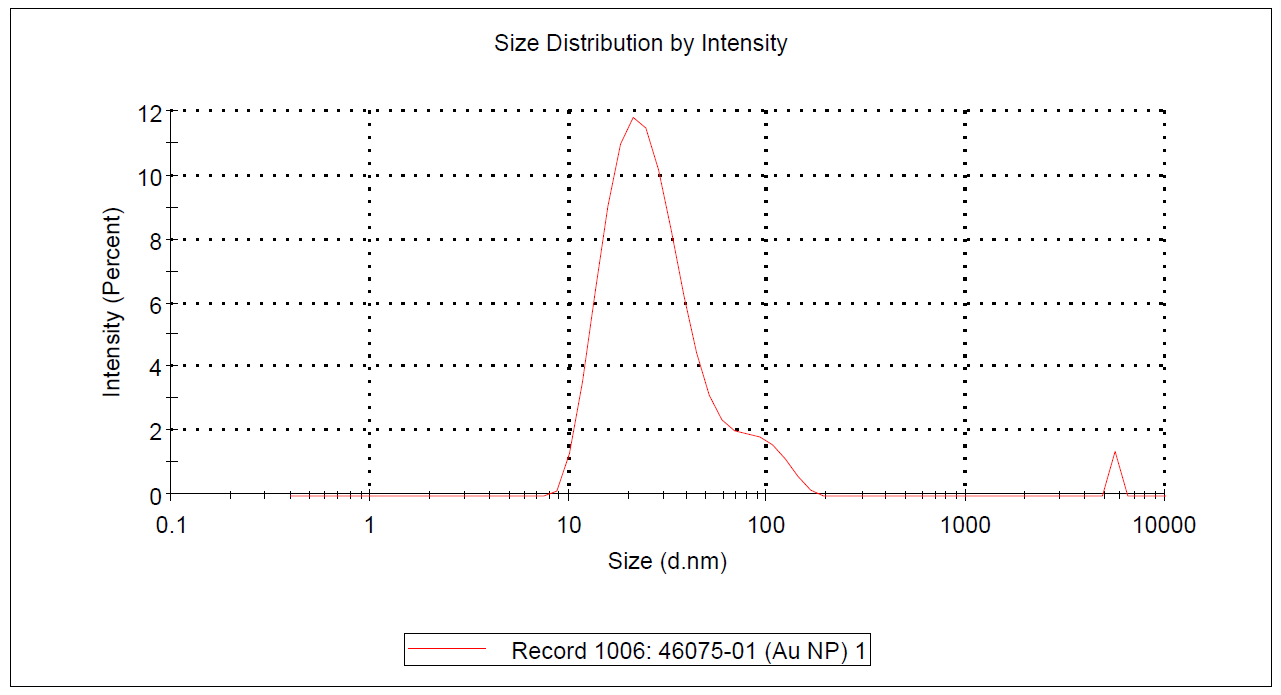
| Average Particle Size (nm) | 20-30 nm |
| Color | Red-Purple |
| Storage Temperature | 2-8°C |
Particle Size Distribution
Applications:
This research-grade aqueous dispersion of gold nanopowder is an odorless and non-toxic product, offering exceptional catalytic activity. The gold nanoparticles in this dispersion have demonstrated the ability to neutralize free radicals in human cells, contributing to their increasing popularity in various industries. The dispersion is highly stable and homogeneously dispersed in water, ensuring consistent performance in a wide range of applications.
- Biomedical and Life Sciences: Gold dispersions are widely used in medical diagnostics (like rapid tests), drug delivery systems, imaging techniques, and cancer treatments. Their biocompatibility and unique optical properties make them ideal for targeting, visualizing, and treating diseases.
- One of the most common uses is in lateral flow tests, where gold nanoparticles provide a visible red line that indicates a positive result—thanks to their strong light-scattering properties.
- Chemical and Biological Sensing: Gold nanoparticles are excellent for sensing applications because they change color when they aggregate or interact with specific molecules. This property is used in sensors for detecting chemicals, toxins, and biological markers.
- Catalysis: Gold dispersions act as efficient catalysts at the nanoscale, especially for oxidation and environmental reactions. Their high surface area and reactivity make them valuable in industrial and research-based chemical processes.
- Electronics and Photonics: In electronics, gold nanoparticles contribute to the development of nano-circuits and conductive materials. Their plasmonic behavior is also exploited in photonic devices for manipulating light at the nanoscale.
- Coatings and Materials Science: Gold dispersions are incorporated into coatings and materials for their aesthetic, antibacterial, and optical properties, enhancing the functionality and value of products like paints, inks, and surface treatments.
Handling and Storage
Gold nanoparticle dispersion contains no additional chemical reagents, ensuring a clean formulation. It should be stored away from direct sunlight and handled only by professionals with under suitable storage conditions. If agglomeration occurs after long-term storage, the dispersion can easily be re-homogenized by mixing prior to use.
Related Products
Related Products


Silver (Ag) Nanopowder/Nanoparticles Water Dispersion, Purity: %99.99, Size: 20-30 nm, 167 ppm


Silver (Ag) Nanopowder/Nanoparticles Water Dispersion, Purity: %99.99, Size: 3 nm, 2200 ppm
Gold (Au) Nanopowder/Nanoparticles, Purity: 99.99+%, Size: 10-30 nm
