
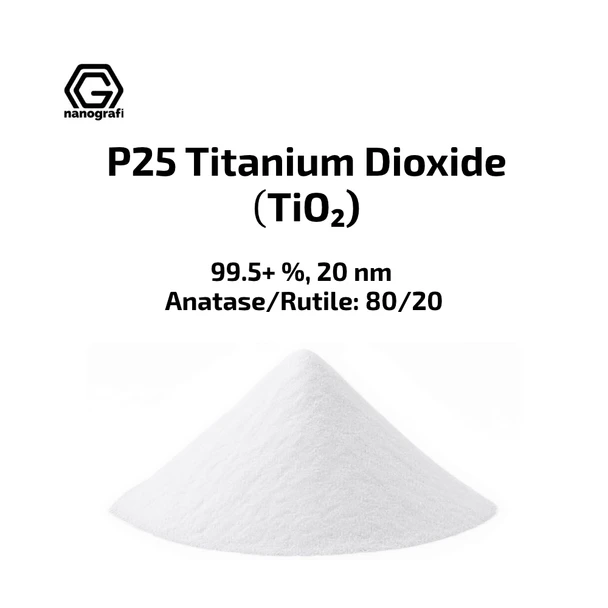
P25 Titanium Dioxide Nanopowder (TiO2), Purity: 99.5+%, Size: 20 nm
(No reviews yet)
Write a Review
- SKU:
- NG10NPW0931
- Shipping:
- Calculated at Checkout

Frequently bought together:
Description
25 grams/38 €
100 grams/87 €
500 grams/184 €
1000 grams/265 €
Please contact us for quotes on larger quantities !!!
Product Overview of P25 Titanium Dioxide Nanopowder (TiO2), Purity: 99.5+%, Size: 20 nm
This product is a high-purity, hydrophilic fumed titanium dioxide powder with a high specific surface area and a mixed anatase–rutile crystal structure. Its aggregated nanoscale particles provide strong catalytic and photocatalytic activity, making it suitable for catalyst supports, self-cleaning formulations, and UV-filtering applications.
Technical Properties of P25 Titanium Dioxide Nanopowder (TiO2), Purity: 99.5+%, Size: 20 nm
| Purity | 99.5+% |
| Particle Size | 20 nm |
| Anatase / rutile ratio (by weight) | 80 / 20 |
| Specific surface area (BET) | 35–65 m²/g |
| pH value (4% dispersion) | 3.5–4.5 |
| Surface Character | Hydrophilic, not surface-treated |
| CAS No | 13463-67-7 |
Applications of P25 Titanium Dioxide Nanopowder (TiO2), Purity: 99.5+%, Size: 20 nm
- Photocatalytic and Environmental Applications: It is used in photocatalytic systems for water treatment, air purification, and deodorization. Under UV irradiation, its photoactive surface promotes the degradation of organic pollutants. It has also been investigated for nitrogen oxide removal and antimicrobial surface applications.
- Self-Cleaning Coatings and Construction Materials: It can be incorporated into concrete, mineral plasters, and inorganic coatings to provide photocatalytic self-cleaning properties. Light-activated reactions help break down organic deposits, while photoinduced hydrophilicity supports water spreading for self-cleaning and antifogging surfaces.
- Catalysts and Catalyst Supports: Its high specific surface area and thermal and hydrothermal stability make P 25 suitable as a catalyst and catalyst support material. These characteristics provide an accessible surface for catalytic reactions and support use in systems exposed to heat and moisture.
- Silicone Elastomers: It is used as a heat stabilizer in silicone rubber and vulcanizates. Its influence on redox processes helps improve resistance to thermal aging, while it can also contribute to reduced flammability in suitably formulated silicone systems.
- Dye-Sensitized Solar Cells: It is suitable for constructing titanium dioxide electrodes in dye-sensitized solar cells. Its high surface area provides an interface for dye adsorption, supporting its use in the development of photovoltaic electrode formulations.
- Lithium-Ion Batteries: It is used as a protective dry-coating additive for electrode active materials, particularly cathode powders. Surface coating can help stabilize active material particles, limit cracking during cycling, and improve capacity retention and battery service life.
- Ceramic and Metal Materials: It can serve as an additive or raw material in ceramic and metal-based systems. Depending on the formulation and processing route, it can function as a bonding agent, sintering additive, or structural component.
Related Products
Related Products
Titanium Dioxide (TiO2) Nanopowder/Nanoparticles, Anatase, High Purity: 99.5+ %, Size: 10-20 nm
€65.00
25 grams/65 € 100 grams/138 € <
NG04SO3503

Titanium Dioxide (TiO2) Nanopowder/Nanoparticles, Anatase/Rutile, Purity: 99.5+%, Size: 18 nm
€58.00
25 grams/58 € 100 grams/131 € <
NG04SO3506
Titanium Dioxide (TiO2) Nanopowder/Nanoparticles, Rutile, High Purity: 99.5+ %, Size: 45 nm
€59.00
25 grams/59 € 100 grams/134 € 500 grams/252
NG04SO3508
Titanium Dioxide (TiO2) Nanopowder/Nanoparticles, Rutile, High Purity: 99.5+ %, Size: 28 nm
€47.00
25 grams/47 € 100 grams/128 € <
NG04SO3507

Titanium Dioxide (TiO2) Nanopowder/Nanoparticles, Rutile, Purity: 99.5+%, Size: 30±5 nm
€58.00
25 grams/57€ 100 grams/101 € 500 grams/236 € 1000 grams/370 €
Please contact us for quotes on larger quantities !!!
Product Overview of Titanium Dioxide (TiO2) Rutile,...
NG04SO3511