
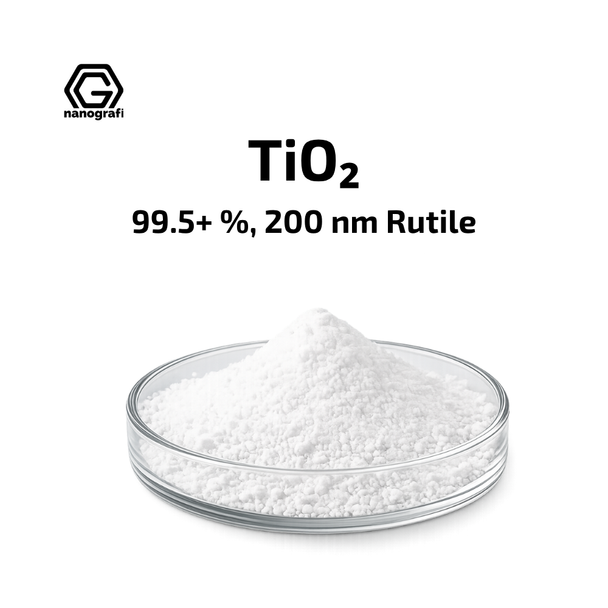
Titanium Dioxide (TiO2) Nanopowder/Nanoparticles, Rutile:99.5+%, Size: 200 nm
- SKU:
- NG04SO3512
- Shipping:
- Calculated at Checkout


Description
Titanium Dioxide (TiO2) Nanopowder/Nanoparticles, Rutile:99.5+%, Size: 200 nm
25 grams/32 €
100 grams/50 €
500 grams/97 €
1000 grams/165 €
Please contact us for quotes on larger quantities !
Technical Properties of Titanium Dioxide (TiO2) Nanopowder/Nanoparticles, Rutile:99.5+%, Size: 200 nm
|
PARTICLE SIZE |
200 nm |
|
CAS |
13463-67-7 |
|
Purity of Rutile |
99.5+ % |
|
Colour |
White |
|
Specific Gravity |
4.1 g/cm3 |
|
Bulk Density |
1.1 g/cm3 |
|
Loss at 105°C |
0.6 % |
|
Oil Absorption |
18/100 cm3/g |
|
Water Demand |
25/100 cm3/g |
|
Specific Surface Area |
19m2/g |
Application Areas of Titanium Dioxide (TiO2) Nanopowder/Nanoparticles, Rutile:99.5+%, Size: 200 nm
TiO2 is used in paints, plastics, cements, windows, tiles, and other products for its UV absorption and photocatalytic sterilizing properties. In addition, TiO2 particles have photocatalytic activity so they can be used to decompose organic compounds in wastewater. TiO2 nanoparticle products are also sometimes coated with silica or alumina, or doped with another metal for specific applications.
Storage Conditions
The pigment should not be stored in outside areas exposed to the weather. All direct contact with moisture should be avoided. By storing the pigment correctly, its properties should not deteriorate with time. However, to ensure optimum performance, it is recommended that the product is used on a first in, first out basis from receipt of shipment.
FAQ
Frequently Asked Questions About MIL-101(Fe)
1. What is MIL-101(Fe) used for?
MIL-101(Fe) is an iron-based metal-organic framework investigated for adsorption, heterogeneous catalysis, environmental remediation, and gas separation. Its porous structure and iron-containing sites make it suitable for various research applications.
2. Why is MIL-101(Fe) suitable for heterogeneous catalysis?
MIL-101(Fe) contains iron centers that can participate in redox reactions and act as Lewis acid sites. Its porous framework can facilitate access to these sites, making it a promising candidate for oxidation reactions and catalytic pollutant degradation.
3. Can MIL-101(Fe) be used for CO2 capture?
MIL-101(Fe) is investigated for carbon dioxide adsorption and gas separation because of its porous architecture. Actual CO2 uptake and selectivity depend on temperature, pressure, activation conditions, and gas composition.
4. How is MIL-101(Fe) used in wastewater treatment?
MIL-101(Fe) can be investigated for the adsorption or catalytic removal of organic dyes and selected contaminants from water. Its effectiveness depends on solution pH, contaminant concentration, contact time, and competing substances.
5. What is the difference between MIL-101(Fe), ZIF-8, and UiO-66?
MIL-101(Fe) is an iron-based framework of interest for catalysis and adsorption. ZIF-8 is a zinc-based framework investigated for molecular separation and encapsulation, while UiO-66 is a zirconium-based framework recognized for its structural robustness. Selection depends on the intended application and operating conditions.
6. Can MIL-101(Fe) be used in drug delivery research?
MIL-101(Fe) is being investigated as a porous carrier for drug encapsulation and controlled-release systems. However, biocompatibility, cytotoxicity, stability, and release behavior must be evaluated for each formulation. Research use does not establish clinical suitability.
7. Does MIL-101(Fe) require activation before adsorption experiments?
Activation may be required to remove residual solvents or guest molecules from the pores before adsorption measurements. Appropriate activation conditions depend on the material's preparation history and thermal stability.
8. How should MIL-101(Fe) be stored?
MIL-101(Fe) should be stored in a tightly sealed container under clean, dry conditions to minimize moisture exposure and contamination. Follow the product's Safety Data Sheet (SDS) for handling precautions.
Related Products
Related Products
Titanium Dioxide (TiO2) Nanopowder/Nanoparticles, Rutile, High Purity: 99.5+ %, Size: 28 nm
Titanium Dioxide (TiO2) Nanopowder/Nanoparticles, Rutile, High Purity: 99.5+ %, Size: 45 nm

Titanium Dioxide (TiO2) Nanopowder/Nanoparticles, Rutile, Purity: 99.5+%, Size: 30±5 nm

Titanium Dioxide (TiO2) Nanopowder/Nanoparticles, Anatase/Rutile, Purity: 99.5+%, Size: 18 nm
