
Titanium Dioxide (TiO2) Nanopowder/Nanoparticles, Rutile, Purity: 99.5+%, Size: 30±5 nm

- SKU:
- NG04SO3511
- Shipping:
- Calculated at Checkout

Description
25 grams/57€
100 grams/101 €
500 grams/236 €
1000 grams/370 €
Product Overview of Titanium Dioxide (TiO2) Rutile, High Purity: 99.5+%, Size: 30±5 nm
Rutile titanium dioxide nanoparticles are a stable crystalline form of TiO₂, distinguished by their high refractive index, strong light-scattering ability, and robust dielectric properties. Their nanoscale morphology provides a large surface-to-volume ratio, enhancing interfacial interactions and chemical stability. The rutile phase is particularly valued for its resistance to photodegradation and thermal stress, making it suitable for long-term industrial use. The particles exhibit uniform dispersion and consistent morphology, which supports reliable performance in advanced material systems. Their surface chemistry allows for effective functionalization, enabling integration into diverse composite matrices. High purity ensures minimal contamination, while the rutile structure contributes to mechanical reinforcement and optical clarity.
Technical Properties of Titanium Dioxide (TiO2) Rutile, High Purity: 99.5+%, Size: 30±5 nm
| Purity | 99.5+% |
| Particle Size | 30±5 |
| Surface Area | 20-50 mg2/g |
| Crystal Structure | Rutile |
| CAS No | 13463-67-7 |
Applications of Titanium Dioxide (TiO2) Rutile, High Purity: 99.5+%, Size: 30±5 nm
- Electronics & Energy Storage: Rutile TiO₂ nanoparticles are used in capacitors and battery electrodes due to their high dielectric constant and stability. The nanoscale size improves ion transport, enhancing performance in lithium-ion batteries and supercapacitors.
- Pigments & Coatings: With strong light scattering and high refractive index, TiO₂ is the main white pigment. In coatings, rutile nanoparticles provide UV resistance, color stability, and long-lasting brightness.
- Photocatalysis & Environmental Uses: Although anatase is more active, rutile TiO₂ can still degrade pollutants under UV light. Its stability makes it suitable for water and air purification coatings.
- Cosmetics & Sunscreens: Rutile TiO₂ nanoparticles block UV rays effectively without leaving a white residue. High purity ensures safety, while nanoscale size allows transparent formulations with strong sun protection.
- Ceramics & Catalysts: TiO₂ improves sintering and mechanical strength in ceramics. As a catalyst support, its surface area helps disperse metals evenly, boosting efficiency in industrial and automotive processes.
- Biomedical & Sensors: Biocompatibility and stability make rutile TiO₂ useful in implant coatings. In sensors, its surface properties enhance sensitivity and signal response for electrochemical detection.
FAQ
Frequently Asked Questions About Rutile Titanium Dioxide (TiO2) Nanopowder
1. What is 30 ± 5 nm rutile titanium dioxide nanopowder used for?
Rutile titanium dioxide (TiO2) nanoparticles are investigated for UV-protective coatings, polymer composites, optical materials, functional surfaces, and selected ceramic formulations. Their high refractive index, chemical stability, and ultraviolet attenuation properties make them useful for materials research. Application performance depends on particle dispersion, surface chemistry, concentration, and processing conditions. Explore NANOGRAFi's Titanium Dioxide Nanoparticles collection for alternative grades.
2. What is the difference between rutile and anatase TiO2 nanoparticles?
Rutile and anatase are different crystalline phases of titanium dioxide. Rutile is thermodynamically more stable and is commonly selected for optical and UV-shielding applications, while anatase frequently exhibits higher photocatalytic activity in conventional UV-driven systems. However, performance depends on surface properties and experimental conditions. Researchers can compare this grade with Anatase TiO2 Nanopowder, 20-30 nm and review NANOGRAFi's guide to rutile and anatase TiO2.
3. How does 30 ± 5 nm rutile TiO2 compare with 200 nm rutile TiO2?
Particle size influences specific surface area, light scattering, agglomeration, and interactions with surrounding materials. The 30 ± 5 nm grade generally provides a higher surface-area-to-volume ratio than larger TiO2 particles of comparable morphology. A coarser grade may be preferable when stronger visible-light scattering or opacity is required. Researchers can compare Rutile Titanium Dioxide Powder, 200 nm when evaluating particle-size effects.
4. Can rutile TiO2 nanoparticles be used in UV-resistant coatings?
Yes. Rutile TiO2 nanoparticles can be incorporated into selected coatings and polymer formulations to attenuate ultraviolet radiation. The effectiveness of UV protection depends on particle loading, dispersion, coating thickness, and the optical properties of the matrix. Surface modification may be important in formulations where photocatalytic reactions could accelerate binder degradation. UV resistance should be validated in the finished coating.
5. Is rutile TiO2 suitable for photocatalytic wastewater treatment?
Rutile titanium dioxide can exhibit photocatalytic activity under suitable irradiation conditions, but anatase and mixed-phase TiO2 materials often demonstrate stronger activity in many conventional photocatalytic systems. Researchers investigating pollutant degradation may also evaluate Anatase/Rutile TiO2 Nanoparticles. Photocatalytic efficiency depends on irradiation wavelength, surface chemistry, pollutant concentration, and reactor conditions.
6. What is the difference between untreated and surface-treated rutile TiO2 nanoparticles?
Surface-treated TiO2 particles may contain inorganic or organic coatings designed to modify dispersibility, compatibility, or surface reactivity. Untreated rutile TiO2 can be useful for fundamental research, while surface-treated grades may be preferable for selected polymer, coating, or UV-protection formulations. Researchers can compare surface-treated rutile TiO2 grades when evaluating formulation requirements.
7. How can 30 nm titanium dioxide nanoparticles be dispersed in liquids?
TiO2 nanoparticles may agglomerate because of their high surface energy. Mechanical stirring, controlled ultrasonication, suitable dispersants, and surface modification can improve dispersion in selected media. The appropriate method depends on solvent composition, pH, particle concentration, and the intended application. Researchers who prefer a pre-dispersed material can explore NANOGRAFi's Titanium Dioxide Dispersions in water and organic media.
8. Can rutile TiO2 nanoparticles be used in sunscreen or cosmetic research?
Rutile titanium dioxide is investigated as a UV-filtering material in cosmetic and sunscreen formulations. However, suitability for such applications depends on particle size distribution, surface treatment, photoreactivity, exposure route, formulation characteristics, and applicable regulations. A research-grade TiO2 powder should not be assumed to meet cosmetic-grade specifications or regulatory requirements without additional testing and documentation.
9. How should rutile titanium dioxide nanopowder be stored and handled?
Rutile TiO2 nanopowder should be stored in a tightly closed container in a clean, dry environment, following the product-specific Safety Data Sheet (SDS). Powder handling should minimize airborne particle generation through suitable containment, local exhaust ventilation, and appropriate protective equipment. Exposure controls should reflect the material's particle characteristics and intended laboratory operations.
Related Products
Related Products
Titanium Dioxide (TiO2) Nanopowder/Nanoparticles, Rutile, High Purity: 99.5+ %, Size: 28 nm

Titanium Dioxide (TiO2) Nanopowder/Nanoparticles, Anatase/Rutile, Purity: 99.5+%, Size: 18 nm
Titanium Dioxide (TiO2) Nanopowder/Nanoparticles, Rutile, High Purity: 99.5+ %, Size: 45 nm
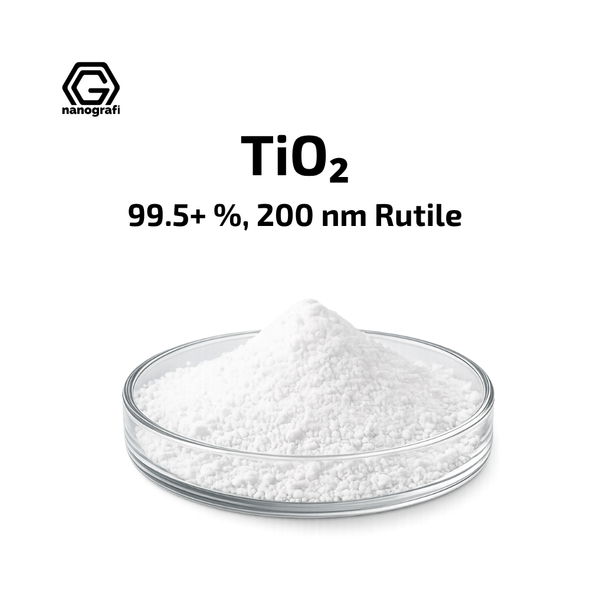
Titanium Dioxide (TiO2) Nanopowder/Nanoparticles, Rutile:99.5+%, Size: 200 nm
