
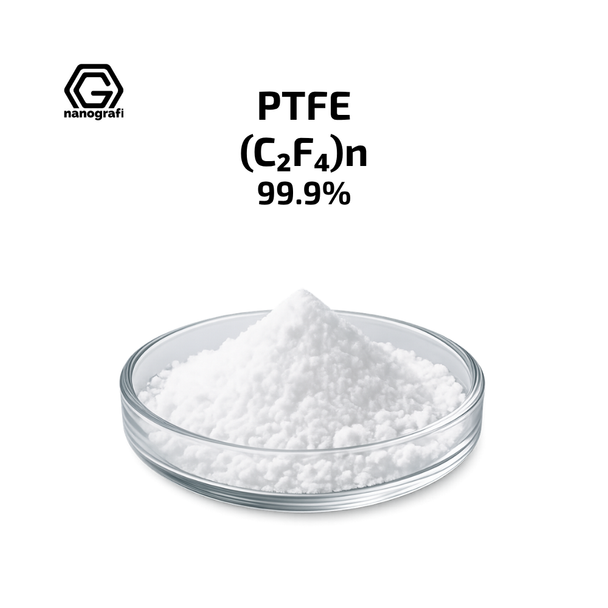
PTFE Nanopowder/Nanoparticles [Polytetrafluoroethylene, (C2F4)n)], Purity: 99.9%
- SKU:
- NG04CO08013
- Shipping:
- Calculated at Checkout



Description
100 grams/35 €
500 grams/165 €
1000 grams/305 €
Product Overview of PTFE Nanopowder/Nanoparticles [Polytetrafluoroethylene, (C2F4)n)] Purity: 99.9%:
PTFE Nanopowder/Nanoparticles (Polytetrafluoroethylene, (C2F4)n) is a high-purity fluoropolymer powder with a purity of 99.9% and a median particle size (D50) of 260 nm. This white, odorless powder has a specific surface area of 4.57 m²/g and is insoluble in water.
Polytetrafluoroethylene (PTFE) is widely recognized for its low coefficient of friction, chemical resistance, non-stick characteristics, and electrical insulation properties. The material is chemically stable under normal temperature conditions, although excessive heating may cause hazardous thermal decomposition.
PTFE nanopowder is of interest for research and development involving advanced polymer composites, functional coatings, surface modification, and tribological materials. Its suitability for specific applications depends on formulation requirements, processing conditions, and experimental validation.
Technical Properties of PTFE Nanopowder/Nanoparticles [Polytetrafluoroethylene, (C2F4)n)] Purity: 99.9%:
| CAS | 9002-84-0 |
| Purity | 99.9% |
| Formula | (C2F4)n |
| Size (D50) | 260nm |
| Molecular Weight | 100.02 g/mol |
| Surface Area | 4.57 m²/g |
| Color | White |
| Melting Point | 279-326 °C |
| Softening Point | In Excess over 320 °C |
| Thermal Conductivity | 0.25 w(m*K) |
Applications
- Advanced Coatings: Used in protective, non-stick, hydrophobic, and low-friction coating formulations to improve surface performance.
- Polymer Composites: Incorporated into polymer matrices to enhance wear resistance, reduce friction, and modify surface characteristics.
- Lubricants and Tribological Systems: Used as a solid lubricant additive in specialized greases, lubricating formulations, and wear-resistant materials.
- Electrical Insulation: Suitable for dielectric coatings and insulating polymer composites due to PTFE's excellent electrical insulation properties.
- Surface Modification: Applied in material formulations requiring low surface energy, chemical resistance, and water-repellent properties.
- Chemical-Resistant Components: Used in the development of protective materials, seals, and specialized components exposed to chemically aggressive environments.
FAQ
Frequently Asked Questions About PTFE Nanopowder (Polytetrafluoroethylene), 99.9% Purity
1. What is PTFE nanopowder used for?
Polytetrafluoroethylene (PTFE) nanopowder is investigated for low-friction coatings, wear-resistant polymer composites, dry lubricants, sealing materials, and specialized industrial formulations. PTFE is valued for its low coefficient of friction, chemical resistance, and electrical insulating properties. The performance of this 99.9% purity grade depends on particle dispersion, processing conditions, and compatibility with the surrounding matrix. Explore NANOGRAFi's PTFE Nanoparticles collection for additional product information.
2. What does D50: 260 nm mean for PTFE nanopowder?
A D50 value of 260 nm indicates the median particle size reported for the powder, meaning that 50% of the measured particle-size distribution falls below this value under the specified measurement basis. D50 does not represent the smallest particle size or the complete size distribution. Particle agglomeration and the measurement technique can influence the reported result. Researchers requiring a narrow particle-size range should consult the product's technical documentation.
3. How does PTFE nanopowder differ from conventional PTFE micropowder?
PTFE nanopowder generally has smaller particle dimensions than conventional micron-scale PTFE powders. Finer particles may offer advantages in selected thin coatings, surface modification processes, and composite formulations where particle distribution is important. However, smaller particles can also present dispersion and handling challenges. The choice between nano- and micron-scale PTFE depends on the desired surface finish, processing method, filler loading, and final material properties. Researchers can explore NANOGRAFi's Compound Nanopowders category for additional particulate materials.
4. Can PTFE nanoparticles improve the wear resistance of polymer composites?
PTFE particles are investigated as solid-lubricant additives in polymer composites to modify friction and wear behavior. Under suitable conditions, PTFE can contribute to the formation of a lubricating transfer film at contacting surfaces. However, the resulting tribological performance depends on particle loading, dispersion, matrix chemistry, counterface material, and operating conditions. Improvements should be verified through application-specific friction and wear testing.
5. Can PTFE nanopowder be used in low-friction and non-stick coatings?
PTFE nanopowder may be incorporated into selected coating formulations to modify surface friction, release behavior, and chemical resistance. Coating performance depends on particle distribution, binder selection, substrate preparation, and curing conditions. PTFE's low surface energy can also create adhesion challenges, making formulation and surface preparation important. Research-grade PTFE nanopowder should not automatically be considered suitable for food-contact or other regulated coating applications.
6. Is PTFE nanopowder suitable for dry electrode manufacturing in lithium-ion batteries?
PTFE is investigated as a binder in dry electrode processing because certain PTFE grades can fibrillate under mechanical shear and form networks that help hold electrode particles together. However, fibrillation behavior depends on the specific PTFE grade, molecular characteristics, particle morphology, and processing conditions. A D50 of 260 nm alone does not establish suitability for dry electrode manufacturing. Researchers can explore NANOGRAFi's Lithium-Ion Battery Materials collection and compare alternative binders and conductive additives.
7. What is the difference between PTFE and SBR binders for battery electrodes?
PTFE and styrene-butadiene rubber (SBR) are different polymer binders used in selected electrode manufacturing approaches. PTFE is investigated in dry-processing routes that rely on mechanical fibrillation, whereas SBR is commonly used with other binder components in water-based electrode slurries. Their processing requirements and electrode compatibility differ. Researchers evaluating aqueous binder systems can compare NANOGRAFi's SBR Binder for Li-Ion Battery Anode Materials with PTFE-based formulations.
8. Can PTFE nanopowder be mixed with conductive carbon additives?
PTFE nanopowder may be incorporated into formulations containing conductive carbon materials, depending on the intended processing route. PTFE primarily contributes binding, lubrication, or insulating characteristics rather than electrical conductivity. The distribution of conductive additives and the PTFE content can influence electrical pathways and mechanical cohesion. Researchers can explore NANOGRAFi's Battery Materials collection, including conductive carbon black products, for comparative electrode formulation studies.
9. How should PTFE nanopowder be processed, stored, and handled safely?
PTFE nanopowder should be stored in a tightly sealed container under the conditions specified in the product's Safety Data Sheet (SDS). Processing temperatures must be controlled because overheating PTFE can produce hazardous decomposition products. Suitable ventilation, temperature monitoring, and exposure controls are important during thermal processing. Powder handling should minimize airborne particles, and researchers should follow the product-specific SDS and applicable workplace safety procedures.
Related Products
Related Products

Indium (In) Nanopowder/Nanoparticles, Purity: 99.9%, Size: 50 nm
Zinc (Zn) Nanopowder/Nanoparticles, Purity: 99.9%,Size: 500 nm

Platinum (Pt) Nanopowder/Nanoparticles, Purity: 99.9%, Size: 15 nm

Iron (Fe) Nanopowder/Nanoparticles, Purity: 99.9%, Size: ~500 nm
