
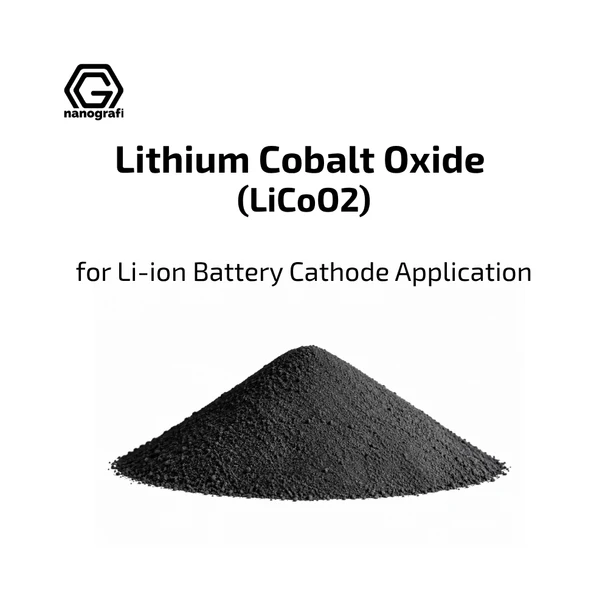
Lithium Cobalt Oxide (LiCoO2) Powder for Li-ion Battery Cathode Application
- SKU:
- NG08BE1402
- Shipping:
- Calculated at Checkout

Description
Contact us for tailored quotes on larger quantities & experience exceptional solutions from our experts.
Product Overview of Lithium Cobalt Oxide (LiCoO2) Powder for Li-ion Battery Cathode Application
Lithium Cobalt Oxide (LiCoO₂ or LCO) Powder is a cathode active material developed for research and development of rechargeable lithium-ion batteries. Supplied as a black powder, this material features a median particle size (D50) of 9.5–11 µm, a specific surface area of 0.2–0.5 m²/g, and a tap density of ≥2.8 g/cm³.
LiCoO₂ is a widely studied cathode material characterized by its layered crystal structure and lithium-ion intercalation properties. Its relatively high volumetric energy density makes it a material of interest for compact rechargeable battery systems, particularly in portable electronic devices.
According to the reported technical specifications, the powder exhibits a coin-cell discharge capacity of ≥151 mAh/g at 1C within a voltage range of 3.0–4.3 V. Its particle size distribution and physical characteristics support research involving cathode formulation, electrode processing, and electrochemical performance evaluation. Actual battery performance depends on electrode composition, cell configuration, and testing conditions.
Technical Properties of Lithium Cobalt Oxide (LiCoO2) Powder for Li-ion Battery Cathode Application
|
Appearance |
Black powder |
|
|
Specific Area |
0.2~0.5 m2/g |
|
|
Tap Density |
≥2.8 g/cm3 |
|
|
Chemical Component |
Co |
59~61 |
|
Na |
0.002~0.005 |
|
|
Cu |
0.0005~0.001 |
|
|
Ca |
0.002~0.005 |
|
|
Li |
6.9~7.1 |
|
|
Moisture |
≤0.1 % |
|
|
PH |
9~11 |
|
|
Coin Cell Capacity 1C (3.0-4.3V) |
≥151 mAh/g |
|
|
Particle Size Distribution |
D10 |
≥5.5 μm |
|
D50 |
9.5~11 μm |
|
|
D90 |
≤20 μm |
|
|
Dmax |
≤45 μm |
|

Applications of Lithium Cobalt Oxide (LiCoO2) Powder for Li-ion Battery Cathode Application
- Lithium-Ion Battery Cathodes: Used as a cathode active material in rechargeable lithium-ion battery research and electrode development.
- Consumer Electronics Battery Research: Investigated in battery systems for smartphones, laptops, tablets, and other portable electronic devices requiring compact energy storage.
- High-Energy-Density Battery Research: Studied in the development of lithium-ion cells where volumetric energy density is an important design consideration.
- Battery Electrode Manufacturing: Used in cathode slurry preparation, electrode coating, and formulation studies involving conductive additives and polymer binders.
- Electrochemical Performance Evaluation: Suitable for laboratory investigations of discharge capacity, charge-discharge characteristics, cycling stability, and rate performance.
- Advanced Cathode Material Research: Investigated in studies involving particle characteristics, electrode architecture, surface modification, and lithium-ion transport.
FAQ
Frequently Asked Questions About Lithium Cobalt Oxide (LiCoO2) Powder for Li-ion Battery Cathode Applications
1. What is lithium cobalt oxide (LiCoO2) powder used for in lithium-ion batteries?
Lithium cobalt oxide (LiCoO2), commonly referred to as LCO, is a layered oxide cathode active material used in lithium-ion batteries. It supports reversible lithium-ion extraction and insertion during charging and discharging. LCO is particularly associated with high-energy-density battery designs for portable electronic devices, although performance depends on the complete cell architecture. This powder is intended for cathode development and electrochemical research. Explore Nanografi's Cathode Materials collection for related lithium-ion battery materials.
2. What are the technical specifications of this LiCoO2 cathode powder?
Nanografi specifies a particle size distribution of D10 ≥5.5 µm, D50 of 9.5-11 µm, D90 ≤20 µm, and Dmax ≤45 µm for this LiCoO2 powder. The reported specific surface area is 0.2-0.5 m2/g, with a tap density of at least 2.8 g/cm3 and moisture content of no more than 0.1%. These characteristics are relevant to powder packing, electrode processing, and material consistency. Researchers can compare this grade with other materials in Nanografi's Lithium-Ion Battery Materials collection.
3. What does the reported LiCoO2 coin-cell capacity of at least 151 mAh/g mean?
The product has a reported coin-cell specific capacity of at least 151 mAh/g when tested at a 1C rate over a voltage window of 3.0-4.3 V. Specific capacity expresses the amount of electrical charge delivered per unit mass of active material under defined testing conditions. The reported value is useful for evaluating this grade, but it should not be interpreted as a guaranteed capacity for every battery configuration. Actual performance depends on electrode composition, voltage limits, temperature, cell assembly, and testing procedures.
4. How does the 9.5-11 µm D50 particle size affect LiCoO2 cathode performance?
The reported D50 range of 9.5-11 µm represents the median particle size of this LiCoO2 powder according to the measurement method used. Particle size distribution can influence electrode packing, slurry rheology, electrolyte contact, and lithium-ion transport. Smaller particles may provide shorter diffusion pathways under certain conditions, while particle morphology and distribution also affect electrode density and processing. Researchers should evaluate D10, D50, D90, and particle shape together rather than using median particle size alone to predict battery performance.
5. What is the difference between LiCoO2, LiFePO4, and NMC cathode materials?
Lithium cobalt oxide (LCO), lithium iron phosphate (LFP), and lithium nickel manganese cobalt oxide (NMC) are different lithium-ion battery cathode chemistries. LCO is widely associated with high-energy-density portable electronics, while LFP is valued for thermal stability and long cycle-life potential. NMC materials offer adjustable nickel, manganese, and cobalt compositions for balancing energy density and other performance requirements. The best material depends on cell design, safety requirements, cost, and operating conditions. Compare this LCO powder with Nanografi's LiFePO4 Cathode Powder and NMC 532 Cathode Powder.
6. Why are conductive carbon additives used in LiCoO2 cathode formulations?
Conductive carbon additives are commonly incorporated into lithium-ion battery cathodes to establish electronic pathways between active material particles and the current collector. Their effectiveness depends on additive loading, dispersion quality, binder interactions, and electrode structure. In LiCoO2 formulations, conductive carbon can help reduce electronic resistance, although excessive loading may reduce the proportion of active material in the electrode. Researchers can evaluate Nanografi's C-NERGY Super P Conductive Carbon Black and C-NERGY SUPER C45 for electrode formulation studies.
7. How do tap density and specific surface area influence LiCoO2 electrode fabrication?
Tap density describes the bulk packing behavior of a powder under standardized tapping conditions, while specific surface area describes its accessible surface area per unit mass. This LiCoO2 grade has a specified tap density of at least 2.8 g/cm3 and a specific surface area of 0.2-0.5 m2/g. These properties can influence powder handling, slurry formulation, electrode packing, and interfacial reactions. However, powder tap density is not equivalent to finished electrode density, and neither property independently determines electrochemical performance.
8. How is LiCoO2 powder processed into lithium-ion battery cathodes?
LiCoO2 cathodes are commonly prepared by combining the active powder with a suitable conductive additive and binder system. In conventional slurry-based processing, these components are dispersed in a compatible solvent, coated onto an aluminum current collector, dried, and further processed according to the electrode design. Coating thickness, solids content, porosity, and electrode density influence final performance. PVDF is a commonly investigated binder for solvent-based cathode fabrication. Explore Nanografi's Raw Materials for Battery Applications for complementary electrode components.
9. How should lithium cobalt oxide powder be stored and handled safely?
LiCoO2 powder should be stored in tightly sealed containers under clean, dry conditions, following the product-specific Safety Data Sheet (SDS). Nanografi specifies a maximum moisture content of 0.1% for this grade, making moisture and contamination control relevant to reproducible electrode preparation. Handling should minimize airborne dust and potential exposure to cobalt-containing particles through appropriate containment, ventilation, and personal protective equipment. Waste and contaminated materials should be managed according to applicable laboratory and environmental requirements.
Related Products
Related Products
Lithium Manganese Oxide (LiMn2O4) Powder for Li-ion Battery Cathode Application

Lithium Nickel Cobalt Aluminum Oxide (NCA) (LiNi0.8Co0.15Al0.05O2) Powder for High Power Li-ion Battery Cathode Application

Lithium Iron Phosphate (LiFePO4) Powder for Li-ion Battery Cathode Application
Lithium Nickel Manganese Cobalt Oxide (LiNiCoMnO2) Powder for High Power Li-ion Battery Cathode Application, (Ni:Mn:Co=5:3:2) NMC 532
