
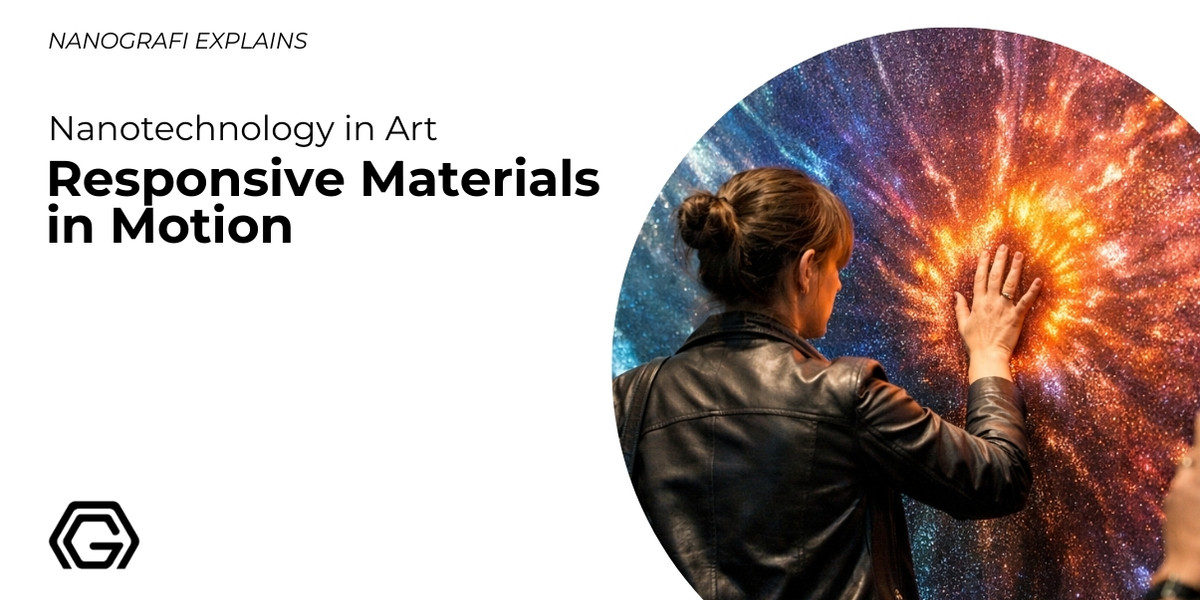
Art That Changes Over Time: Stimuli-Responsive Materials Enabled by Nanotechnology
Art, design, and advanced materials are converging at an unprecedented pace, with nanotechnology in art emerging as a central force behind this transformation. As one of the leading companies developing advanced nanomaterials and functional surfaces, Nanografi operates at the forefront of nano-engineered materials that enable stimuli-responsive behavior, adaptability, and time-dependent performance. This same material intelligence is now reshaping contemporary art, making it possible for artworks to change over time, react to external stimuli, and transform physical matter into an active, stimuli responsive system rather than a static object.

Nanotechnology as a Driver of Material Behavior in Art
Nanotechnology fundamentally alters how materials behave at the nanoscale; the physical and chemical properties of materials are determined by high surface area-to-volume ratios and quantum effects rather than macroscopic bulk properties. This leads to the emergence of characteristics-such as size-dependent optical responses, enhanced electrical conductivity, and tunable surface energy- that differ significantly from those of conventional materials (Whitesides, 2005). These characteristics allow engineers -and an increasingly number of artists- to design materials whose behavior can be precisely controlled rather than merely observed.
In artistic contexts, this shift moves materials from passive carriers of form into active systems. Responsive materials, including thermochromic nanoparticles, conductive nanocomposites, plasmonic nanostructures, and carbon-based nanomaterials such as graphene and carbon nanotubes, enable surfaces that are responsive to stimuli such as heat, light, moisture, or mechanical stress. Graphene and carbon nanotube-based systems integrate this change directly into the material's own structure, without the need for external mechanical or digital components.
Structural Color and Nano-Engineered Light Interaction
One of the most visible applications of nano-engineered materials in contemporary art is structural color. Unlike conventional pigments, structural color arises from nanoscale patterns control light through scattering, diffraction, and interference. Through these photonic mechanisms, surfaces exhibit colors that shift with viewing angle, illumination, or environmental conditions (Kinoshita et al., 2008).
This phenomenon has been widely explored in large-scale installations and architectural artworks, where surfaces appear fluid or unstable despite being physically solid. Artists such as Olafur Eliasson frequently work with engineered light–material interactions that rely on principles directly aligned with nano-optics and photonic materials research. In these works, nanotechnology in art does not simply enhance visual impact; it fundamentally destabilizes perception, making the viewer’s movement and environment part of the artwork itself.
Carbon Nanotubes and the Manipulation of Absence
A landmark example of nanotechnology’s direct entry into contemporary art is Anish Kapoor’s use of Vantablack, a coating composed of vertically aligned carbon nanotubes arrays (VANTAs) originally developed for aerospace and optical applications. Due to its nanoscale structure, this nano-engineered material absorbs almost all incident light across a wide spectrum preventing reflection and effectively erasing surface geometry (Surrey NanoSystems, 2016).

When applied to sculptural forms, the material creates the illusion of absolute voids rather than objects. Depth cues disappear, and spatial perception collapses. The artistic effect cannot be separated from the nanotechnology behind it; without nanoscale engineering, such optical behavior is physically unattainable. This example demonstrates how nanomaterials in contemporary art can redefine space by manipulating light at the most fundamental level.
Stimuli-Responsive Nanomaterials and Time-Based Art
Beyond optics, nanotechnology enables stimuli-responsive materials that actively react to environmental conditions. Stimuli-responsive polymeric nanocomposites can reversibly change their molecular conformations or phase states in response to environmental changes, leading to variations in their electrical, optical, or mechanical properties (Stuart et al., 2010).

Graphene and carbon nanotube-based nanocomposites, for example, exhibit changes in electrical resistance through piezorezistive or thermoresistive effects in response to mechanical stress or temperature variations (Geim & Novoselov, 2007). In artistic installations, these behaviors translate into surfaces that fade, pulse, darken, or brighten as conditions change. Time becomes an intrinsic design parameter rather than an external variable, positioning responsive materials as a defining element of nanotechnology in art.
From Gallery Installations to Architectural Scale
The same principles of nanotechnology and responsive materials influencing contemporary art increasingly appear at architectural and urban scales. Nano-engineered coatings that regulate reflectivity, heat absorption, and responsiveness to stimuli are now used in façades, public art installations, and interior surfaces. These applications blur the boundaries between art, architecture, and engineering.
At this scale, nanotechnology in art enables materials to perform multiple functions simultaneously: aesthetic impact, interaction with external stimuli, and functional performance. Originally developed for electronics, energy systems, and sensing technologies, nano-engineered materials now shape visual culture in public spaces, reinforcing the idea that material innovation transcends disciplinary boundaries.
Constraints, Safety, and Long-Term Performance
Despite its potential, the use of nanotechnology in art introduces important considerations related to durability, safety, and lifecycle management. Nanomaterials may be sensitive to UV exposure, oxidation, or mechanical fatigue, and their long-term behavior requires careful assessment. Responsible handling and risk evaluation are critical, particularly for public-facing installations and architectural artworks (Maynard et al., 2006).
These challenges mirror those encountered in industrial and scientific applications, highlighting the importance of collaboration between artists, material scientists, and advanced materials producers. As responsive materials become more prevalent in contemporary art, material reliability and transparency become as important as conceptual intent.
Nanotechnology and the Future of Contemporary Art
Stimuli-responsive art reflects a broader shift in how materials are understood and deployed across disciplines. Performance is no longer limited to mechanical strength or high strength-to-weight ratios; it now includes interaction, adaptability, and time-dependent behavior. Nanotechnology in art provides the material framework for this transition, enabling matter itself to sense, respond, and evolve.
Nanografi stands among the companies advancing this shift by developing nano-engineered materials designed for dynamic performance across diverse application areas. The growing role of nanomaterials in contemporary art demonstrates how functional materials extend beyond industrial use, redefining perception, interaction, and the role of material itself in modern visual culture.
References
Geim, A. K., & Novoselov, K. S. (2007). The rise of graphene. Nature Materials, 6(3), 183–191.
https://doi.org/10.1038/nmat1849
Kinoshita, S., Yoshioka, S., & Miyazaki, J. (2008). Physics of structural colors. Reports on Progress in Physics, 71(7), 076401.
https://doi.org/10.1088/0034-4885/71/7/076401
Maynard, A. D., Aitken, R. J., Butz, T., Colvin, V., Donaldson, K., Oberdörster, G., & Warheit, D. B. (2006). Safe handling of nanotechnology. Nature, 444(7117), 267–269.
https://doi.org/10.1038/444267a
Stuart, M. A. C., Huck, W. T. S., Genzer, J., Müller, M., Ober, C., Stamm, M., & Winnik, F. (2010). Emerging applications of stimuli-responsive polymer materials. Nature Materials, 9(2), 101–113.
https://doi.org/10.1038/nmat2614
Surrey NanoSystems. (2016). Vantablack: The darkest material ever made.
https://www.surreynanosystems.com/vantablack
Whitesides, G. M. (2005). Nanoscience, nanotechnology, and chemistry. Small, 1(2), 172–179.
https://doi.org/10.1002/smll.200400130
Recent Posts
-

MXene for EMI Shielding: Materials, Mechanisms and Applications
Electromagnetic interference has become a design constraint rather than an afterthought. Densely pac …10th Sep 2026 -

Handling and Storage Best Practices for Metal Oxide Nanopowders
A metal oxide nanopowder is bought for a property that a coarse powder cannot deliver: a specific su …1st Sep 2026 -

Activated Carbon vs Zeolites vs MOFs: Which Adsorbent Material Should You Choose?
Activated carbon, zeolites and metal-organic frameworks (MOFs) represent three distinct adsorbent cl …20th Aug 2026