
What Are Advanced Materials and Why They Matter for High-Tech Industries
Introduction
Advanced materials are no longer peripheral inputs in technology development; they have become decisive factors that define performance ceilings, reliability thresholds, and scalability limits. In sectors such as energy storage, electronics, aerospace, and defense, the critical threshold between the prototyping stage and the transition to industrial proof-of-concept and mass production is increasingly determined by material behavior under real operating conditions. Parameters such as charge carrier kinetics, thermal management, mechanical fatigue resistance, and interface-driven interactions are now engineered at the material level rather than being externally compensated variables at the system level; they have become subjects of engineering directly at the material architecture level.

Operating within this landscape, Nanografi is part of a broader industrial ecosystem where material science directly intersects with manufacturing reality. However, understanding advanced materials begins not with suppliers or products, but with a clear definition of what makes a material truly “advanced” and why this distinction matters across high-tech industries.
What Defines an Advanced Material?
Advanced materials are engineered systems designed to deliver tightly controlled and often multifunctional performance characteristics that conventional materials cannot reliably provide. These characteristics include, but are not limited to, high electrical or thermal conductivity, exceptional specific strength (strength-to-specific gravity ratio), chemical inertness and thermodynamic stability under extreme operational conditions, and tunable surface or interfacial behavior at micro- and nanometer scales.
What differentiates advanced materials is not the presence of exotic elements or novel names, but the degree of structural control embedded in their design. Lattice parameters, dislocation density, degree of crystallinity, morphology, phase distribution, and surface functionalization are controlled and manipulated to achieve precise material characteristics. As a result, two materials with identical chemical compositions may exhibit radically different electrical, mechanical, or electrochemical behavior depending on how their internal structure is engineered (Geim & Novoselov, 2007).
Why Advanced Materials Matter for High-Tech Industries
High-tech industries increasingly operate at the theoretical limits of materials, on the threshold of extreme thermodynamic and mechanical boundaries. As systems become smaller, lighter, faster, and more efficient, conventional materials approach their functional limits. Advanced materials allow engineers to redefine these limits rather than merely optimize within them.
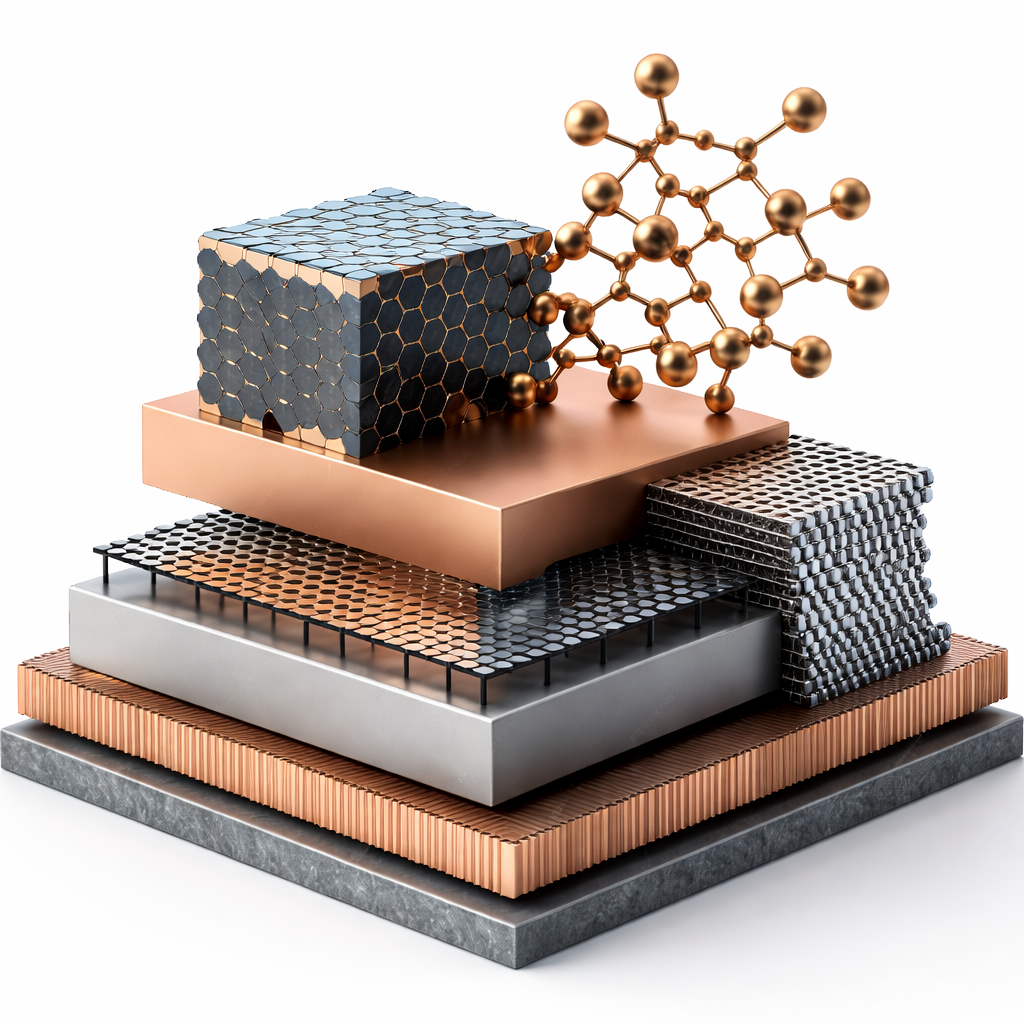
In energy technologies, material-level properties govern ionic and electronic diffusion pathways, electrochemical reaction kinetics and degradation mechanisms that directly affect efficiency and lifetime. In electronics, they influence carrier mobility, thermal management, and signal integrity as device dimensions shrink. Aerospace and defense platforms depend on materials that maintain high specific strength and high-temperature creep resistance, while providing robust protection against environmental stressors such as corrosion and oxidation. Across all these domains, material performance is no longer a secondary consideration but a primary design constraint.
Advanced Materials as Engineered Systems
Advanced materials should be understood not as isolated substances, but as engineered systems whose performance emerges from the interaction between microstructure, chemical composition, and thermomechanical history to gain functionality. This systems-level perspective is essential for industrial deployment.
Processing conditions such as synthesis methodology, nucleation, growth kinetics, and post-treatment steps directly influence defect chemistry, agglomeration tendency, and surface reactivity. Even minor deviations in these parameters can alter the phase equilibrium, free carrier concentration, and grain boundary energy, leading to measurable macro-scale performance variations. For this reason, reproducibility and structural consistency are as critical as intrinsic material properties when evaluating advanced materials for industrial use.
From Scientific Potential to Industrial Reality
The transition from academic discovery to industrial application represents one of the most significant challenges in advanced materials development. Laboratory-scale performance advantages often degrade during scale-up challenges in stoichiometric control, non-homogeneous nucleation, increased defect density, or integration issues with existing manufacturing lines.

Research on scalable nanomaterial production highlights that maintaining performance during scale-up requires rigorous control over morphology, defect evolution, and interparticle interactions (Bonaccorso et al., 2012). Without such control, materials that appear promising in controlled experimental settings may fail to deliver consistent results in real-world applications. Industrial relevance, therefore, depends as much on process control and optimization of production parameters as on material architecture.
Performance Evaluation in Applied Contexts
In applied high-tech environments, advanced materials are evaluated based on how they perform under specific operational demands rather than abstract material descriptors. Electrical conductivity must remain stable under electrochemical cycles, surface accessibility must support transport-driven processes, and mechanical properties must exhibit fatigue resistance under dynamic loading
These evaluation criteria vary by sector but share a common emphasis on measurable, application-relevant outcomes. Material selection decisions are guided by how effectively a material supports system-level objectives such as efficiency, durability, safety, and long-term reliability. Understanding this applied evaluation framework is essential for interpreting why materials that appear similar on paper may diverge significantly in practice.
Conclusion
Advanced materials define the technological boundaries of modern high-tech industries by shaping performance at the most fundamental level. Their value lies not in terminology, but in microstructural control, phase stability, and deterministic performance characteristics under extreme operational conditions. Treating advanced materials as İntegrated engineering systems rather than static substances provides a more accurate basis for both development and deployment.
Within this broader framework, Nanografi operates where material science meets industrial execution, focusing on materials whose structure can be deliberately engineered and consistently reproduced. Building on this foundation, the next article in this series will narrow the scope to a single but highly consequential nomenclature -graphene -examining why not all graphene materials deliver the same performance and why structural differences matter in industrial contexts.
References
Bonaccorso, F., Lombardo, A., Hasan, T., Sun, Z., Colombo, L., & Ferrari, A. C. (2012). Production and processing of graphene and 2D crystals. Nature Photonics, 6(12), 819–827.
Geim, A. K., & Novoselov, K. S. (2007). The rise of graphene. Nature Materials, 6(3), 183–191.
Recent Posts
-

Graphene Coating Technology: A New Standard in Corrosion and Wear Protection
Every metal surface is, in a sense, already losing a slow chemical war. Oxygen, moisture, and dissol …28th Jul 2026 -

Graphene Dispersion vs CNT Dispersion: Use Cases and How to Choose
If you have ever tried to formulate a conductive ink, a battery slurry, or an anti-static coating, y …16th Jul 2026 -
The 10 Strongest Advanced Materials of All Time (2026 Guide)
The phrase "strongest material" is more ambiguous than it first appears. In materials science, mecha …7th Jul 2026