
Carbon Nanotubes Doped with 32 wt% Graphene Nanopowder/Nanoparticles

- SKU:
- NG01SC0606
- Shipping:
- Calculated at Checkout


Description
1 gram: 40 €
5 grams: 80 €
25 grams: 190 €
100 grams: 450 €
500 grams: 1640 €
1000 grams: 2750 €
Contact us for tailored quotes on larger quantities & experience exceptional solutions from our experts.
Carbon Nanotubes Doped with 32 wt% Graphene Nanopowder/Nanoparticles
Graphene Purity: 99%, Thickness: 5 nm, CNT Purity: >97 wt%
Carbon Nano Tubes doped with graphene, one of the promising graphene derivatives, is a hybrid structure composes of a covalently bonded graphene and carbon nano tubes. The hybrid material, CNT doped with graphene, extends the excellent properties of low-dimensional carbon materials (e.g., graphene, carbon nanotube - CNT) such as electrical condctivity and large specific surface area. CNT doped with graphene can be used in many various applications in areas such as energy storage, supercapacitor and building blocks composite. Nanografi supplies Carbon Nanotubes Doped wtih 32 wt% Graphene products with high quantity and low price and many types for different applications.
Technical Properties
| 32 wt% Graphene Nanopowder | ||
| Purity | 99% | |
| Thickness (nm) | 5 | |
| Diameter (μm) | 1.0-12.0 | |
| Specific Surface Area (m2/g) | 500-1200 | |
| Conductivity (s/m) | 1000-1500 | |
| Shape | two-dimensional | |
| Elemental Analysis | C | O |
| 99.6 | 0.4 | |
| Carbon Nanotubes (Multi Walled Carbon Nanotubes) | ||
| Purity | > 97 wt% | |
| Color | black | |
| Average Outside Diameter (nm) | > 50 | |
| Average Inside Diameter (nm) | 5 | |
| Length (µm) | 15-25 | |
| Tap Density (g/cm3) | 0.15 | |
| True Density (g/cm3) | ~2.4 | |
| Specific Surface Area (m2/g) | > 65 | |
| Ash | < 1.5 wt% | |
| Electrical Conductivity (S/cm) | > 98 |
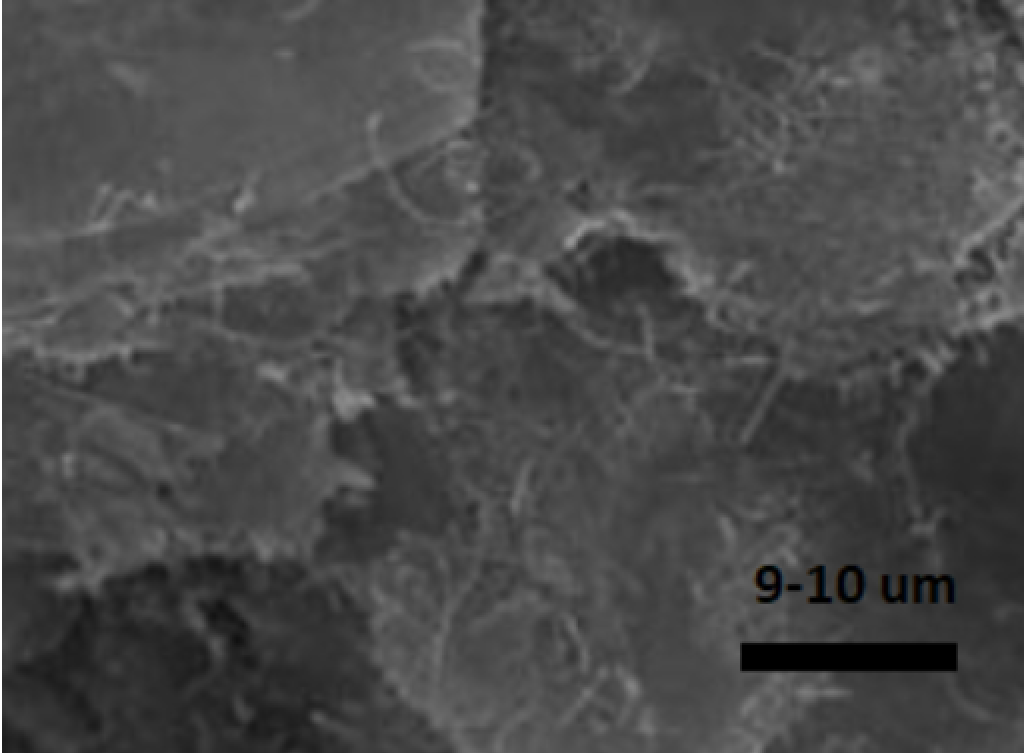
SEM Image
Applications
- Energy Storage: CNT–graphene hybrids improve lithium-ion batteries by enhancing conductivity, cycle life, and mechanical stability. In supercapacitors they boost capacitance and charge–discharge efficiency, while their porous structure supports hydrogen storage and fuel cell catalyst layers.
- Electronics & Optoelectronics: They serve as conductive inks for flexible electronics, high-mobility channels in transistors, transparent layers in displays, and hybrid optoelectronic materials for solar cells and photoluminescence.
- Biomedical & Biosensing: In biosensors they enable sensitive detection through fast electron transfer, while in drug delivery they act as carriers with controlled release. CNT–graphene nanoprobes also support imaging and tracking applications.
- Composites & Structural Materials: As fillers in polymer, ceramic, and metal composites, they enhance tensile strength, modulus, toughness, and conductivity, making them valuable for aerospace, automotive, and construction materials.
- Catalysis & Environmental: They act as catalyst supports in electrochemical reactions, conductive fillers in gas-discharge tubes, and adsorbents for pollutants, combining high surface area with hybrid reactivity.
FAQ
FAQ About Carbon Nanotubes Doped with 32 wt% Graphene
1) What does combining nanotubes with graphene achieve?
The two carbon forms have complementary geometries. Nanotubes conduct along one dimension and bridge distance; graphene platelets present broad two-dimensional surface. Bringing them together produces a hybrid in which the tubes link neighbouring platelets into a continuous network while the platelets supply accessible area. The result is higher effective conductivity and larger usable surface than either component reaches alone at the same loading.
2) What are the graphene component's specifications?
The graphene fraction is specified at 99% purity, 5 nm thickness, 1.0–12.0 µm diameter, 500–1200 m²/g specific surface area and 1000–1500 S/m conductivity, with a two-dimensional platelet shape and elemental analysis of 99.6% carbon and 0.4% oxygen. The very high surface area figure is the reason this hybrid is favoured for supercapacitor work over metal-doped variants, which contribute conductivity but little additional area.
3) What nanotube backbone is used?
The nanotube component is multi-walled, specified at greater than 97 wt% purity, average outer diameter above 50 nm, inner diameter 5 nm, length 15–25 µm, tap density 0.15 g/cm³, specific surface area above 65 m²/g, ash below 1.5 wt% and electrical conductivity above 98 S/cm. This same backbone is shared across Nanografi's doped nanotube range, which means the differences between those products come entirely from the dopant.
4) Why choose 32 wt% rather than a lower or higher loading?
The graphene fraction sets where the hybrid sits between the two parent materials. Lower loadings behave more like nanotubes — better at bridging and reinforcement, less surface area. Higher loadings shift toward platelet behaviour with more area but shorter conductive paths. At 32 wt% the material carries a substantial platelet population while the nanotube network still dominates connectivity, which suits electrode work where both matter.
5) Which applications suit this hybrid specifically?
Reported uses are lithium-ion batteries where conductivity, cycle life and mechanical stability all improve; supercapacitors where capacitance and charge–discharge efficiency benefit from the combined surface; hydrogen storage and fuel cell catalyst layers exploiting the porous structure; conductive inks and transistor channels in flexible electronics; biosensing through fast electron transfer; and polymer, ceramic and metal matrix composites.
6) Is this preferable to buying nanotubes and graphene separately and mixing them?
The product is described as a covalently bonded hybrid rather than a physical blend, which is the meaningful distinction. In a dry mixture the two components segregate during processing and the interface between them is a contact resistance. A bonded hybrid keeps the geometry that produces the synergy. If your process disperses both components thoroughly into a liquid phase anyway, separate materials may suffice; for dry blending, the hybrid holds together.
7) What related doped grades are available?
Nanografi supplies this hybrid at several graphene loadings, and the same nanotube backbone doped with metal nanoparticles for applications needing catalytic, magnetic or antimicrobial function rather than surface area. The full set is listed under special CNTs. Undoped platelets alone are listed under graphene nanoplatelets.
8) In what quantities is it supplied?
This hybrid is available in 1 g, 5 g, 25 g, 100 g, 500 g and 1000 g quantities, with tailored quotes for larger volumes. The 1 g entry point supports formulation screening at low cost, and the kilogram tier supports pilot production of electrodes or composite masterbatches without a change of material source.
Related Products
Related Products
Carbon Nanotubes Doped with 12 wt% Graphene Nanopowder/Nanoparticles

Carbon Nanotubes Doped with 52 wt% Graphene Nanopowder/Nanoparticles

Carbon Nanotubes Doped with 32 wt% Silicon (Si) and 32 wt% Graphene Nanopowder/Nanoparticles

Carbon Nanotubes Doped with 32 wt% Silver (Ag) Nanopowder/Nanoparticles
