
Multi Walled Carbon Nanotubes Isopropanol Dispersion, 2 wt%, Purity: >95%, OD: 5-15 nm, Length: 10-30 µm
- SKU:
- NG02CN0103
- Shipping:
- Calculated at Checkout

Description
15 ml/315 €
30 ml/525 €
60 ml/882 €
120 ml/1350 €
Product Overview
MWCNT-Isopropanol (IPA) Dispersion is a high-purity, ready-to-use suspension designed for applications where rapid evaporation and uniform surface wetting are critical. Utilizing Multi-Walled Carbon Nanotubes with a slender diameter (5-15 nm) and significant length (10-30 µm), this dispersion provides an exceptionally high aspect ratio, enabling the formation of robust conductive networks at minimal loading levels. The use of Isopropanol as a carrier ensures excellent compatibility with various substrate types and quick-drying properties, making it an ideal choice for the development of thin films, conductive coatings, and advanced composite materials where solvent residue must be minimized.
Technical Properties
|
Purity |
>95 % |
|
|
MWCNT Content |
2 wt% |
|
|
Outer Diameter |
5-15 nm |
|
|
Length |
10-30 μm | |
|
Spesific Surface Area |
220-300 m2/g | |
|
Tap Density |
0.09 g/cm3 | |
|
CAS No |
MWCNT | Isopropanol |
| 308068-56-6 | 67-63-0 |
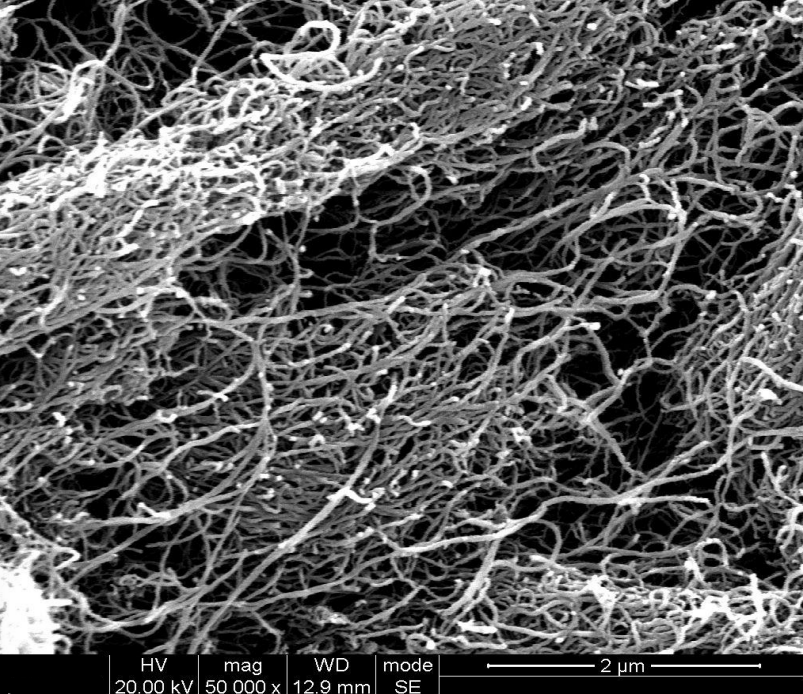
SEM Image
Applications
- Conductive Thin Films & Coatings: Ideal for creating transparent or opaque conductive layers on glass, silicon, or plastic substrates due to IPA’s low surface tension and fast evaporation rate.
- Anti-Static (ESD) Protection: Application in the electronics industry to provide permanent electrostatic discharge protection for sensitive components and packaging materials.
- Sensor Development: Used as an active sensing material in gas, pressure, or electrochemical sensors, benefiting from the massive specific surface area (220-300 m²/g) for high sensitivity.
- Electromagnetic Interference (EMI) Shielding: Integration into lightweight coatings and sprays to shield high-frequency electronic devices from signal interference.
- Fuel Cell & Battery Research: Utilization in the development of gas diffusion layers or electrode modifiers where an alcohol-based carrier is preferred for slurry compatibility.
- Spray-Coating & Inkjet Printing: Optimized for spray-pyrolysis or inkjet systems to deposit uniform CNT layers for flexible electronics and solar cell research.
FAQ
Technical FAQ About Multi Walled Carbon Nanotubes Isopropanol Dispersion, 2 wt%
1) Why choose an isopropanol-based MWCNT dispersion instead of dry carbon nanotube powder?
An IPA-based dispersion can simplify formulation steps when a ready-to-use liquid CNT system is preferred over dry powder handling. Nanografi NG02CN0103 combines 2 wt% MWCNT content with an isopropanol carrier, making it relevant for coating, printing and surface-deposition processes where rapid solvent evaporation is useful.
2) Is Nanografi NG02CN0103 suitable for conductive thin films and coatings?
Yes. Conductive thin films and coatings are key application areas for this 2 wt% MWCNT dispersion. The IPA carrier supports fast evaporation and surface wetting on substrates such as glass, silicon and plastics, while the 5-15 nm diameter and 10-30 µm CNT length support conductive network formation.
3) Can this MWCNT dispersion be used for spray coating or inkjet printing?
Yes. Spray-coating and inkjet printing are listed application areas for this grade, particularly for depositing CNT layers in flexible electronics and solar-cell research. Process parameters such as nozzle geometry, substrate compatibility and final viscosity should still be optimized for the specific printing system.
4) Is the 2 wt% IPA dispersion suitable for ESD and antistatic applications?
Yes. Nanografi positions this MWCNT dispersion for anti-static and ESD protection applications where a conductive CNT network is required on or within a surface coating. Final resistance depends on deposited CNT amount, coating thickness, dispersion uniformity and substrate properties.
5) How is the 220-300 m²/g specific surface area relevant for sensor development?
A high specific surface area increases the available nanotube interface for interaction with gases, liquids or electrode environments. For NG02CN0103, the 220-300 m²/g surface area can therefore be relevant when evaluating the material for gas, pressure or electrochemical sensor research.
6) Can this dispersion be used for EMI shielding coatings?
Yes. EMI shielding is one of the listed application areas. The dispersion can be evaluated for lightweight conductive coatings or sprays where a CNT-based network is used to reduce electromagnetic interference.
7) Is Nanografi's 2 wt% MWCNT IPA dispersion suitable for battery and fuel-cell research?
Yes. The material can be evaluated for gas-diffusion layers, electrode modification and related electrochemical research where an alcohol-based CNT carrier is compatible with the formulation route.
8) When should a researcher choose this 2 wt% IPA grade instead of another CNT dispersion?
Selection should consider CNT concentration, carrier solvent, nanotube dimensions, surface area, target coating thickness and the processing method. Nanografi NG02CN0103 is suited to applications where a lower-concentration, ready-to-use IPA dispersion with 5-15 nm OD and 10-30 µm CNT length is preferred.
9) Where can related carbon nanotube dispersions be compared?
Related formulations can be compared in Nanografi's CNT Dispersions category, including water-based, IPA-based and NMP-based CNT systems with different concentrations and nanotube dimensions.
10) Is there a higher-concentration IPA-based MWCNT dispersion available?
Yes. For applications requiring a higher CNT loading, Nanografi also offers higher-concentration CNT dispersion options, including a 10 wt% MWCNT isopropanol dispersion with different nanotube dimensions. The appropriate grade depends on the target solids content and processing method.
11) Where can published research using Nanografi carbon nanotubes be reviewed?
Researchers can review Nanografi's Carbon Nanotube Publication List for examples of CNT use in published academic and technical studies.
12) What should be checked before integrating this MWCNT dispersion into a formulation?
Key factors include compatibility with isopropanol, target CNT loading, substrate or matrix compatibility, drying rate, coating or printing method and the required electrical performance. Nanografi NG02CN0103 provides a defined starting composition with 2 wt% MWCNT content, >95% purity, 5-15 nm OD and 10-30 µm length.
Related Products
Related Products

Multi Walled Carbon Nanotubes N-Methyl-2-Pyrrolidinone Dispersion, 4 wt%, Purity: > 95%, OD: 5-15 nm, Length: 10-30 µm

Multi Walled Carbon Nanotubes N-Methyl-2-Pyrrolidinone Dispersion, 10 wt%, Purity: >95 %, OD: 30-80 nm, Length: <10 µm
