
(-OH) Functionalized Single Walled Carbon Nanotubes, Purity: > 65%

- SKU:
- NG01SW0302
- Shipping:
- Calculated at Checkout

Description
5 grams/95 €
25 grams/445 €
100 grams/1280 €
500 grams/4940 €
1000 grams/8780 €
Please contact us for quotes on larger quantities !!!
(-OH) Functionalized Single Walled Carbon Nanotubes
Purity: > 65%, SSA: 400 m2/g, Dia: 1.0 nm
Single walled carbon nanotubes (SWCNTs, SWNTs) comprise of one-atom-thick sheets of graphene that rolled up to form long hollow tubes. SWCNTs possess exceptional thermal, mechanical and electrical properties. These remarkable properties lead to advances in performance in a wide range of materials and devices. Single-walled carbon nanotubes are actively used in diverse area including energy storage, molecular electronics, nano mechanial devices, composites and bio-sensing. Our (-OH) Functionalized Single Walled Carbon Nano Tubes compete on price and performance with counterparts.
Technical Properties
| Purity | > 65 wt% |
| Content of (-OH) | 4.0% |
| Color | black |
| Average Diameter | 1.0 nm |
| Length | 5-35 µm |
| OD | 1-2 nm |
| ID | 0.8-1.6 nm |
| Tap Density | 0.45 g/cm3 |
| True Density | 2.2 g/cm3 |
| SSA | 400 m2/g |
| Ash | 3.0 wt% |
| Thermal Conductivity | 45-190 W/m.K |
| Electrical Conductivity | 98 S/cm |
| Ig/Id | 9 |
| Manufacturing Method | CVD |
| CAS No | 308068-56-6 |
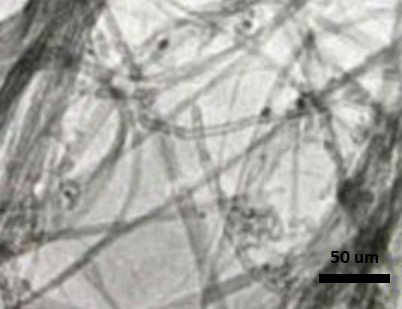
SEM Image
Applications
- Biomedical & Biosensing: Hydroxyl-functionalized SWCNTs offer improved aqueous dispersibility and biocompatibility, making them suitable for biosensors, drug delivery systems, and bioimaging platforms. Their surface chemistry supports further conjugation with biomolecules.
- Catalysis & Surface Chemistry: The -OH groups enable strong interaction with metal ions and catalytic species, enhancing performance in heterogeneous catalysis, photocatalysis, and template-assisted synthesis.
- Polymer & Composite Integration: Functionalized SWCNTs disperse more uniformly in polar solvents and polymer matrices, improving mechanical reinforcement, thermal stability, and electrical conductivity in advanced composites.
- Energy Devices: Their tailored surface chemistry supports better electrode–electrolyte interaction in supercapacitors, lithium-ion batteries, and fuel cells, contributing to higher charge transfer efficiency and cycle stability.
Related Products
Related Products

(-OH) Functionalized Double Walled Carbon Nanotubes, Purity: > 65%

(-OH) Functionalized Short Single Walled Carbon Nanotubes, Purity: >92%
(-OH) Functionalized Short Length Double Walled Carbon Nanotubes, Purity: > 65%

(-COOH) Functionalized Short Single Walled Carbon Nanotubes, Purity: > 65%
