
Graphene Aerogels
Explore Graphene Aerogels and 3D Graphene Foams from Nanografi for energy storage, environmental remediation, sensors, conductive frameworks and advanced materials research. Our portfolio includes ultralight graphene aerogels, mechanically reinforced graphene aerogels, carbon nanotube (CNT)-modified structures, magnetic Fe3O4/graphene aerogels and transferable graphene foam materials.
Compare ultralight aerogels with densities of 1.2–3.2 mg/cm³, strong graphene aerogels, CNT-modified porous structures and magnetic aerogels containing 50% or 65% Fe3O4. Select from different dimensions and material architectures to match your experimental requirements, or explore our broader Graphene portfolio.
- Product
- Qty in Cart
- Quantity
- Price
- Subtotal
-
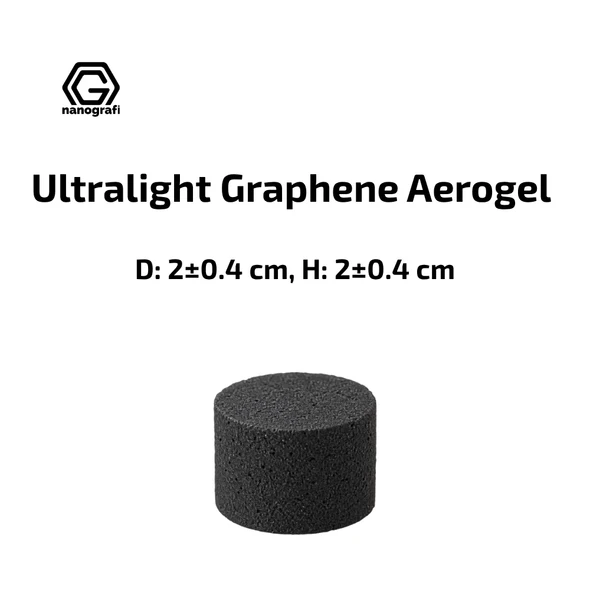
Ultralight Graphene Aerogel, Diameter: 2±0.4 cm, Height: 2±0.4 cm
€260.001 piece/ 260 € 5 pieces/ 1039 € Contact us for tailored quotes on larger quantitieNG01GA0104€260.00 -

Ultralight Graphene Aerogel, Diameter: 1.2±0.1 cm, Height: 1.2±0.1 cm
€196.001 piece/ 196 € 5 pieces/ 743 € Contact us for tailored quotes on larger quantities & experience exceptional solutions from our experts.NG01GA0103€196.00 -

Magnetic Graphene Aerogel, Content of Fe3O4: 50%, Diameter: 2±0.4 cm
€259.001 piece/ 259 € 5 pieces/ 1204 € Contact us for tailored quotes on larger quantities & experiNG01GA0108€259.00 -

Strong Graphene Aerogel, Diameter: 2±0.4 cm, Height: 2±0.4 cm
€295.001 piece/ 295 € 5 pieces/ 1185 € Contact us for tailored quotes on larger quantities & experience exceptional solutions from our experts.NG01GA0102€295.00 -

Strong Graphene Aerogel, Diameter: 1.2±0.1 cm, Height: 1.2±0.1 cm
€202.001 piece/ 202 € 5 pieces/ 759 € Contact us for tailored quotes on larger quantitiesNG01GA0101€202.00 -

Impending Self-Help Transfer Nickel Graphene Foam, Thickness: 1±0.1 mm, Size: 5x10 cm
€1,373.001 piece/ 1373 € 5 pieces/ 5472 € Contact us for tailored quotes on larger quantities & experience exceptional solutions from ourNG01GA0114€1,373.00 -

Impending Self-Help Transfer Nickel Graphene Foam, Thickness: 1±0.1 mm, Size: 5x5 cm
€765.001 piece/ 765 € 5 pieces/ 3658 € Contact us for tailored quotes on larger quantities & experience exceptional solutions from our eNG01GA0113€765.00 -

Impending Self-Help Transfer Nickel Graphene Foam, Thickness: 1±0.1 mm, Size: 2x2 cm
€292.001 piece/ 292 € 5 pieces/ 1348 € Contact us for tailored quotes on larger quantities &amNG01GA0112€292.00 -

Impending Self-Help Transfer Nickel Graphene Foam, Thickness: 1±0.1 mm, Size: 1x1 cm
€193.001 piece/ 193 € 5 pieces/ 869 € Contact us for tailored quotesNG01GA0111€193.00 -

Magnetic Graphene Aerogel, Content of Fe3O4: 65%, Diameter: 2±0.4 cm
€258.001 piece/ 258.50 € 5 pieces/ 1199 € Contact us for tailored quotes on larger quantities & experience exceptionaNG01GA0110€258.00 -

Magnetic Graphene Aerogel, Content of Fe3O4: 65%, Diameter: 1±0.1 cm
€192.001 piece/ 192 € 5 pieces/ 748 € Contact us for tailored quotesNG01GA0109€192.00 -

Magnetic Graphene Aerogel, Content of Fe3O4: 50%, Diameter: 1±0.1 cm
€194.001 piece/ 194 € 5 pieces/ 753 € Contact us for tailored qNG01GA0107€194.00 -

Carbon Nanotubes(CNT) Modified Graphene Aerogel, Diameter: 2±0.4 cm, Height: 2±0.4 cm
€273.001 piece/ 273 € 5 pieces/ 1089 € Contact us for tailored quotes on larger quantities & experience exceptional solutioNG01GA0106€273.00 -

Carbon Nanotubes(CNT) Modified Graphene Aerogel, Diameter: 1.2±0.1cm, Height: 1.2±0.1cm
€203.501 piece/ 203.50 € 5 pieces/ 764.50 € Contact us for tailored quotes on largeNG01GA0105€203.50
Graphene Aerogels: Lightweight, Porous 3D Graphene Materials
Graphene aerogels are ultralight, three-dimensional porous materials formed from interconnected graphene-based sheets. Unlike conventional graphene powders or two-dimensional films, graphene aerogels create continuous 3D frameworks with low bulk density, high porosity and accessible internal surfaces. These characteristics make them promising materials for energy storage, environmental remediation, sensors, conductive composites and advanced materials research.
The combination of a porous architecture and graphene-based carbon networks provides opportunities to investigate electrical conductivity, adsorption, mechanical response and multifunctional material performance. However, these properties depend on the aerogel's density, composition, pore structure and manufacturing conditions.
Nanografi offers a range of graphene aerogels and 3D graphene foam materials, including ultralight graphene aerogels, strong graphene aerogels, carbon nanotube (CNT)-modified aerogels, magnetic graphene aerogels and transferable graphene foams. Explore the available materials to identify a suitable structure for your research or browse our broader Graphene Materials collection.
What Makes Graphene Aerogels Unique?
Graphene aerogels combine the characteristics of graphene-based materials with a three-dimensional network containing interconnected pores. Their structure distinguishes them from dense carbon materials and conventional particulate graphene products.
Ultralow Density and High Porosity
One of the defining properties of graphene aerogels is their exceptionally low bulk density. Their internal architecture consists of graphene-based walls and interconnected void spaces, allowing the material to maintain a three-dimensional form while containing relatively little solid matter.
Nanografi's ultralight graphene aerogels have listed densities of 1.2–3.2 mg/cm³, making them relevant to research involving lightweight functional structures, porous electrodes and adsorption materials.
Three-Dimensional Conductive Networks
The interconnected graphene framework can provide pathways for electrical charge transport. This makes graphene aerogels attractive for research involving conductive scaffolds, electrodes, electrochemical devices and electronic sensing materials.
Electrical performance depends on the connectivity between graphene sheets, structural defects, material composition and contact resistance. The conductivity of a graphene aerogel should therefore be evaluated using product-specific measurements.
Large Accessible Surface and Porous Structure
The internal pore network of graphene aerogels can provide surfaces for interaction with liquids, gases and other materials. This characteristic is particularly relevant to adsorption, catalysis-support research and electrochemical applications.
The actual accessible surface area depends on pore size distribution, surface chemistry and structural characteristics rather than porosity alone.
Mechanical Flexibility and Structural Stability
Depending on their architecture, graphene aerogels may exhibit compressibility, elastic recovery or improved mechanical stability through structural reinforcement.
Different graphene aerogel formulations can therefore be selected according to whether the research prioritizes minimum weight, structural integrity or repeated mechanical deformation.
Functionalization and Hybrid Material Design
Graphene aerogels can incorporate additional materials such as carbon nanotubes or magnetic nanoparticles to introduce new functionality.
For example, CNT-modified graphene aerogels provide hybrid carbon networks, while Fe3O4-containing magnetic graphene aerogels combine a porous structure with magnetic characteristics.
Types of Graphene Aerogels Available from Nanografi
Nanografi supplies several graphene aerogel formulations designed for different experimental requirements. The portfolio includes materials optimized for low density, structural robustness, hybrid conductive networks and magnetic functionality.
Ultralight Graphene Aerogels
Ultralight graphene aerogels are characterized by exceptionally low density and a highly porous three-dimensional architecture. These materials are particularly relevant to lightweight structural research, adsorption studies, porous electrodes and advanced composite development.
Nanografi offers ultralight graphene aerogels in different dimensions, allowing researchers to select samples according to experimental geometry and testing requirements.
Their low-density structure makes them an interesting starting point for investigating how pore architecture influences electrical, mechanical and adsorption behavior.
Strong Graphene Aerogels
Strong graphene aerogels are developed for applications in which mechanical robustness is an important consideration alongside porosity and low weight.
Compared with ultralight formulations, these materials have a higher listed density and may be more suitable for investigating porous structures exposed to mechanical loading or handling requirements.
Potential research areas include compression-responsive materials, functional supports, energy storage structures and mechanically reinforced composites.
CNT-Modified Graphene Aerogels
Carbon nanotube-modified graphene aerogels combine graphene-based sheets with carbon nanotubes to create hybrid three-dimensional carbon networks.
The high aspect ratio of CNTs can influence connections between graphene sheets and the resulting network architecture. These hybrid materials are investigated for conductive scaffolds, flexible sensors, electrochemical electrodes and advanced energy storage systems.
Explore Nanografi's Carbon Nanotubes collection to learn more about the related carbon nanomaterials used in hybrid structures.
Magnetic Graphene Aerogels
Magnetic graphene aerogels combine porous graphene frameworks with magnetic iron oxide (Fe3O4) nanoparticles. The resulting hybrid structure is particularly relevant to adsorption, magnetic separation and environmental remediation research.
Nanografi offers magnetic graphene aerogels with different Fe3O4 contents, including 50% and 65% formulations.
These materials can be investigated for removing selected contaminants from aqueous systems and subsequently recovering the adsorbent using an external magnetic field, subject to suitable magnetic response and experimental conditions.
Their adsorption capacity, selectivity and recovery efficiency depend on the specific contaminant, solution chemistry and material properties.
Transferable 3D Graphene Foam
In addition to graphene aerogels, Nanografi offers transferable graphene foam structures for research involving three-dimensional conductive frameworks.
Graphene foams provide interconnected porous architectures that can be useful for electrodes, sensors and other functional materials.
Transferable graphene foams differ from conventional aerogel monoliths in their preparation, handling and transfer requirements. The appropriate material should be selected according to the desired structure and experimental process.
Applications of Graphene Aerogels
The combination of porosity, low density and tunable graphene-based networks makes graphene aerogels attractive for a wide range of research applications.
Energy Storage: Supercapacitors and Batteries
Graphene aerogels are widely investigated as three-dimensional electrode frameworks for supercapacitors, lithium-ion batteries and other electrochemical energy storage devices.
The porous network can provide pathways for electrolyte access and electronic conduction, while the interconnected structure may support the integration of additional active materials.
CNT-modified graphene aerogels are particularly relevant to research involving hybrid conductive networks and porous electrode architectures.
Electrochemical performance depends on electrode composition, pore accessibility, electrolyte compatibility and device design. Properties such as capacitance, rate capability and cycling stability require experimental verification.
Oil Absorption and Environmental Remediation
Graphene aerogels are investigated for oil absorption, solvent uptake and environmental remediation because their porous frameworks can interact with selected liquids and contaminants.
Surface chemistry plays an important role in determining whether an aerogel preferentially interacts with water, oils or other substances.
For adsorption applications, researchers should evaluate uptake capacity, selectivity, regeneration behavior and structural stability under realistic operating conditions.
Water Treatment and Magnetic Separation
Magnetic graphene aerogels containing Fe3O4 are investigated for water-treatment research, including the adsorption of selected heavy metals and other contaminants.
Magnetic functionality can provide an additional approach for recovering the adsorbent from a liquid medium after treatment.
These materials are relevant to laboratory studies involving contaminant removal, adsorption kinetics, magnetic recovery and adsorbent regeneration.
Pressure Sensors and Flexible Electronics
Porous graphene networks can exhibit changes in electrical resistance when compressed or mechanically deformed. This behavior makes graphene aerogels interesting candidates for pressure-sensitive and strain-responsive materials.
Potential research applications include flexible pressure sensors, wearable electronic components, tactile sensing and experimental motion-detection systems.
The sensitivity, operating range, hysteresis and repeatability of a sensor depend on the aerogel structure and device design.
Electromagnetic Interference Shielding
Graphene-based aerogels are investigated for electromagnetic interference (EMI) shielding and electromagnetic wave absorption.
Their interconnected carbon networks and porous architectures can influence electrical losses and electromagnetic interactions within appropriately designed materials.
Shielding effectiveness depends on composition, thickness, conductivity, frequency range and structural design.
Thermal Management and Insulation
Graphene aerogels are studied for thermal management, insulation and multifunctional thermal materials.
Their highly porous structures can influence heat transfer through solid conduction, gas conduction and radiation.
Although individual graphene sheets exhibit high intrinsic thermal conductivity, the effective thermal behavior of a graphene aerogel depends on its density, network connectivity and pore architecture.
Catalysis and Functional Material Supports
Three-dimensional graphene aerogels can also be investigated as porous supports for catalysts, nanoparticles and other functional components.
Their interconnected structures may facilitate access to active sites and provide conductive frameworks for selected electrochemical processes.
Performance depends on the active material, surface chemistry, pore accessibility and operating conditions.
Graphene Aerogels vs. Graphene Foams vs. Graphene Nanoplatelets
Graphene-based materials are available in different physical forms, each offering distinct processing and application possibilities.
Graphene Aerogels
Graphene aerogels are highly porous, self-supporting three-dimensional structures. They are suitable for research where low density, interconnected pores and a preformed porous framework are important.
Graphene Foams
Graphene foams also feature three-dimensional porous networks but may differ in manufacturing method, pore architecture, mechanical characteristics and transfer requirements.
Graphene Nanoplatelets
Graphene nanoplatelets are particulate graphene-based materials commonly used as fillers in polymers, coatings and composite formulations.
Unlike preformed graphene aerogels, graphene nanoplatelets generally require additional processing to form a continuous porous structure.
Researchers developing polymer composites or coatings may also explore Nanografi's Graphene Nanoplatelets category.
How to Choose the Right Graphene Aerogel
Selecting the appropriate graphene aerogel depends on the desired balance between density, mechanical behavior, conductivity, porosity and additional functionality.
- For ultralight porous structures: Consider ultralight graphene aerogels when minimum weight and high porosity are primary research requirements.
- For mechanical robustness: Evaluate strong graphene aerogels when structural stability and handling characteristics are important.
- For hybrid conductive networks: CNT-modified graphene aerogels may be relevant to conductive scaffolds, sensors and electrode research.
- For magnetic functionality: Fe3O4-containing graphene aerogels are suitable candidates for investigating magnetic separation and adsorption processes.
- For transferable porous frameworks: Graphene foam structures may be appropriate when a porous graphene network must be integrated with another substrate or device.
Additional considerations include sample dimensions, pore morphology, electrical characteristics, surface chemistry and compatibility with the intended experimental environment.
How Are Graphene Aerogels Produced?
Graphene aerogels can be prepared through methods that assemble graphene-based sheets into a three-dimensional network while preserving a porous structure.
Common research approaches involve graphene oxide dispersions, hydrogel formation, controlled drying and subsequent chemical or thermal treatment.
Methods such as freeze-drying and supercritical drying are investigated to preserve porous networks during solvent removal. The resulting material properties depend on the assembly conditions, reduction process and any added functional components.
For research involving graphene-based liquid precursors, explore Nanografi's Graphene Dispersions category.
Graphene Aerogel Characterization and Material Selection
Graphene aerogel performance should be evaluated using measurements relevant to the intended application.
Common characterization techniques include scanning electron microscopy (SEM) for pore morphology, BET surface area analysis, density measurements, Raman spectroscopy, compression testing and electrical resistance measurements.
For magnetic graphene aerogels, magnetic characterization and adsorption studies may also be necessary. For energy storage applications, electrochemical measurements are required to evaluate device-level performance.
Because graphene aerogels vary in composition and structure, performance values reported for one formulation should not automatically be applied to another.
Graphene Aerogel Research and Technical Resources
Graphene aerogels continue to attract research interest because they combine a porous three-dimensional architecture with the functional possibilities of graphene-based materials.
For additional information about graphene aerogel structures, properties and research applications, explore Nanografi's Graphene Aerogels article and Graphene Aerogel Applications and Properties.
Researchers can also visit the Nanografi Publication Library for scientific publications and materials research references.
Buy Graphene Aerogels from Nanografi
Nanografi supplies graphene aerogels, CNT-modified graphene aerogels, magnetic graphene aerogels and 3D graphene foams for scientific research and advanced materials development.
Whether your research focuses on lightweight porous materials, conductive scaffolds, electrochemical electrodes, environmental adsorption or magnetic separation, our graphene aerogel portfolio offers different material architectures for experimental investigation.
Browse the products above to compare available formulations, dimensions and technical specifications, or explore Nanografi's wider Graphene Materials collection.
Frequently Asked Questions About Graphene Aerogels
What is a graphene aerogel?
A graphene aerogel is a lightweight, three-dimensional porous material made from interconnected graphene-based sheets. It combines low bulk density with a network of internal pores and is investigated for energy storage, adsorption, sensors and advanced composites.
What are graphene aerogels used for?
Graphene aerogels are investigated for supercapacitors, battery electrodes, environmental remediation, oil absorption, pressure sensors, EMI shielding and multifunctional conductive structures.
Why are graphene aerogels so lightweight?
Graphene aerogels contain a large volume of interconnected pores and relatively little solid material. Their three-dimensional architecture allows them to maintain a porous structure at very low bulk densities.
Are graphene aerogels electrically conductive?
Graphene aerogels can form electrically conductive networks through interconnected graphene-based sheets. Their actual conductivity depends on the material composition, network connectivity and processing conditions.
What is the difference between ultralight and strong graphene aerogels?
Ultralight graphene aerogels prioritize very low density, while strong graphene aerogels are designed for research involving greater mechanical robustness. The most suitable type depends on the experimental requirements.
What is a CNT-modified graphene aerogel?
A CNT-modified graphene aerogel is a hybrid porous structure containing graphene-based sheets and carbon nanotubes. These materials are investigated for conductive networks, sensors, composite scaffolds and energy storage applications.
What is a magnetic graphene aerogel?
A magnetic graphene aerogel contains magnetic particles, such as Fe3O4, incorporated into a porous graphene-based framework. It is investigated for adsorption, magnetic separation and environmental remediation.
Can graphene aerogels absorb oil and other liquids?
Graphene aerogels are investigated for oil and solvent absorption because of their porous structures. Absorption capacity and selectivity depend on surface chemistry, pore accessibility and the liquid being tested.
What is the difference between graphene aerogel and graphene foam?
Both are three-dimensional porous graphene-based materials, but they can differ in production methods, pore architecture, mechanical behavior and transfer requirements. The choice depends on the intended application.
Where can I buy graphene aerogels?
Nanografi offers ultralight, strong, CNT-modified and magnetic graphene aerogels, along with transferable graphene foam materials. Browse the Graphene Aerogels category to compare available products and technical specifications.