
Titanium (Ti) Micron Powder, Purity: 99.5+%, Size: 15-53 µm, Spherical

- SKU:
- NG10MPW1285
- Shipping:
- Calculated at Checkout


Description
100 grams / 96€
500 grams / 338€
1000 grams / 596€
Prouduct Overview | Titanium (Ti) Micron Powder, 99.5+%, 15-53 µm
Titanium (Ti) Micron Powder with 99.5+% purity and particle size in the 15–53 µm range is a high-performance material engineered for advanced industrial and scientific applications. Known for its exceptional strength-to-weight ratio, corrosion resistance, and biocompatibility, titanium is widely used across aerospace, biomedical, and electronic industries. In powder form, it offers versatility for precision manufacturing, coatings, and composite integration. Its stability under harsh conditions and compatibility with biological systems make it suitable for both structural and functional uses, while its optical properties allow specialized applications in glass and ceramic modification.
Technical Properties
| Purity | 99.5+% | |||||
| Particle Size | 15-53 µm | |||||
| Melting Point | 1668 °C | |||||
| Boiling Point | 3260 °C | |||||
| Density | 4.507 g/cm³ | |||||
| Coefficient of Thermal Expansion @ 20 °C | 8.5×10⁻⁶ K−1 | |||||
| Electrical Resistivity | 47.8 μΩ⋅cm | |||||
| Crystal Structure | Spherical | |||||
| CAS No | 7440-32-6 | |||||
| Chemical Composition (%) | Fe | Al | Cr | Mo | Cu | As |
| <0.2 | <0.01 | <0.005 | <0.001 | <0.001 | <0.001 |
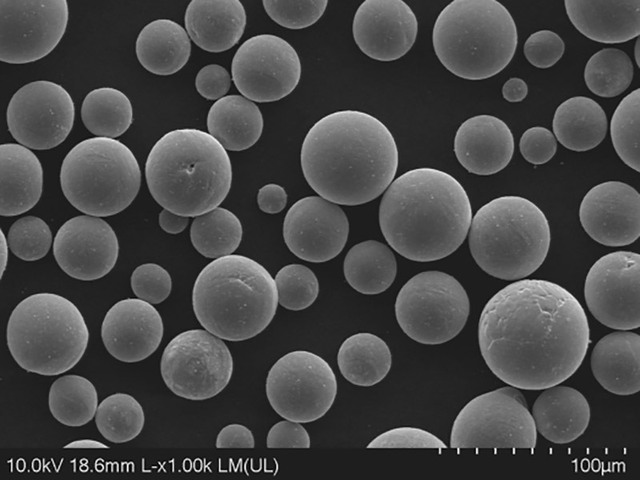
SEM Image
Applications
- Aerospace and Engineering: Used in aerospace machines and high-performance components where lightweight strength and resistance to extreme environments are critical.
- Biomedical and Implants: Applied in medical implants and devices due to its biocompatibility and mechanical durability.
- Electronics and Devices: Integrated into electronic components, sensors, and devices, leveraging titanium’s conductivity and stability.
- Nano-Composites and Advanced Materials: Serves as a reinforcing agent in nano-composites, improving mechanical strength, thermal stability, and corrosion resistance.
- Optical and Glass Applications: Utilized in optical materials and as a glass modification additive, enhancing durability, UV resistance, and performance.
- Sensors and Precision Devices: Employed in micro and nano sensors, benefiting from titanium’s stability and resistance to environmental factors.
- Porcelain Enamels: Used as an opaque and whitening agent in porcelain enamels, providing high gloss, acid resistance, and hardness.
FAQ
Technical FAQ About Titanium (Ti) Micron Powder, 99.5+%, 15-53 µm, Spherical
1) Why is the 15-53 µm spherical particle range important when selecting titanium powder?
A 15-53 µm particle range is commonly evaluated where controlled powder flow, packing behavior and repeatable processing are important. Nanografi NG10MPW1285 combines this size range with spherical morphology and 99.5+% purity for advanced manufacturing and material development applications.
2) Is Nanografi Titanium Micron Powder suitable for additive manufacturing research?
The spherical 15-53 µm morphology makes this grade relevant for research involving powder-based manufacturing routes where flowability and particle-size consistency are important. Final suitability should be confirmed against the requirements of the specific equipment and process.
3) How does spherical morphology affect the handling of titanium micron powder?
Spherical particles generally support more consistent powder flow and packing than irregular particles. For this grade, morphology should be evaluated together with the 15-53 µm size range, density and the requirements of the selected processing method.
4) Can this titanium powder be used in aerospace and high-performance engineering applications?
Yes. Aerospace and engineering applications are among the listed uses for this titanium grade, particularly where low weight, corrosion resistance and mechanical durability are relevant material-selection criteria.
5) Is the 99.5+% titanium grade relevant for biomedical material research?
Yes. Biomedical and implant-related applications are listed for this titanium micron powder. Material selection for biomedical use should additionally consider application-specific purity, surface, processing and regulatory requirements.
6) Which technical parameters should be compared when selecting this titanium grade for thermal or electrical applications?
Useful comparison parameters include density, electrical resistivity, coefficient of thermal expansion, melting point and particle morphology. Nanografi specifies 47.8 μΩ·cm electrical resistivity, 8.5×10⁻⁶ K-1 thermal expansion and 4.507 g/cm³ density for NG10MPW1285.
7) Can this material be considered for sensors and precision-device applications?
Yes. Sensors and precision devices are listed among the application areas. Titanium's environmental stability and the defined 15-53 µm powder specification can be relevant when evaluating it for specialized device or material-integration studies.
8) Is this grade appropriate for composite development?
Yes. Titanium micron powder can be evaluated as a metallic component or reinforcing phase in advanced composite systems where mechanical strength, thermal stability or corrosion resistance are targeted.
9) What should be considered before selecting this titanium powder for a new process?
Selection should consider particle-size range, spherical morphology, purity, impurity limits, thermal properties, electrical resistivity and the requirements of the processing equipment. These parameters are more informative than particle size alone when comparing titanium powder grades.
10) Where can related titanium and elemental micron powder grades be compared?
Related materials can be reviewed in Nanografi's Elemental Micron Powder category, where other titanium and elemental metal powder grades can be compared by particle size, purity and morphology.
Related Products
Related Products
Titanium (Ti) Micron Powder, Purity:99.5+%, Size:5-25 µm, Spherical

Titanium (Ti) Micron Powder, Purity:99.5+%, Size:75-150 µm, Spherical

Nickel (Ni) Micron Powder, Purity: 99.5+%, Size: 15-45 µm, Spherical


Titanium Based Micron Powder, Ti6Al4V (TC4), Size: 15-53 µm, Spherical
