
MXene for EMI Shielding: Materials, Mechanisms and Applications
Electromagnetic interference has become a design constraint rather than an afterthought. Densely packed circuit boards, higher operating frequencies, wireless modules sitting millimetres away from sensitive analogue front-ends and the weight limits of aerospace and wearable hardware have all narrowed the space available for conventional metal shielding cans and thick conductive gaskets. This is the gap that two-dimensional transition metal carbides have moved into.
MXenes entered materials science in 2011, when selective etching of the aluminium layer from a Ti3AlC2 MAX phase produced a layered titanium carbide with a fundamentally different surface chemistry from its precursor [1]. What made the family relevant to shielding was the combination that followed: metallic electrical transport, water-processable colloidal chemistry, and a stacked lamellar architecture that behaves very differently from a single homogeneous conductor when an electromagnetic wave passes through it.
This article covers what EMI shielding is, how conductive materials attenuate electromagnetic radiation, why MXene structure is well matched to that physics, and what a researcher or engineer should actually evaluate when selecting an MXene grade for a shielding study or a scale-up programme.
What Is EMI Shielding?
EMI shielding refers to the attenuation of an electromagnetic field by a barrier placed between an interference source and a susceptible circuit or environment. The performance metric is shielding effectiveness (SE), expressed in decibels as the ratio of incident to transmitted power. Total shielding effectiveness is conventionally decomposed into three contributions: reflection at the material surface, absorption within the material bulk, and multiple internal reflections at internal boundaries.
Electromagnetic interference itself is unwanted electromagnetic energy that couples into a system and degrades its function. It can be radiated through free space or conducted along cables and traces. In practice, EMI shielding materials address the radiated path.
Two shielding regimes matter commercially. Reflection-dominated shielding sends the incident energy back into the surrounding environment, which protects the enclosed circuit but can create secondary interference elsewhere. Absorption-dominated shielding dissipates energy inside the barrier as heat, which is preferable in dense electronics, radar-relevant systems and any assembly where reflected energy would couple into a neighbouring module.
Why EMI Shielding Matters in Modern Electronic Systems
Shielding requirements have tightened because operating frequencies, integration density and regulatory pressure have all increased together. A system that passed emissions testing as a discrete assembly can fail once the same functions are compressed into a single flexible module.
Four pressures shape material selection today. Frequency has shifted upward, so shielding at higher bands and across broader bandwidths is now routine rather than specialised. Integration density has removed the physical separation that once provided isolation for free. Weight and thickness budgets in aerospace, satellite, automotive and wearable platforms can limit the use of heavy metal enclosures and increase demand for lighter shielding solutions. And mechanical requirements have changed, since a shield on a flexible display, a textile sensor or a conformal antenna housing must survive bending, folding and washing without losing electrical continuity.
Metal foils and electroplated coatings still deliver excellent attenuation, but depending on the material and deposition method, they can introduce limitations related to added mass, corrosion, repeated flexing and conformity to complex or soft geometries. Conductive nanomaterial systems exist to fill that space.
Why Are MXenes Suitable for EMI Shielding?
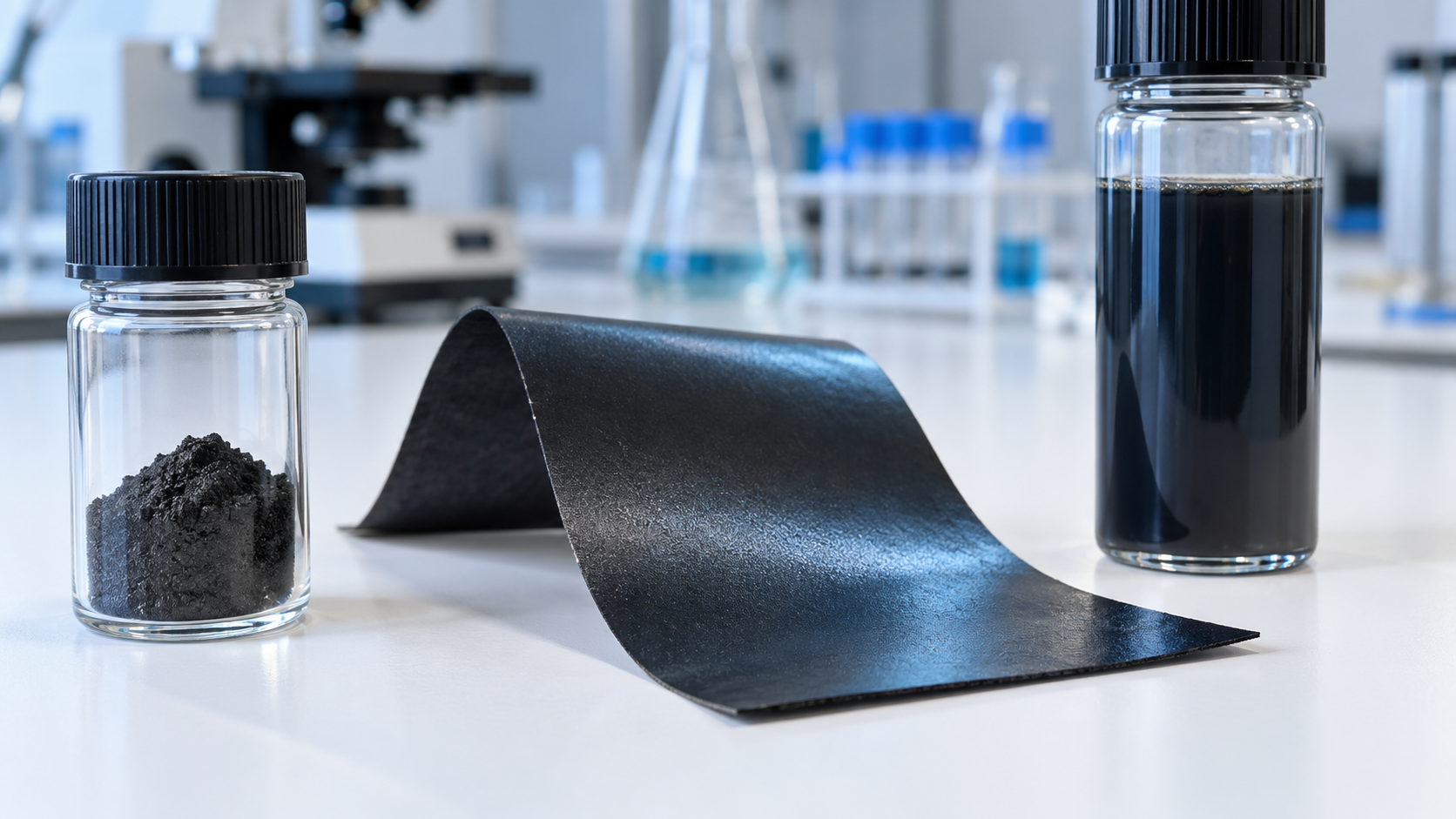
MXenes are suitable for EMI shielding because they combine metallic electrical conductivity with a layered, solution-processable morphology, which lets thin films deliver high attenuation without the mass or rigidity of metal. The general formula is Mn+1XnTx, where M is an early transition metal, X is carbon and/or nitrogen, and Tx denotes surface terminations such as oxygen, hydroxyl and fluorine species.
Ti3C2Tx is the composition most frequently used in shielding research, and it remains the reference point against which other MXene chemistries are compared [6]. It is available in dry form through the MXene powders category and as a pre-dispersed colloid for direct film casting.
Electrical Conductivity
In homogeneous, non-magnetic conductive shields, electrical conductivity, material thickness and operating frequency are among the primary factors governing shielding effectiveness. Both the reflection term and the absorption term scale with conductivity, and conductivity also sets the skin depth, which determines how much material thickness is needed for meaningful absorption at a given frequency.
In free-standing MXene films, conductivity is provided by conductive Ti₃C₂Tₓ flakes and their interflake contacts rather than by a conventional filler network dispersed within an insulating matrix, which is the practical difference from most conductive composites. A free-standing MXene film conducts through overlapping flakes that are themselves metallic, so useful attenuation can be reached in micrometre-scale films where a filled polymer would require far greater thickness or filler loading [3].
Conductivity is a sample property, not a family property. Synthesis route, etchant chemistry, delamination method, flake size, defect density, residual precursor and oxidation state all move the measured value. A conductivity figure reported for one Ti3C2Tx film should not be assumed for a different grade or batch.
Layered Structure
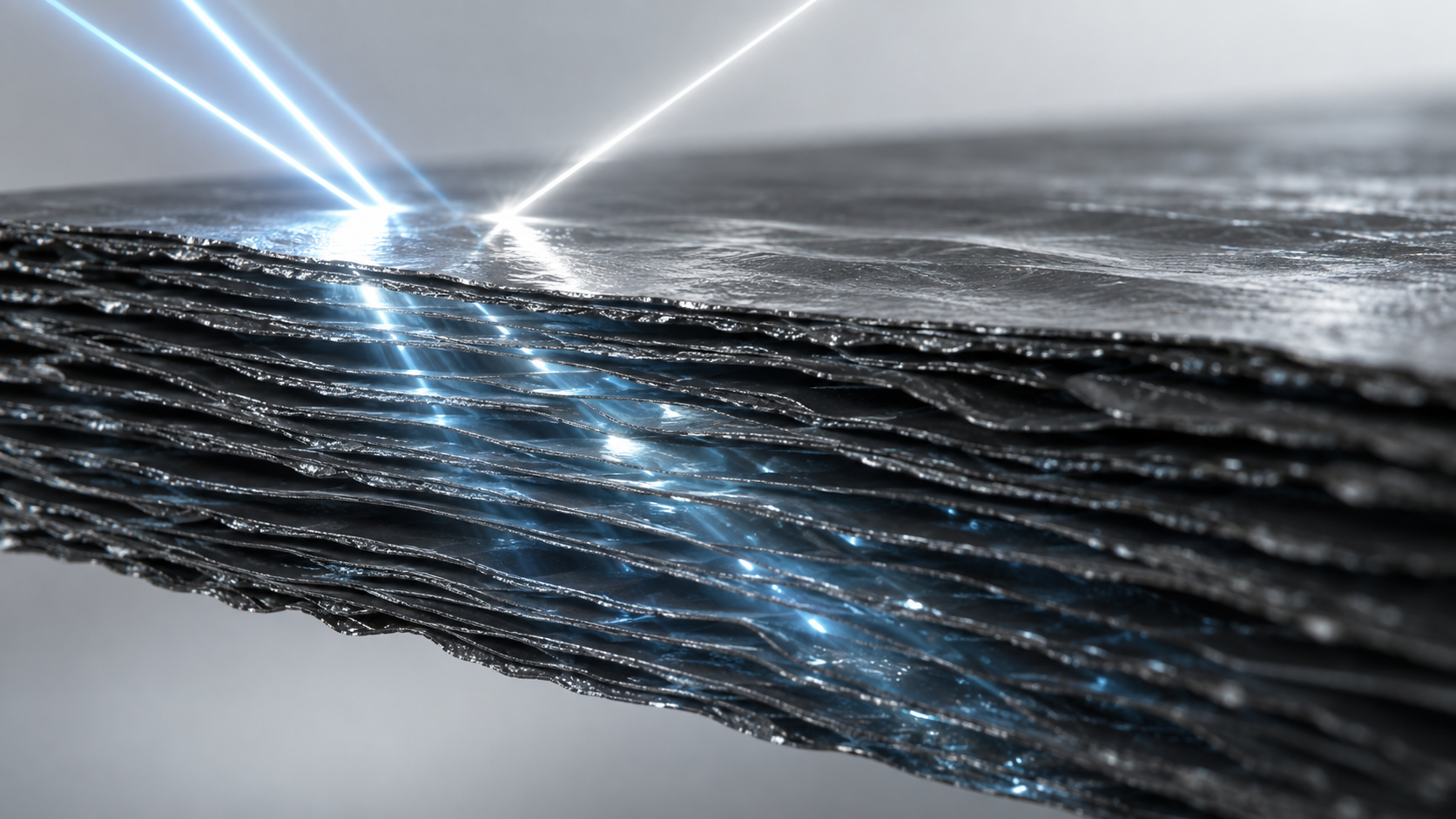
The lamellar architecture of an assembled MXene film can influence electromagnetic-wave propagation through interflake regions and structural discontinuities. Under suitable conductivity and impedance conditions, scattering and internal reflections at these interfaces may extend the effective propagation path and contribute to absorption [4].
This is why shielding performance in MXene films is not a simple function of bulk conductivity alone. Flake alignment, interlayer spacing, film density and the presence of intercalated species all influence how the internal interface population behaves.
Porous architectures can extend this effect. Freeze-cast foams and aerogels introduce cellular pore walls and air–solid interfaces that, when pore structure and conductivity are appropriately controlled, can reduce reflected power and increase the absorbed power fraction [7]. which is why lightweight MXene foam structures are studied specifically where reflected energy would be a problem [7].
Surface Chemistry and Processability
The Tx terminations do more than complete the surface. They give MXene flakes hydrophilic and often negatively charged surfaces, allowing suitably delaminated flakes to form stable aqueous colloids under appropriate pH, ionic-strength and storage conditions, often without surfactants or aggressive sonication. This property substantially reduces the dispersion bottleneck encountered with many carbon nanomaterials.
Practically, this means MXene can be filtered into free-standing paper, spray coated, blade coated, dip coated onto textile and fibre substrates, or spin coated into thin films, all from water-based dispersions and at low temperature [10]. These low-temperature, water-based processes provide an alternative for polymers, fabrics and other substrates that are unsuitable for thermal or vacuum-based metallisation.
Terminations also affect the electronic structure and the interaction with polymer matrices, so surface chemistry is a selection parameter rather than a synthesis detail. Fluorine-rich and oxygen-rich surfaces do not behave identically in composites, dispersions or long-term storage.
How Do MXenes Shield Electromagnetic Interference?
MXenes attenuate electromagnetic interference primarily through reflection and absorption. Their high free-carrier density can produce significant reflection at the entry surface, while electrical and dielectric losses dissipate part of the energy that enters the material. Internal reflections and scattering within the layered structure can modify wave propagation and, under suitable morphological and impedance conditions, contribute to absorption.
Reflection
Reflection occurs at the air-to-material boundary and arises from the impedance mismatch between free space and a conductive medium. Mobile charge carriers at the surface interact with the incident field, and a portion of the wave is returned before entering the material at all.
Reflection is the dominant first-stage mechanism in high-conductivity MXene films. It is efficient, but it does not eliminate the energy, it redirects it. In an assembly where a reflected wave can couple into an adjacent subsystem, reflection-heavy shielding solves one problem and creates another.
Absorption
Absorption converts electromagnetic energy into heat inside the material through ohmic loss and polarisation loss. Conduction loss dominates in dense metallic MXene films, while interfacial polarisation and dipole relaxation associated with surface terminations add dielectric loss contributions.
Absorption scales with thickness, so it is the mechanism that architecture and formulation can most readily be engineered to enhance. Foams, aerogels, segregated composites and gradient or sandwich structures are all approaches to increasing the absorbed fraction relative to the reflected fraction. Ti₃CNTₓ carbonitride MXene has attracted attention because thermal annealing has been shown to produce anomalously high electromagnetic-wave absorption relative to reflection. This result demonstrates that both composition and processing conditions can serve as absorption-design variables [5].
Multiple Internal Reflections
Multiple internal reflections describe repeated reflection and transmission at the front and back surfaces of a shield and at impedance discontinuities within the material. Stacked MXene films contain numerous interlayer regions and flake boundaries, but their electromagnetic significance depends on impedance contrast, morphology and operating frequency.
In classical shielding theory, the multiple-reflection correction becomes important when the shield thickness is comparable to or smaller than the skin depth and absorption loss is low. When absorption is high, internally reflected waves are strongly attenuated and the correction generally becomes negligible. In MXene films, lamellar architecture may modify the propagation path and support absorption, but multiple internal reflections should not be assumed to provide an independent, universally positive contribution to total shielding effectiveness.
MXene-Based EMI Shielding Materials
MXene-based shielding materials fall into three practical categories: free-standing films and coatings, polymer composites, and hybrid or porous architectures. The choice determines processing route, achievable thickness, mechanical behaviour and whether shielding is reflection-dominated or absorption-dominated.
MXene Films and Coatings
Dense, binder-free MXene films and coatings generally provide the highest-conductivity route because they contain no insulating matrix that dilutes the conductive network. Vacuum filtration of a delaminated MXene colloid produces free-standing paper, while spray, blade, dip and spin coating deposit continuous conductive layers onto rigid or flexible substrates.
Coating applications extend beyond flat surfaces. MXene has been deposited onto polyester textiles to produce flexible EMI-shielding fabrics; water resistance can be improved through suitable binders, encapsulation or protective topcoats [10]. Patterned MXene films have also been used as radiating elements in antennas, confirming that the material behaves as a genuine RF conductor rather than only as a lossy barrier [12].
For coating work, MXene suspensions shorten the path to a film because the flakes are already delaminated and dispersed in a defined medium at a known concentration. Powder is the better starting point when the solvent system, concentration or binder chemistry has to be developed rather than adopted.
MXene Polymer Composites
Polymer composites trade peak conductivity for mechanical integrity, processability and durability. The polymer contributes toughness, adhesion and environmental protection, while the MXene contributes the conductive network.
Composite performance depends heavily on architecture rather than loading alone. Nacre-inspired layered composites, in which MXene sheets are aligned and bridged by a compliant polymer or nanofibre phase, retain much of the conductive continuity of a pure film while gaining mechanical robustness [8]. Foamed composites introduce porosity to modify impedance matching and electromagnetic-wave propagation; with appropriate pore structure and conductivity, this approach can increase the absorbed power fraction relative to reflection [9].
The general principles of dispersing a conductive filler in a polymer matrix carry over from carbon nanomaterials, and the overview of graphene reinforced polymer composites provides general principles of matrix compatibility and interface design that can also inform MXene systems, although MXene-specific surface terminations, hydrophilicity and oxidation sensitivity must be evaluated separately.
Hybrid MXene Materials
Hybrid systems combine MXene with a second conductive or structural phase to correct a weakness of the pure material. Pairing MXene flakes with carbon nanotubes is the most common approach: the one-dimensional tubes bridge gaps between two-dimensional flakes, reinforce fragile aerogel walls and maintain conduction paths under deformation [11].
Similar logic applies to MXene combined with graphene derivatives, cellulose nanofibres, magnetic particles or elastomers. Each addition targets something specific, whether that is mechanical resilience, magnetic loss, reduced density, oxidation protection or lower material cost per unit area. For the carbon side of hybrid formulations, both multi-walled carbon nanotubes and graphene nanoplatelets are commonly used as the secondary conductive phase.
MXene vs Graphene and Carbon Nanotubes for EMI Shielding
MXene, graphene and carbon nanotubes are all studied as conductive fillers for shielding, but they differ in dimensionality, intrinsic conductivity, dispersion behaviour and stability. None is universally superior, and the correct choice depends on the processing route and the operating environment as much as on electrical performance.
|
Property |
MXene (Ti3C2Tx) |
Graphene / rGO |
Carbon nanotubes |
|
Dimensionality |
2D flakes, metallic carbide core |
2D sheets, sp2 carbon |
1D tubes, high aspect ratio |
|
Electrical conductivity in films or conductive networks |
Metallic; high in dense assembled films |
High for pristine graphene, substantially lower for rGO |
High along the tube axis, limited by junction resistance |
|
Aqueous dispersion |
Stable without surfactant due to Tx terminations |
Requires surfactant or oxidation; GO disperses but is insulating until reduced |
Requires surfactant or functionalisation |
|
Dominant mechanism |
Strong surface reflection and material-internal absorption in dense films; relative contributions depend on architecture and frequency |
Reflection–absorption balance depends on conductivity, reduction degree, defect density, loading and architecture |
Conduction and polarisation losses can support absorption in composites; dominant behaviour depends on loading and network architecture |
|
Composite loading |
Effective at low volume fraction in aligned or layered architectures |
Required loading varies strongly with flake size, reduction degree, dispersion quality and conductive-network architecture |
Low percolation threshold due to aspect ratio |
|
Density |
Higher, transition metal based |
Low, carbon based |
Low, carbon based |
|
Environmental stability |
Sensitive to oxidation in humid and oxygenated conditions [13] |
Chemically stable |
Chemically stable |
|
Typical strength |
High attenuation from very thin films and coatings |
Cost, availability and thermal performance |
Mechanical reinforcement and low-loading percolation |
The practical reading is that MXene wins where thin, conformal, solution-processed shields are needed and where oxidation can be controlled. Graphene derivatives remain attractive where cost, chemical stability and thermal management dominate, and the comparison of MXene and graphene sets out those trade-offs in more detail. Carbon nanotubes remain the reference choice where mechanical reinforcement and low percolation thresholds matter, as covered in the technical overview of carbon nanotube properties and applications.
When a single material cannot meet the electrical, mechanical and environmental requirements simultaneously, hybridisation may provide a better outcome than direct substitution. A MXene and CNT aerogel is not a compromise between two materials, it is a structure in which the two phases can provide complementary functions.
Applications of MXene-Based EMI Shielding
MXene shielding materials are applied wherever attenuation must be achieved within tight thickness, weight or flexibility constraints. The following areas represent the most active research directions.
Flexible and wearable electronics. Shields on flexible displays, e-skin sensors and smart textiles must bend and stretch without losing conductive continuity. Solution-coated MXene layers on fabric and polymer substrates hold attenuation under deformation, and self-healing conductive network designs address damage tolerance directly, a topic covered in the analysis of self-healing MXene-based conductive networks.
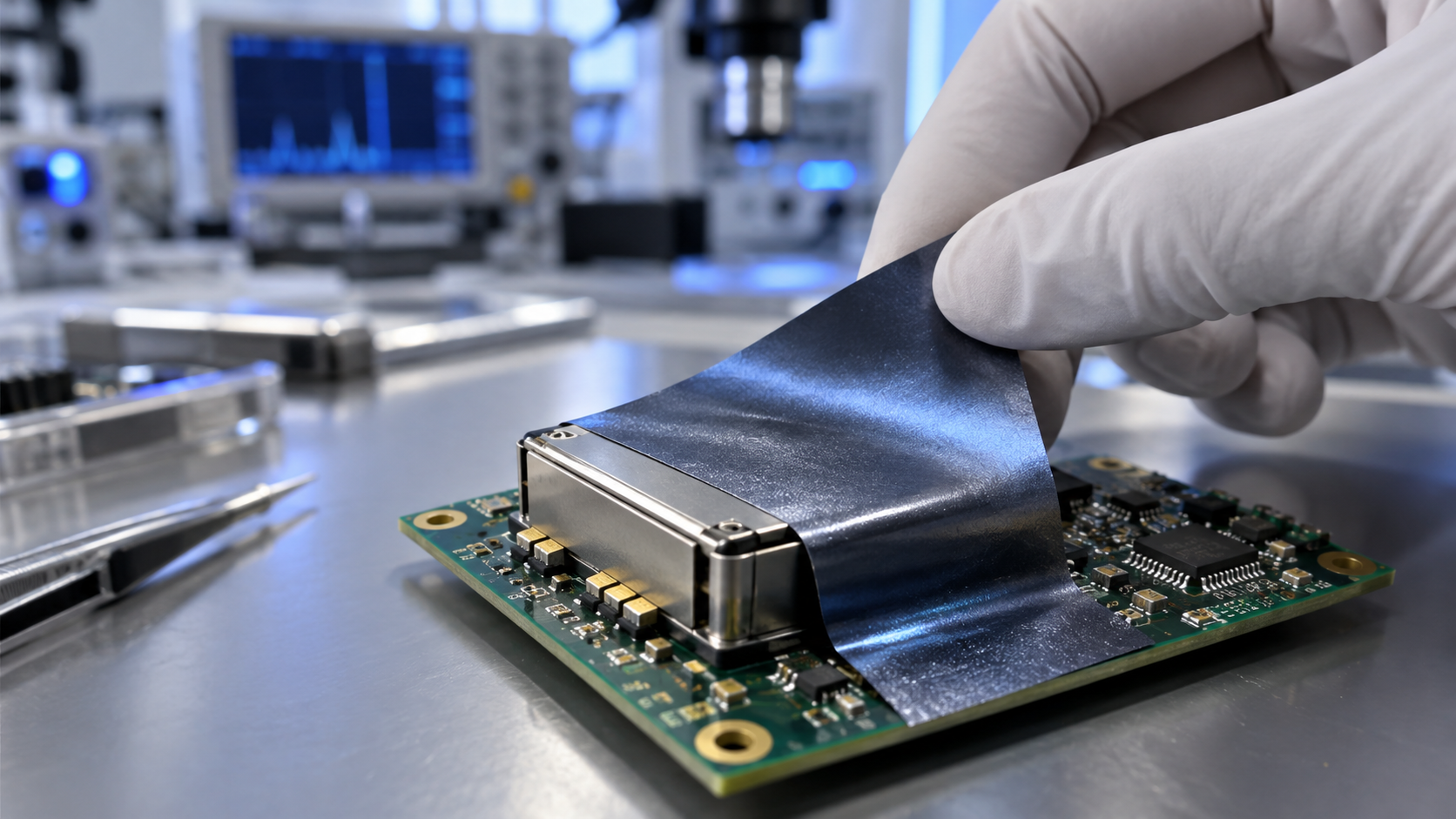
Electronic enclosures and board-level shielding. Conformal coatings can be applied to plastic housings, internal partitions and component-level cans in geometries where metal plating is impractical. In sealed enclosures, internal reflections can increase cavity resonances and coupling between components. MXene structures designed to limit reflection and increase the absorbed power fraction may therefore provide an advantage in such applications.
Aerospace and satellite hardware. Mass is the binding constraint. A coating that delivers the required attenuation at micrometre-scale thickness may reduce the need for heavier metallic shielding or replace it in selected applications, provided that environmental and operational requirements are met.
Automotive electronics. Electric drivetrains, power inverters, battery management systems and ADAS sensor suites create dense, high-power EMI environments inside a vehicle. Thin conformal shields that survive vibration and thermal cycling are of direct interest.
Communication systems. Antenna isolation, filter shielding and shielding at higher frequency bands all benefit from thin, low-mass conductive layers. That MXene can act as the antenna conductor itself [12] indicates the material is compatible with RF design constraints, not merely adjacent to them, which is relevant context for the role of advanced materials in 5G communication systems.
Defence and radar-relevant systems. In radar-absorption and radar-cross-section-reduction applications, low reflection and high absorption are desirable because backscattered energy contributes to the radar signature. This objective shares some material-design principles with graphene-based radar absorbers, including impedance matching and loss optimisation; however, radar absorption and general EMI shielding are not identical design problems.
How to Select an MXene Material for EMI Shielding Applications
MXene selection for EMI shielding should be driven by the intended processing route first and by composition second, because the form of the material determines what is possible downstream.
Composition. Ti3C2Tx is the default starting point for shielding work and has the deepest supporting literature. Ti2CTx and Nb2CTx are different material systems with different electronic structures and should be evaluated independently rather than treated as substitutes [6]. Where a project is exploring composition as a variable rather than optimising a known system, Working across different MAX phases and MXene compositions makes that comparison practical. MAB phases should be treated separately because they are precursors to two-dimensional borides known as MBenes rather than MXenes.
Layer state. Multilayer, accordion-like powder and delaminated single or few-layer flakes behave differently. Multilayer material retains stacked morphology and is appropriate when delamination or intercalation is part of the planned work. Delaminated flakes are generally preferred when a continuous, dense film is to be formed from a colloid.
Powder, dispersion or composite route. This is the decision that most often determines project timeline.
|
Requirement |
Recommended form |
Rationale |
|
Free-standing film by vacuum filtration |
Delaminated suspension |
Flake state and concentration are already defined |
|
Spray, dip or blade coating onto substrate |
Suspension, adjusted for rheology |
Avoids the dispersion development step |
|
Custom solvent or binder system |
Powder |
Full control over medium, concentration and additives |
|
Polymer composite by solution mixing |
Powder or suspension, matched to matrix solvent |
Compatibility with the polymer solvent governs the choice |
|
Delamination or intercalation study |
Multilayer powder |
Starting morphology is the experimental variable |
|
Precursor chemistry or in-house etching |
MAX phase powder |
Etching route and termination chemistry are controlled internally |
Where the study starts from the precursor rather than the finished MXene, MAX phase powders are the relevant input, and the relationship between the two families is explained in the guide to producing MXenes from MAX phases.
Factors beyond conductivity. Conductivity is necessary but not sufficient. Flake lateral size affects film continuity and the number of internal interfaces. Surface termination chemistry affects polymer compatibility and dielectric loss. Oxidation state affects both conductivity and shelf life. Density affects specific shielding effectiveness, which is an important comparison metric when mass is constrained; however, it should be assessed together with absolute SE, thickness and mass per unit area. Adhesion, flexibility and environmental durability determine whether a shield survives its service environment rather than only its first measurement.
Documentation. Composition, purity, particle or flake size distribution, and batch identity should be available on a certificate of analysis before a grade is committed to a study. Where a specification needs clarification before purchase, Nanografi's technical support centre handles grade-level enquiries, and the research output generated using these material families is collected in the publication list, which is a useful reference point when checking whether a given grade has already been used in work comparable to your own.
Technical Considerations for Research and Scale-Up
Moving an MXene shielding result from a laboratory coupon to a manufacturable part introduces constraints that do not appear at research scale.
Oxidation and storage. Ti₃C₂Tₓ MXene can degrade in the presence of dissolved oxygen and water, with oxidation generally initiating at flake edges, forming TiO₂ and reducing conductivity accordingly [13]. Colloids are more vulnerable than dry powder. Cold, dark, deaerated and sealed storage slows the process, and larger flakes with fewer defects degrade more slowly than small, defective ones. Any scale-up plan needs a defined shelf life and a re-qualification point rather than an assumption of indefinite stability.
Batch consistency. Etching and delamination conditions influence flake size distribution, termination population and residual precursor content, all of which propagate into film conductivity. Fixing conductivity targets without fixing the upstream synthesis and handling variables is not reproducible. Sheet resistance measured on a standard-thickness film prepared under controlled deposition and drying conditions is a useful rapid proxy for batch acceptance.
Characterisation set. A defensible shielding claim needs a minimum characterisation package: XRD to confirm conversion from MAX phase and to track interlayer spacing, XPS for surface terminations and the chemical state of residual fluorine, with EDS used as a complementary method for elemental distribution, SEM or TEM for flake morphology and film cross-section, SEM, TEM or AFM image analysis for lateral flake-size distribution, with DLS used only for comparative equivalent hydrodynamic-size monitoring in dispersions, zeta potential for colloidal stability, four-point probe for sheet resistance, and profilometry or cross-sectional imaging for thickness. Shielding effectiveness itself should be reported with the measurement method and frequency range stated, and specific shielding effectiveness normalised by thickness and density should be given whenever weight or thickness is a design constraint.
Process transfer. Vacuum filtration has limited throughput and presents challenges for continuous, large-area production, while spray, blade, dip and roll-based coating methods are generally more scalable. Spray coating, blade coating, dip coating and roll-based deposition do, but each changes flake alignment and film density, and therefore changes measured attenuation. Coating adhesion, substrate pretreatment, drying profile and any protective overcoat all need to be developed alongside the shielding target, not after it.
Cost and volume. Material price per gram should be considered together with the material consumption and total processing cost required to achieve the target SE per unit area. Hybrid formulations containing carbon nanotubes or graphene derivatives may provide a better cost-to-performance balance than pure MXene when composition, dispersion and network architecture are appropriately optimised. Comparative material data across conductive systems is summarised in the overview of conductive materials and their industrial applications.
Sampling and evaluation. Evaluation quantities should be large enough to produce films at the intended thickness with replicates, since single-coupon results carry little weight. For bulk requirements, defined grades, or a specification that does not match a catalogue product, a quotation request is the route to grade-level and volume-level discussion.
Frequently Asked Questions
Why are MXenes effective for EMI shielding? MXenes combine metallic electrical conductivity with a layered flake structure. Conductivity drives reflection at the surface and ohmic absorption inside the material, Internal flake boundaries can modify wave propagation through scattering and internal reflection and, under suitable morphological and impedance conditions, may extend the effective path length and contribute to absorption. The result is useful attenuation from films that are thin and light compared with metal shields.
Which MXene is commonly used for EMI shielding research? Ti3C2Tx titanium carbide MXene is the most widely studied composition for shielding and has the largest body of supporting literature. Ti2CTx and Nb2CTx are investigated as alternative chemistries with different electronic structures, and Thermally treated Ti₃CNTₓ carbonitride MXene has attracted particular interest where absorption-dominated behaviour is required.
Is MXene better than graphene for EMI shielding? Not universally. MXene generally reaches higher attenuation from thinner solution-processed films and disperses in water without surfactants. Graphene and its derivatives are chemically more stable, lower in density and usually lower in cost. MXene is the stronger option where thin conformal shields are needed and oxidation can be managed, while graphene-based materials remain competitive where stability, thermal performance and cost dominate.
Can MXene be used in polymer composites for EMI shielding? Yes. MXene is incorporated into polymer matrices by solution mixing, layer-by-layer assembly, freeze casting and in-situ polymerisation. Composite performance depends more on architecture than on loading alone, with aligned layered structures preserving conductive continuity and Foamed structures that, with appropriate pore structure and conductivity, can increase the absorbed power fraction.
What properties should be considered when selecting MXene for EMI shielding? Composition, layer state, flake lateral size, surface termination chemistry, purity and residual precursor content, oxidation state, density, and the physical form of the material relative to the intended process. Conductivity alone is insufficient, since two materials with the same nominal formula can differ substantially in film-forming behaviour and stability.
Can MXene be used as a conductive coating? Yes. Aqueous MXene dispersions can be spray, dip, blade or spin coated onto polymers, glass, textiles and fibres at low temperature, Potentially producing continuous conductive layers on substrates that are unsuitable for thermal or vacuum-based metallisation, provided that coating and drying conditions are appropriately controlled. Coating adhesion, drying conditions and protection against oxidation are the practical limiting factors.
Where can MXene materials for EMI shielding research be sourced? Nanografi currently lists Ti₃C₂Tₓ, Ti₂CTₓ and Nb₂CTₓ as multilayer powders. Delaminated liquid formats are currently listed for Ti₃C₂Tₓ and Nb₂CTₓ. MAX phase powders are available for groups conducting their own MXene synthesis, while MAB phases belong to the separate precursor family used to produce two-dimensional borides known as MBenes.
References
- Naguib, M.; Kurtoglu, M.; Presser, V.; Lu, J.; Niu, J.; Heon, M.; Hultman, L.; Gogotsi, Y.; Barsoum, M. W. "Two-Dimensional Nanocrystals Produced by Exfoliation of Ti3AlC2." Advanced Materials, 23(37), 4248-4253, 2011. https://doi.org/10.1002/adma.201102306
- Alhabeb, M.; Maleski, K.; Anasori, B.; Lelyukh, P.; Clark, L.; Sin, S.; Gogotsi, Y. "Guidelines for Synthesis and Processing of Two-Dimensional Titanium Carbide (Ti3C2Tx MXene)." Chemistry of Materials, 29(18), 7633-7644, 2017. https://doi.org/10.1021/acs.chemmater.7b02847
- Shahzad, F.; Alhabeb, M.; Hatter, C. B.; Anasori, B.; Hong, S. M.; Koo, C. M.; Gogotsi, Y. "Electromagnetic interference shielding with 2D transition metal carbides (MXenes)." Science, 353(6304), 1137-1140, 2016. https://doi.org/10.1126/science.aag2421
- Iqbal, A.; Sambyal, P.; Koo, C. M. "2D MXenes for Electromagnetic Shielding: A Review." Advanced Functional Materials, 30(47), 2000883, 2020. https://doi.org/10.1002/adfm.202000883
- Iqbal, A.; Shahzad, F.; Hantanasirisakul, K.; Kim, M.-K.; Kwon, J.; Hong, J.; Kim, H.; Kim, D.; Gogotsi, Y.; Koo, C. M. "Anomalous absorption of electromagnetic waves by 2D transition metal carbonitride Ti3CNTx (MXene)." Science, 369(6502), 446-450, 2020. https://doi.org/10.1126/science.aba7977
- Han, M.; Shuck, C. E.; Rakhmanov, R.; Parchment, D.; Anasori, B.; Koo, C. M.; Friedman, G.; Gogotsi, Y. "Beyond Ti3C2Tx: MXenes for Electromagnetic Interference Shielding." ACS Nano, 14(4), 5008-5016, 2020. https://doi.org/10.1021/acsnano.0c01312
- Liu, J.; Zhang, H.-B.; Sun, R.; Liu, Y.; Liu, Z.; Zhou, A.; Yu, Z.-Z. "Hydrophobic, Flexible, and Lightweight MXene Foams for High-Performance Electromagnetic-Interference Shielding." Advanced Materials, 29(38), 1702367, 2017. https://doi.org/10.1002/adma.201702367
- Cao, W.-T.; Chen, F.-F.; Zhu, Y.-J.; Zhang, Y.-G.; Jiang, Y.-Y.; Ma, M.-G.; Chen, F. "Binary Strengthening and Toughening of MXene/Cellulose Nanofiber Composite Paper with Nacre-Inspired Structure and Superior Electromagnetic Interference Shielding Properties." ACS Nano, 12(5), 4583-4593, 2018. https://doi.org/10.1021/acsnano.8b00997
- Xu, H.; Yin, X.; Li, X.; Li, M.; Liang, S.; Zhang, L.; Cheng, L. "Lightweight Ti2CTx MXene/Poly(vinyl alcohol) Composite Foams for Electromagnetic Wave Shielding with Absorption-Dominated Feature." ACS Applied Materials & Interfaces, 11(10), 10198-10207, 2019. https://doi.org/10.1021/acsami.8b21671
- Wang, Q.-W.; Zhang, H.-B.; Liu, J.; Zhao, S.; Xie, X.; Liu, L.; Yang, R.; Koratkar, N.; Yu, Z.-Z. "Multifunctional and Water-Resistant MXene-Decorated Polyester Textiles with Outstanding Electromagnetic Interference Shielding and Joule Heating Performances." Advanced Functional Materials, 29(7), 1806819, 2019. https://doi.org/10.1002/adfm.201806819
- Sambyal, P.; Iqbal, A.; Hong, J.; Kim, H.; Kim, M.-K.; Hong, S. M.; Han, M.; Gogotsi, Y.; Koo, C. M. "Ultralight and Mechanically Robust Ti3C2Tx Hybrid Aerogel Reinforced by Carbon Nanotubes for Electromagnetic Interference Shielding." ACS Applied Materials & Interfaces, 11(41), 38046-38054, 2019. https://doi.org/10.1021/acsami.9b12550
- Sarycheva, A.; Polemi, A.; Liu, Y.; Dandekar, K.; Anasori, B.; Gogotsi, Y. "2D titanium carbide (MXene) for wireless communication." Science Advances, 4(9), eaau0920, 2018. https://doi.org/10.1126/sciadv.aau0920
- Zhang, C. J.; Pinilla, S.; McEvoy, N.; Cullen, C. P.; Anasori, B.; Long, E.; Park, S.-H.; Seral-Ascaso, A.; Shmeliov, A.; Krishnan, D.; Morant, C.; Liu, X.; Duesberg, G. S.; Gogotsi, Y.; Nicolosi, V. "Oxidation Stability of Colloidal Two-Dimensional Titanium Carbides (MXenes)." Chemistry of Materials, 29(11), 4848-4856, 2017. https://doi.org/10.1021/acs.chemmater.7b00745
- Al-Saleh, M. H.; Sundararaj, U. "Electromagnetic interference shielding mechanisms of CNT/polymer composites." Carbon, 47(7), 1738-1746, 2009. https://doi.org/10.1016/j.carbon.2009.02.030
Recent Posts
-

Advanced Materials for Humanoid Robots: Actuators, Sensors and E-Skin
Humanoid robots are leaving the lab. They now walk warehouse floors, handle parts on assembly lines …23rd Oct 2026 -
What Is Conductive Masterbatch? CNT, Carbon Black and Graphene Compared
A conductive masterbatch is a concentrated blend of a conductive carbon additive and a carrier polym …14th Oct 2026 -

Biomaterials for Implants: Titanium vs Nitinol vs Hydroxyapatite Coatings
Implantable medical devices operate under very different mechanical and biological conditions. A hip …7th Oct 2026