
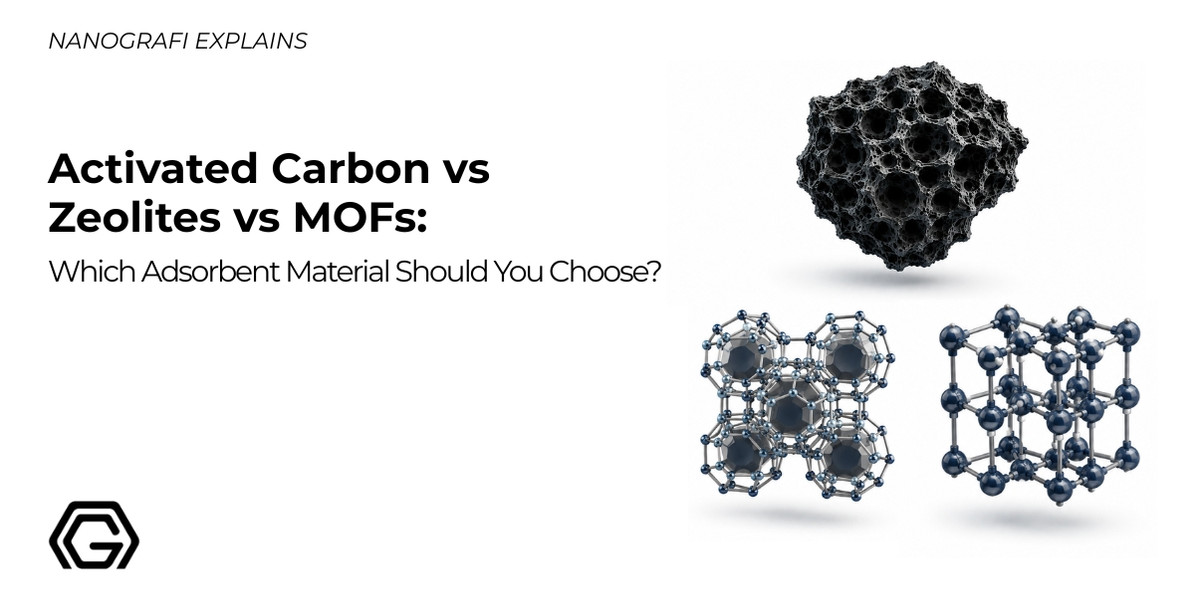
Activated Carbon vs Zeolites vs MOFs: Which Adsorbent Material Should You Choose?
Activated carbon, zeolites and metal-organic frameworks (MOFs) represent three distinct adsorbent classes with substantially different pore architectures, surface chemistries and regeneration characteristics.
Although these materials are frequently compared on the basis of BET surface area, adsorption performance under practical process conditions depends on a broader set of parameters, including pore-size distribution, adsorbate–surface interactions, humidity, working capacity, regeneration requirements and cycle stability.
Activated carbon remains a mature and cost-effective option for broad-spectrum adsorption, particularly where material cost and commercial availability are key selection criteria. Zeolites provide crystallographically defined pore apertures and are therefore highly effective in molecular sieving, drying and selective gas separation. MOFs offer considerably greater structural and chemical tunability and become technically relevant where framework-specific selectivity, working capacity or lower regeneration energy in selected frameworks and processes provide a measurable process advantage.
Accordingly, adsorbent selection should be based on process-specific performance rather than on a single headline property.
Activated Carbon vs Zeolites vs MOFs: Structure and Pore Architecture Compared
|
Property |
Activated carbon |
Zeolites |
MOFs |
|
Structure |
Amorphous, disordered carbon |
Crystalline aluminosilicate |
Crystalline metal node plus organic linker |
|
Typical BET surface area |
500 to 2,500 m²/g |
300 to 800 m²/g (13X measured at 472 m²/g, 5A at 411 m²/g) |
1,000 to 7,800 m²/g (DUT-60 holds the record at about 7,800 m²/g) |
|
Pore size control |
Distributed and non-uniform; governed by precursor and activation
|
Well-defined, governed by framework topology and cation |
Highly tunable; governed by linker geometry/length, metal node, topology and framework flexibility
|
|
Surface polarity |
Heterogeneous; hydrophobic graphitic domains coexist with polar oxygen-containing surface groups
|
Generally polar; hydrophilicity depends on Si/Al ratio and extra-framework cation identity
|
Highly tunable, from hydrophilic to hydrophobic, depending on framework chemistry and functionalization
|
|
Regeneration |
Thermal reactivation, 450 to 900 °C |
Thermal swing, typically around 280 °C |
Often 55 to 150 °C |
|
Indicative cost |
1 to 5 USD/kg |
2 to 10 USD/kg |
100 to 500 USD/kg at current market volumes
|
These values should be treated as general ranges rather than purchasing specifications. Performance can vary substantially between grades within the same material family.
How Pore Structure Changes Adsorption Performance
Activated Carbon
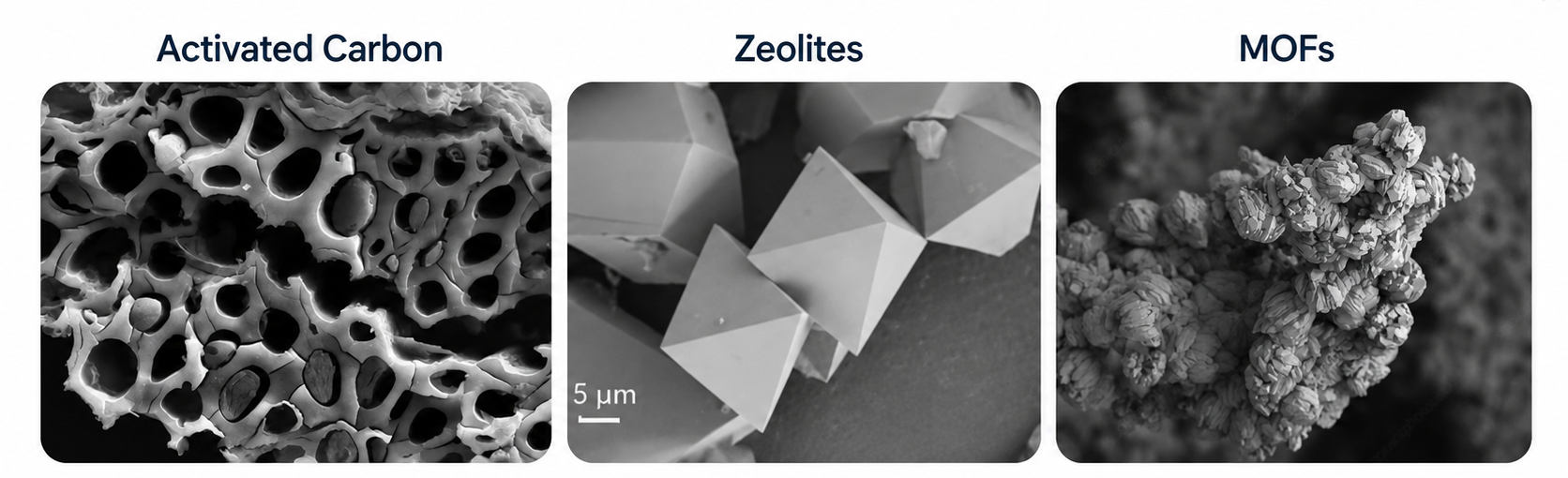
Activated carbon is a disordered carbon skeleton in which porosity is developed during carbonization and subsequent physical or chemical activation. There is no unit cell and no crystallographic pore. What exists is a heterogeneous distribution of pores, with micropores often approximated using slit-shaped pore models and that distribution is set by the raw material and the activation chemistry. Steam-actiavted coconut-shell carbons are typically predominantly microporous, whereas phosphoric-acid activation of lignocellulosic precursors such as wood can generate a broader micro-/mesopore distribution with greater mesoporosity. This pore-size tendency can favor coconut-shell carbons for the adsorption of smaller molecules, whereas more mesoporous wood-based carbons may provide better accessibility for larger molecules such as dyes and colour bodies.
Zeolites
Zeolites are the opposite case. Their pores are crystallographic features with fixed dimensions, and the International Zeolite Association reports the maximum sphere that can diffuse through each framework: 4.21 Å for LTA, 7.35 Å for FAU (the framework behind 13X and Y), and 4.70 Å for MFI (ZSM-5). Cation exchange changes the effective aperture by altering the identity, number and location of extra-framework cations; in LTA, K⁺ exchange produces 3A (~3 Å), the Na⁺ form corresponds to 4A (~4 Å), and partial Ca²⁺ exchange produces 5A (~5 Å). When a separation depends on molecular size, the well-defined apertures of zeolites can provide highly effective molecular-sieving selectivity.
Metal-Organic Frameworks
Metal-organic frameworks sit between design freedom and engineering risk. Because the pore is defined by a metal node bridged by an organic linker, both the aperture and the internal chemistry can be changed deliberately. MOF-210 reaches 6,240 m²/g BET with a pore volume of 3.60 cm³/g, and ZIF-8 combines a 1,630 m²/g surface with an 11.6 Å connected through a crystallographic aperture of about 3.4 Å, providing a well-defined molecular-sieving geometry that is fundamentally different from the heterogeneous pore network of amorphous activated carbon. The 2025 Nobel Prize in Chemistry, awarded to Susumu Kitagawa, Richard Robson and Omar M. Yaghi for the development of metal-organic frameworks, marked the point at which the class moved from laboratory curiosity to industrial infrastructure.
Why BET Surface Area Is Not a Direct Predictor of Adsorbent Performance
BET surface area remains one of the most widely reported characterisation parameters for porous materials, but it should not be treated as a direct measure of process performance.
IUPAC classifies pores below approximately 2 nm as micropores, pores between 2 and 50 nm as mesopores, and pores above 50 nm as macropores. These pore classes influence both adsorption capacity and mass-transfer behaviour.
Microporous materials typically exhibit strong uptake at relatively low partial pressures, making them attractive for trace contaminant removal, VOC capture and gas adsorption.
However, maximum equilibrium capacity does not necessarily correspond to high usable capacity during cyclic operation.
For adsorption processes involving repeated loading and regeneration, working capacity is generally more relevant. Working capacity represents the difference between adsorption loading under process conditions and residual loading after regeneration.
A material may therefore exhibit high equilibrium uptake while providing limited practical capacity if the adsorption isotherm remains relatively flat across the operating swing window or if desorption requires severe regeneration conditions.
BET surface area should consequently be considered alongside pore-size distribution, surface chemistry, adsorption isotherm shape and regeneration behaviour.
A further limitation arises in very narrow micropores, where adsorption occurs predominantly through pore filling rather than the multilayer adsorption behaviour assumed by the BET model. For this reason, cross-comparison of BET values between different adsorbent classes should be interpreted carefully.
How Humidity Affects Activated Carbon, Zeolite and MOF Adsorption Capacity
Humidity is one of the most important variables in practical adsorbent selection.
Many laboratory adsorption studies are conducted under dry conditions, whereas industrial gas streams commonly contain significant quantities of water vapour. Competitive adsorption by water can therefore substantially alter both capacity and selectivity.
Zeolites
Water affinity in zeolites is strongly influenced by the Si/Al ratio.
Framework aluminium introduces negative charge that must be balanced by cations, and these cations interact strongly with water molecules. Low-silica zeolites therefore exhibit high water affinity and are highly effective as desiccants.
The same characteristic can become a limitation when the target molecule is a VOC or CO₂, because water competes directly for adsorption sites.
By contrast, high-silica and dealuminated zeolites generally exhibit greater hydrophobicity and can therefore perform more effectively in selected organic adsorption applications.
Activated carbon
Activated carbon is commonly described as hydrophobic, but this behaviour depends on surface chemistry.
Oxygen-containing functional groups introduced during activation can promote water adsorption and the formation of water clusters inside the pore structure. At elevated relative humidity, these clusters may occupy adsorption sites and reduce the capacity available for organic molecules.
The magnitude of this effect depends on carbon precursor, activation route and post-treatment conditions.
For humid-service applications, activated carbon should therefore be evaluated according to both pore structure and surface chemistry rather than surface area alone.
MOFs
MOFs show the greatest variability in water stability.
Some frameworks, such as MOF-5, are highly sensitive to moisture, while others exhibit substantially greater hydrothermal stability. ZIF-8, for example, exhibits relatively high water and chemical stability compared with many MOFs, although its stability remains condition-dependent while CALF-20 has demonstrated CO₂ selectivity under humid conditions.
Water tolerance should therefore be treated as a framework-specific property rather than a general characteristic of MOFs.
For practical applications, stability should be confirmed under the expected humidity and temperature conditions before material selection.
Adsorbent Regeneration Temperature and Cycle Life Compared
Spent activated carbon is thermally reactivated at 450 to 900 °C. A systematic study on exhausted water treatment carbon reported reactivation yields of 84.9 to 92.1 percent mass yield per cycle, meaning 8 to 15 percent across different reactivation conditions, with BET surface area recovering to approximately 70 to 91 percent of the fresh-carbon value.
Zeolites regenerate by thermal swing at far lower temperatures. Over 2,000 rapid cycles at 280 °C, zeolite 4A lost 7 percent of its water capacity while 13X lost 19 percent, approximately 2.7-fold greater capacity loss for 13X under these experimental conditions.
The MOF argument is strongest here. MIL-101(Cr) regenerates under nitrogen stripping at 55 °C or by vacuum-temperature swing at 75 °C, and retained about 99 percent of its capacity over five cycles in a stream containing 10 percent CO2, 100 ppm SO2, 100 ppm NO and 10 percent relative humidity. For CO₂ capture processes, complete regeneration of MIL-101(Cr) at 75 °C under VTSA can substantially reduce the temperature requirement of the regeneration step; this low-temperature regenerability, rather than surface area alone, is an important potential process advantage of selected MOFs.
CO2 Capacity, Cost per Kilogram and Supply Maturity Compared
Activated carbons, zeolites and MOFs are all actively used or investigated for CO₂ capture, but their technical and economic positions differ.
Comparative studies report overlapping CO₂ capacity ranges for activated carbon and zeolites, while selected MOFs can reach higher uptake under optimised conditions.
However, adsorption capacity alone does not determine process viability.
Activated carbon benefits from low material cost, mature manufacturing infrastructure and broad commercial availability. Zeolites similarly offer established industrial production and well-characterised performance in gas separation and drying applications.
Many MOFs remain more expensive than activated carbons and zeolites at current commercial scales, although cost varies strongly with framework chemistry, synthesis route and production scale
At the same time, commercial MOF manufacturing has expanded considerably. Industrial-scale production by companies such as BASF, together with increasing deployment in carbon capture and semiconductor gas handling, demonstrates that selected MOF systems are moving beyond laboratory-scale applications.
The key economic comparison is therefore application-specific.
In high-volume and cost-sensitive applications, activated carbon and zeolites remain difficult to replace. In applications where lower regeneration energy, higher selectivity or reduced equipment requirements generate measurable process savings, the higher initial cost of a MOF may be technically justified.
How to Choose Between Activated Carbon, Zeolites and MOFs
Choose activated carbon when the target is a broad mixture of organics, the concentration is low, the stream is close to ambient temperature, and cost per kilogram governs. It is one of the EPA-designated best available technology for PFAS in drinking water, with reported maximum removal efficiencies above 99% for PFOA and PFOS, although performance is generally lower and breakthrough occurs earlier for shorter-chain PFAS. Format matters more than most buyers expect: granular pellets suit fixed beds with a pressure drop constraint, micron powders suit batch dosing where kinetics dominate, and sub-100 nm activated carbon nanopowders suit electrode and composite work where external surface and dispersion matter more than bed hydraulics. Hybrid formats such as activated carbon and carbon nanotube composites address the conductivity limitation of pure carbon in supercapacitor and electrochemical applications, and the same logic underlies carbon nanotube membranes in water purification.
Choose a zeolite when the separation is size-based and the feed is dry, or when water itself is the target. Pressure swing adsorption oxygen concentrators run on 13X and lithium-exchanged X because the exchangeable cations interact strongly with the nitrogen quadrupole and weakly with oxygen, producing roughly 90 volume percent oxygen from air with no cryogenic step. Zeolites are also the default molecular sieve for solvent drying and natural gas dehydration, and their aluminium content is the design knob, not a defect.
Choose a MOF when the process is swing-based and regeneration energy dominates operating cost, when the required selectivity cannot be achieved with a fixed aluminosilicate aperture, or when the application is genuinely new. CALF-20 delivers 2.6 mmol/g CO2 at 0.15 bar and 298 K with an IAST CO2/N2 selectivity around 222, and has been deployed at commercial scale. MOF-303 harvested 0.11 to 0.29 L of water per kilogram per day from Death Valley at an average night-time relative humidity of 14%, with productivity reaching up to 0.210 L kg⁻¹ day⁻¹ across the Death Valley tests. Framework families such as ZIF-8, ZIF-67 and ZIF-L give a practical starting set for gas separation, catalysis and sensing work, and the design space is discussed further in the context of porosity engineering for carbon capture and quantum applications.
Adsorbent Materials from Nanografi
Nanografi supplies materials for adsorption, separation, electrochemical and composite research across several material classes and physical formats.
The portfolio includes activated carbon in pellet, micron-powder and nanopowder forms, ZIF-family metal-organic frameworks and carbon-based nanomaterials and composites.
Material selection should therefore extend beyond a single headline value such as BET surface area. Particle size, purity, pore characteristics, surface chemistry, stability and intended operating conditions should all be evaluated together.
Where a process lies close to a material-selection boundary, comparing multiple candidate grades under representative humidity, temperature and concentration conditions can provide more meaningful information than relying solely on published equilibrium adsorption values.
Frequently Asked Questions
What is the difference between activated carbon, zeolites and MOFs?
Activated carbon is an amorphous porous carbon whose pore distribution is determined primarily by precursor and activation conditions. Zeolites are crystalline aluminosilicates with well-defined pore apertures. MOFs are crystalline frameworks composed of metal nodes and organic linkers, allowing pore architecture and internal chemistry to be designed more deliberately.
Which adsorbent has the highest surface area?
MOFs can reach substantially higher BET surface areas than most activated carbons and common zeolites. However, higher surface area does not necessarily result in better adsorption performance because pore accessibility, surface chemistry and working capacity are also critical.
Does higher BET surface area mean better adsorption performance?
Not necessarily. Adsorption performance depends on the relationship between pore dimensions and target molecules, surface chemistry, operating conditions and the shape of the adsorption isotherm. For cyclic processes, working capacity is often more relevant than maximum equilibrium capacity.
Which adsorbent performs best under humid conditions?
Performance depends on the specific material rather than only on the adsorbent class. Low-silica zeolites strongly adsorb water, activated carbon can lose capacity as humidity rises, and MOF water stability varies considerably between individual frameworks.
Which adsorbent is most suitable for CO₂ capture?
There is no single best material for every CO₂ capture process. Zeolites can provide strong adsorption under dry conditions, activated carbon offers cost and scalability advantages, and selected water-stable MOFs can provide high selectivity and lower regeneration requirements.
What is working capacity?
Working capacity is the difference between adsorption loading under process conditions and residual loading after regeneration. It represents the amount of adsorbate that can actually be cycled and therefore has direct implications for vessel size, cycle time and regeneration energy.
Which particle size or format should be specified?
Granules and pellets are generally preferred for fixed-bed systems where pressure drop is important. Micron powders can improve mass transfer in batch processes, while nanopowders are more relevant to electrodes, coatings and composite materials where dispersion and external surface area are critical.
What should be included in an adsorbent purchasing specification?
The specification should reflect the intended operating environment. Particle size, pore structure, surface area, chemistry, stability, regeneration behaviour and material-specific parameters such as precursor, cation form or MOF framework should all be considered.
References
- Thommes, M. et al. Physisorption of gases, with special reference to the evaluation of surface area and pore size distribution (IUPAC Technical Report). Pure and Applied Chemistry 87 (2015) 1051. DOI: 10.1515/pac-2014-1117
- Furukawa, H. et al. Ultrahigh Porosity in Metal-Organic Frameworks. Science 329 (2010) 424. DOI: 10.1126/science.1192160
- Hoenicke, I. M. et al. Balancing Mechanical Stability and Ultrahigh Porosity in Crystalline Framework Materials. Angewandte Chemie International Edition (2018). DOI: 10.1002/anie.201808240
- Park, K. S. et al. Exceptional chemical and thermal stability of zeolitic imidazolate frameworks. PNAS 103 (2006) 10186. DOI: 10.1073/pnas.0602439103
- Structure Commission of the International Zeolite Association. Database of Zeolite Structures, framework types LTA, FAU and MFI. https://www.iza-structure.org/databases/
- Li, J., Gao, M., Yan, W., Yu, J. Regulation of the Si/Al ratios and Al distributions of zeolites and their impact on properties. Chemical Science 14 (2023) 1935. DOI: 10.1039/D2SC06010H
- Hang, W. et al. Selective Adsorption of VOCs/Water Vapor on Activated Carbon: The Role of Adsorbent and VOC Molecular Polarity. Separations 12 (2025) 86. DOI: 10.3390/separations12040086
- Yang, X. et al. Competitive Adsorption of Moisture and SO2 for Carbon Dioxide Capture by Zeolites FAU 13X and LTA 5A. Processes 12 (2024) 1547. DOI: 10.3390/pr12081547
- Al-Janabi, N. et al. Mapping the Cu-BTC metal-organic framework (HKUST-1) stability envelope in the presence of water vapour for CO2 adsorption from flue gases. Chemical Engineering Journal 281 (2015) 669. DOI: 10.1016/j.cej.2015.07.020
- Kaye, S. S., Dailly, A., Yaghi, O. M., Long, J. R. Impact of Preparation and Handling on the Hydrogen Storage Properties of MOF-5. JACS 129 (2007) 14176. DOI: 10.1021/ja076877g
- Rathinam, K. et al. Eliminating Luck and Chance in the Reactivation Process: A Systematic and Quantitative Study of the Thermal Reactivation of Activated Carbons. C: Journal of Carbon Research 9 (2023) 115. DOI: 10.3390/c9040115
- Jacobs, J. H. et al. Rapid Cycling Thermal Swing Adsorption Apparatus: Commissioning and Data Analyses for Water Adsorption of Zeolites 4A and 13X Over 2000 Cycles. Industrial and Engineering Chemistry Research 60 (2021) 7487. DOI: 10.1021/acs.iecr.1c00469
- Liu, Q. et al. Adsorption of Carbon Dioxide by MIL-101(Cr): Regeneration Conditions and Influence of Flue Gas Contaminants. Scientific Reports 3 (2013) 2916. DOI: 10.1038/srep02916
- Mouctar, M. H. et al. Comparative Assessment and Deployment of Zeolites, MOFs, and Activated Carbons for CO2 Capture and Geological Sequestration Applications. Inventions 10 (2025) 78. DOI: 10.3390/inventions10050078
- Lin, J.-B. et al. A scalable metal-organic framework as a durable physisorbent for carbon dioxide capture. Science 374 (2021) 1464. DOI: 10.1126/science.abi7281
- Oktavian, R. et al. Gas adsorption and framework flexibility of CALF-20 explored via experiments and simulations. Nature Communications 15 (2024) 3898. DOI: 10.1038/s41467-024-48136-0
- DeSantis, D. et al. Techno-economic Analysis of Metal-Organic Frameworks for Hydrogen and Natural Gas Storage. Energy and Fuels 31 (2017) 2024. DOI: 10.1021/acs.energyfuels.6b02510
- Pan, M., Omar, H. M., Rohani, S. Application of Nanosize Zeolite Molecular Sieves for Medical Oxygen Concentration. Nanomaterials 7 (2017) 195. DOI: 10.3390/nano7080195
- Song, W., Zheng, Z., Alawadhi, A. H., Yaghi, O. M. MOF water harvester produces water from Death Valley desert air in ambient sunlight. Nature Water (2023). DOI: 10.1038/s44221-023-00103-7
- Chew, T. W. et al. A Review of Bio-Based Activated Carbon Properties Produced from Different Activating Chemicals during Chemicals Activation Process on Biomass and Its Potential for Malaysia. Materials 16 (2023) 7365. DOI: 10.3390/ma16237365
- Saenz Cavazos, P. A. et al. Evaluating solid sorbents for CO2 capture: linking material properties and process efficiency via adsorption performance. Frontiers in Energy Research 11 (2023) 1167043. DOI: 10.3389/fenrg.2023.1167043
- Athar, M. et al. Thermal degradation of defective high-surface-area UiO-66 in different gaseous environments. RSC Advances 11 (2021) 38849. DOI: 10.1039/D1RA05411B
- US Environmental Protection Agency. Best Available Technologies and Small System Compliance Technologies for PFAS in Drinking Water. EPA 815R24011 (2024).
- US Environmental Protection Agency. Technologies and Costs for Removing PFAS from Drinking Water. EPA-815R24012 (2024).
- A market for metal-organic frameworks (Editorial). Nature Materials 24 (2025) 157. DOI: 10.1038/s41563-025-02147-4
- Morris, W., Lee, J.-S. Bringing metal-organic frameworks to commercialization. Communications Materials 6 (2025) 8. DOI: 10.1038/s43246-024-00716-9
- BASF. BASF becomes first company to successfully produce metal-organic frameworks on a commercial scale for carbon capture. Press release P-23-327 (2023).
- Svante Technologies. Svante Launches World's First Commercial Gigafactory for Carbon Capture and Removal Filters. Press release (2025).
- The Royal Swedish Academy of Sciences. The Nobel Prize in Chemistry 2025: Susumu Kitagawa, Richard Robson and Omar M. Yaghi, for the development of metal-organic frameworks. https://www.nobelprize.org/prizes/chemistry/2025/press-release/
Recent Posts
-
CNT Paste vs Silver Paste vs Carbon Paste: Which Conductive Adhesive Should You Use?
Conductive pastes quietly hold much of modern electronics together. They bond chips to substrates, d …1st Oct 2026 -
ZnO Nanoparticles in OLED and Perovskite Solar Cells
Many printed solar cells and inverted display stacks need a layer that collects electrons and passes …23rd Sep 2026 -
MXene for EMI Shielding: Materials, Mechanisms and Applications
Electromagnetic interference has become a design constraint rather than an afterthought. Densely pac …10th Sep 2026