
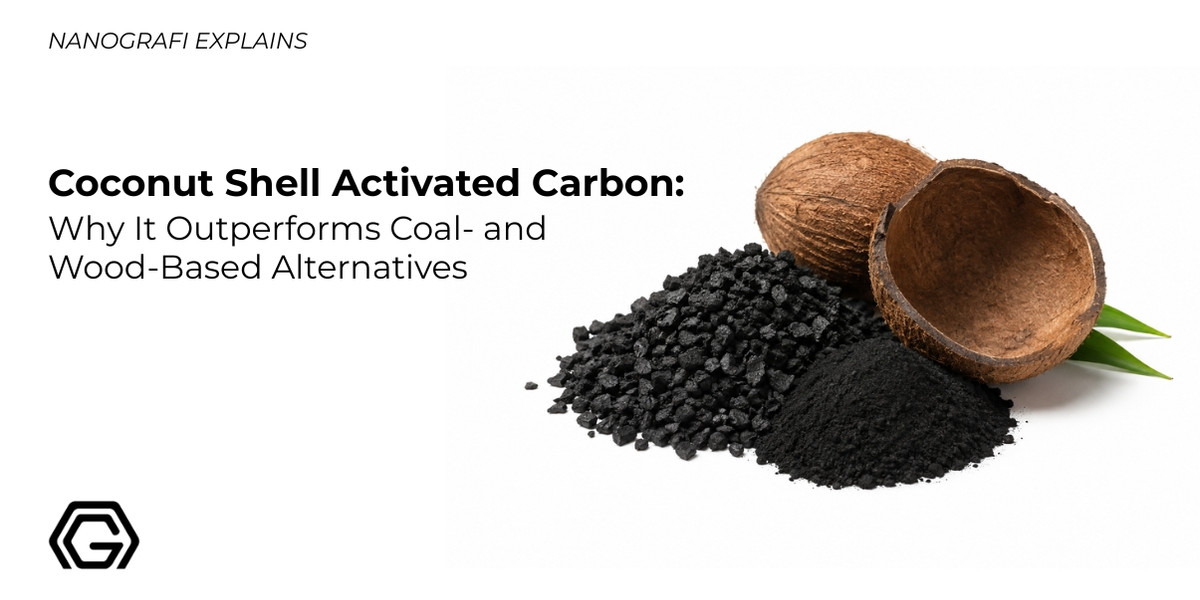
Coconut Shell Activated Carbon: Why It Outperforms Coal- and Wood-Based Alternatives
Not all activated carbon starts from the same place, and the raw material behind it matters more than most technical spec sheets let on. Coconut shell, bituminous coal, and wood all turn into "activated carbon" after carbonization and activation, but the internal pore architecture each ends up with is genuinely different, and that difference decides whether a given carbon is right for drinking water, gold recovery, or decolorizing a sugar syrup. A broader look at how these production routes work, and how to read a full technical spec sheet, is covered in a companion guide to activated carbon types, production methods, and properties; this article focuses specifically on why coconut shell wins as often as it does.
Activated Carbon in Brief: What It Is and How It's Made
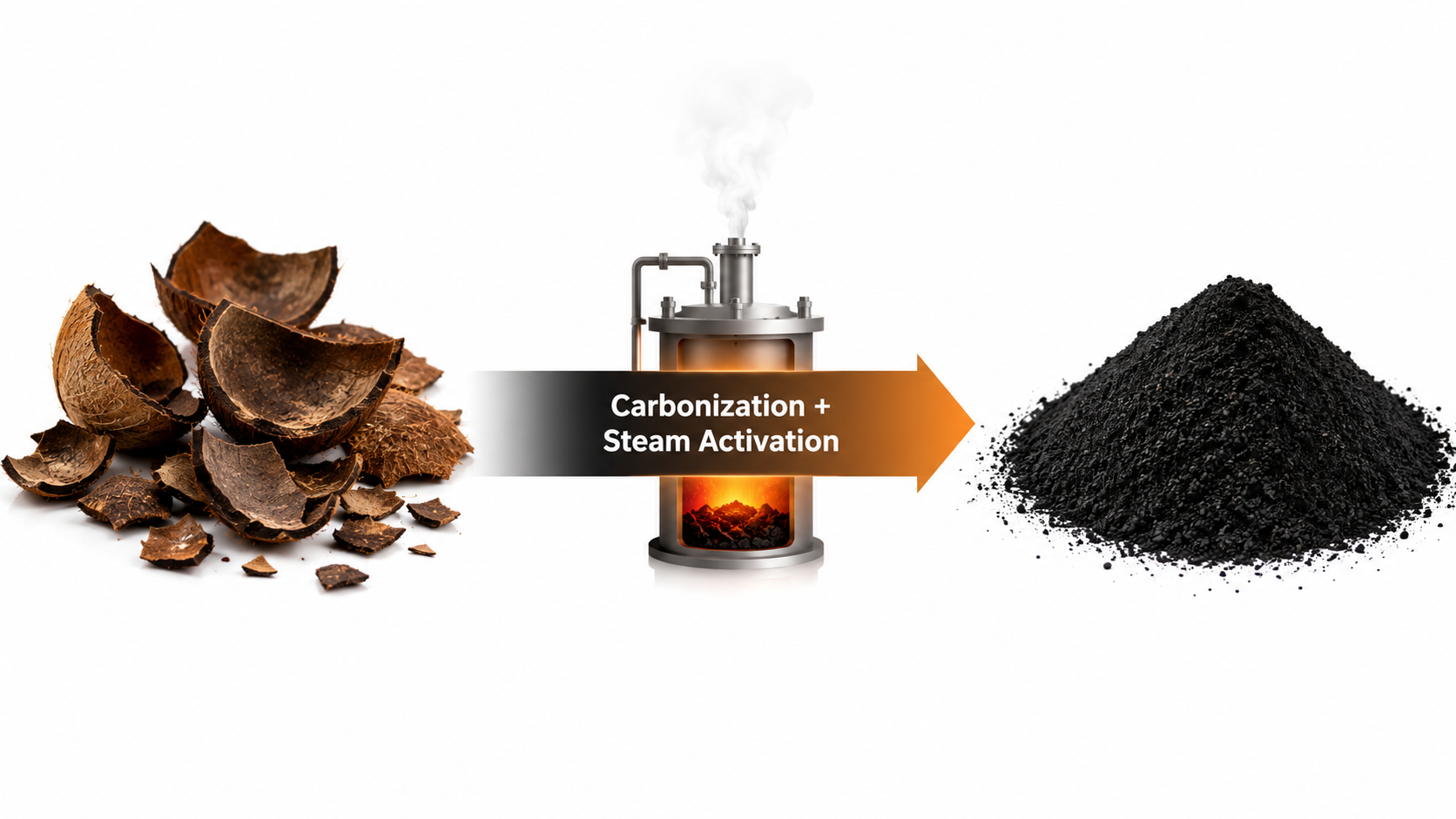
Activated carbon is produced by first carbonizing any carbon-rich raw material in an oxygen-limited environment, then running it through an activation step, either physical (steam or CO2 at 800 to 1,100°C) or chemical (impregnation with phosphoric acid, zinc chloride, or potassium hydroxide followed by pyrolysis at a lower temperature). That step opens up the raw material's relatively closed starting structure, selectively gasifying amorphous carbon and building an internal pore network that can reach hundreds, even thousands, of square meters per gram. The resulting material doesn't soak up contaminants like a sponge; it adsorbs molecules onto its pore walls through van der Waals forces. Final performance depends heavily on the raw material's natural cellular structure and on the specific activation method and temperature used, which is exactly what makes coconut shell such a distinct case.
Advantages of Coconut Shell Activated Carbon
Coconut shells have a dense, uniform lignocellulosic structure with fixed-carbon content around 75% and naturally low mineral matter, and when activated, typically with high-temperature steam at 800 to 1,000°C, they develop an exceptionally microporous carbon of the kind found in Nanografi's own coconut-derived activated carbon nanopowder: pores under 2 nanometers make up more than 85% of total pore volume in a typical grade. That microporosity isn't a minor technical detail. Small, dissolved contaminants such as chlorine, chloramines, hydrogen sulfide, and light volatile organic compounds are removed or catalytically reduced primarily within the microporous network, following adsorption kinetics that favor a tight, uniform pore network over a broad one, which is exactly why coconut shell carbon consistently outperforms coal and wood-based carbons on precisely the contaminants a drinking water plant or a gas mask cartridge needs to remove.
The Technical Data: Three Feedstocks Compared
|
Property |
Coconut shell |
Bituminous coal |
Wood (powdered) |
|
Iodine number |
~1,000-1,200 mg/g |
~700-950 mg/g |
Variable, often lower on micropore-specific tests |
|
BET surface area |
~900-1,200 m2/g |
~700-1,100 m2/g |
~1,200-1,800 m2/g |
|
Pore character |
Predominantly microporous |
Broader distribution |
Mesopore-dominated |
|
Ash content |
~2-4% |
~6-14% |
Typically ~3-7% (varies by processing and acid-washing) |
|
Hardness (ASTM D3802) |
~97-99%+ |
~75-95% |
Generally low, mainly used as powder |
|
Apparent density |
~430-550 g/L |
~400-550 g/L |
Varies, typically lower |
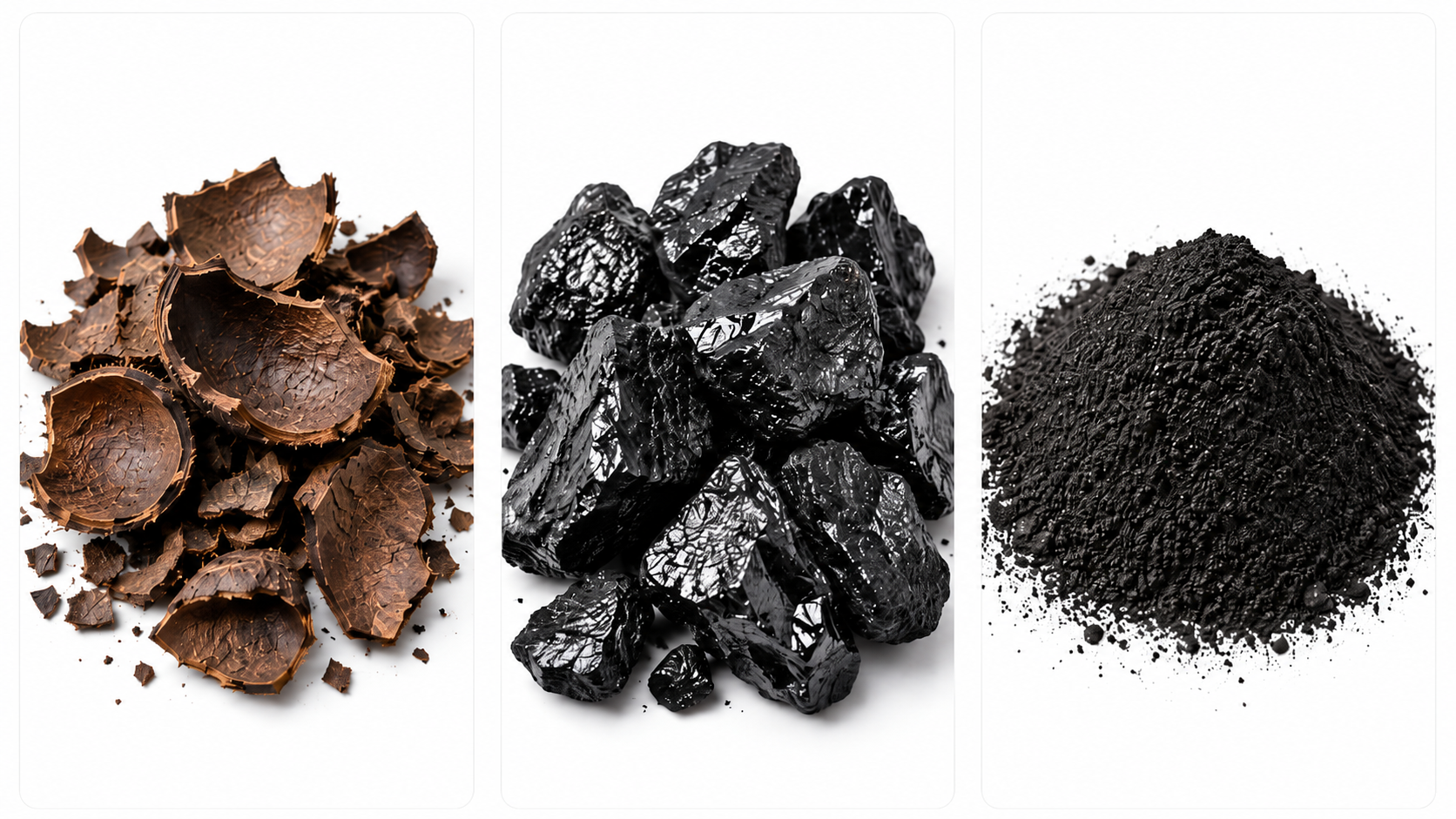
This table is worth reading carefully rather than skimming for a single winner, because it isn't one. Wood-based carbon actually shows a higher total BET surface area than coconut shell in this comparison, and yet coconut shell still wins on small-molecule removal, since wood's extra surface area sits mostly in mesopores rather than micropores. Iodine number and BET surface area measure genuinely different things, and choosing a carbon based on either number alone, without knowing how that surface area is distributed across the pore network, is a common and costly procurement mistake, one that shows up later as underperformance in the field rather than on paper.
Coconut Shell Activated Carbon Hardness and Attrition Resistance
Coconut shell's hardness advantage isn't just a nice-to-have. In applications where carbon gets moved repeatedly, backwashed, or agitated, gold carbon-in-pulp and carbon-in-leach circuits being the clearest example, a softer carbon breaks down into fines that causes gold loss and blinds downstream screens and need constant replenishment. Coconut shell's hardness rating of 97 to 99%, or higher, on the ASTM D3802 ball-pan hardness test, well above bituminous coal's typical 75 to 95% range, is why it dominates gold recovery applications almost by default, even in regions where coal-based carbon is the cheaper local option. The same attrition resistance also matters in multi-cycle regeneration systems, where a carbon that survives repeated thermal reactivation without excessive mass loss keeps operating costs down over the life of an installation.
Where Coconut Shell Falls Short
None of this makes coconut shell carbon the right answer everywhere, and that's worth saying plainly. Decolorizing sugar syrups, vegetable oils, or pharmaceutical intermediates depends on removing larger organic molecules and chromophores, work that mesopores handle far better than micropores do, which is exactly why wood-based powdered activated carbon remains the standard choice in sugar refining and much of pharmaceutical purification despite its lower iodine number. And at the scale of large municipal water treatment plants processing enormous carbon volumes continuously, coal-based granular carbon often remains the more economical choice, since its somewhat lower performance per unit volume offset by a meaningfully lower cost per ton in many markets, particularly where coal is a domestically mined resource.
The Environmental Sourcing Advantage
Coconut shell also carries an argument that extends beyond pore structural chemistry. It's a byproduct of an existing agricultural industry, coconut farming for food, oil, and fiber, rather than a fossil-derived, finite geological resource the way coal is. That gives coconut shell activated carbon a genuinely different sustainability profile: less extraction impact, a renewable input stream tied to ongoing agricultural production rather than geological reserves, and, in many supply chains, a cradle-to-gate carbon footprint per ton produced. For buyers weighing environmental sourcing alongside technical performance, that's frequently a real factor rather than a marketing add-on, and it increasingly shows up as a line item in procurement decisions for public-sector water utilities specifically.
Applications of Coconut Shell Activated Carbon
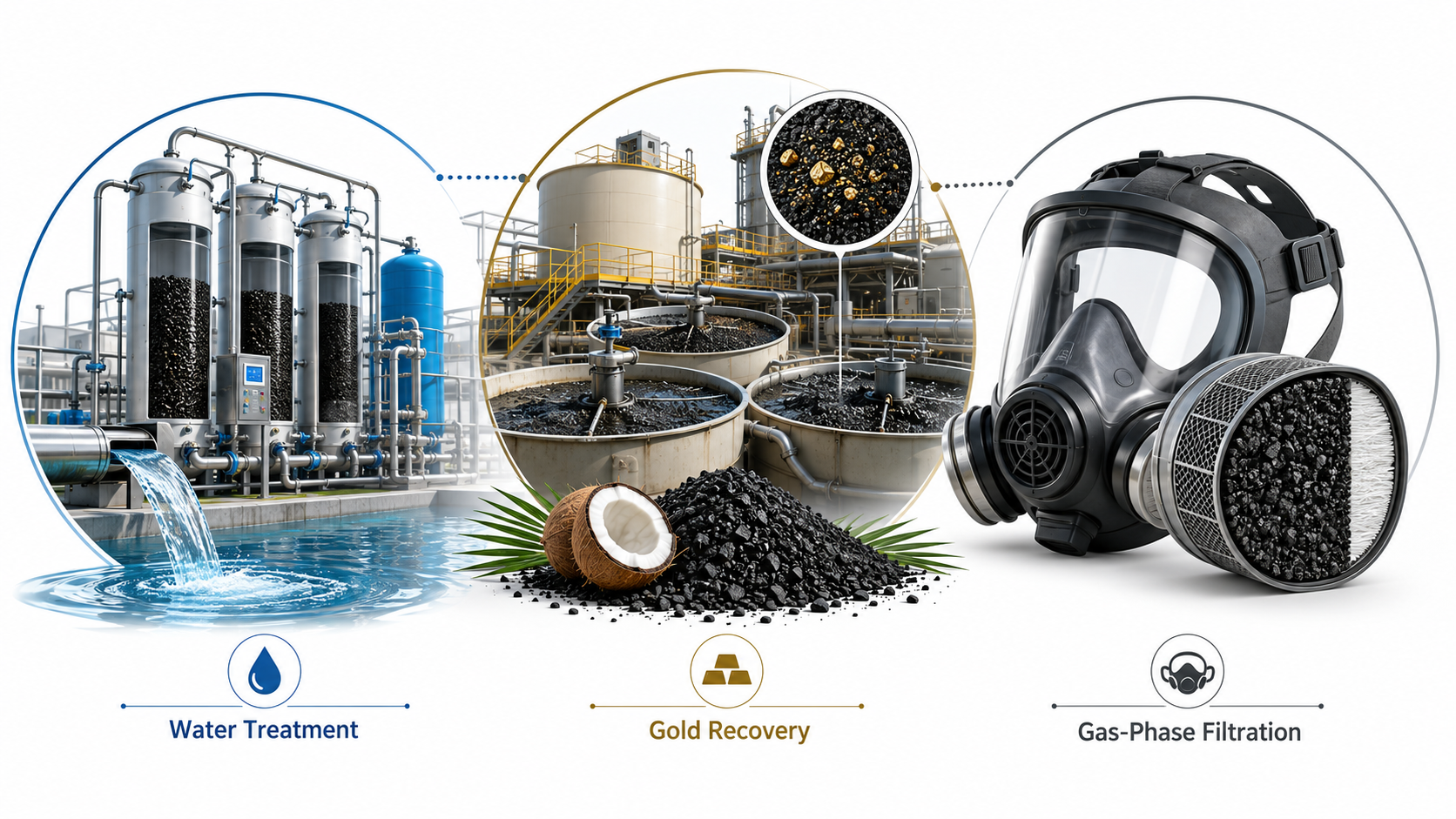
- Drinking water treatment: chlorine, chloramine, and trace organic reduction and trace organic removal in municipal and point-of-use filters
- Gold recovery: carbon-in-pulp and carbon-in-leach circuits, where hardness and micropore affinity for gold-cyanide complexes both matter
- Respirators and gas masks: fast, efficient adsorption of low-molecular-weight organic vapors and toxic gases
- Food-grade and potable-water-certified applications: where low ash content and high purity are frequently regulatory requirements rather than preferences
- Aquarium and home water filtration: the same micropore catalytic reactivity toward
chlorine and odor compounds that works at municipal scale, at consumer scale.
Nanografi's own carbon portfolio reflects this same raw-material distinction directly: a charcoal-derived activated carbon nanopowder grade sits alongside its coconut-derived counterpart for applications where a wood-based pore profile is actually the better fit, and both belong to a wider carbon nanoparticle range worth comparing side by side before committing to one raw material over another.
Frequently Asked Questions
Is coconut shell activated carbon always better than coal-based carbon? No. It's better specifically for small-molecule, micropore-dominant adsorption processes such as drinking water and gas-phase purification. For decolorization or very large-scale, cost-driven municipal treatment, wood-based or coal-based carbon can be the more appropriate and economical choice.
Why does coconut shell carbon have a higher iodine number than coal-based carbon? Because its naturally dense lignocellulosic precursor matrix yields a predominantly microporous network, and the iodine number test specifically correlates with the adsorption capacity within the micropore regime.
Does higher BET surface area always mean better performance? No. BET surface area reflects total pore surface across all pore sizes, so a carbon with a higher BET number but a mesopore-dominated structure can still underperform a lower-BET, micropore-dominated carbon on small-molecule contaminants.
Is coconut shell activated carbon more expensive than coal-based carbon? Generally yes, per ton, but its higher hardness and lower fines generation often reduce replacement frequency and downstream screen blinding and erosion, which can offset the higher upfront cost over the life of an installation.
References
- Danish, M., & Ahmad, T. (2018). A review on utilization of wood biomass as a sustainable precursor for activated carbon production and application. Renewable and Sustainable Energy Reviews, 87, 1-21.
- Marsh, H., & Rodríguez-Reinoso, F. (2006). Activated carbon. Elsevier.
- Western Carbon. (2026). Coconut shell vs coal-based activated carbon: A technical comparison for industrial buyers. https://www.westerncarbon.com/coconut-shell-vs-coal-based-activated-carbon/
- Western Carbon. (2026). Iodine number vs BET surface area: How to technically evaluate activated carbon quality. https://www.westerncarbon.com/iodine-number-vs-bet-surface-area-activated-carbon-quality/
- Yahya, M. A., Al-Qodah, Z., & Ngah, C. W. Z. (2015). Agricultural bio-waste materials as potential sustainable precursors used for activated carbon production: A review. Renewable and Sustainable Energy Reviews, 46, 218-235.
Recent Posts
-
MXene for EMI Shielding: Materials, Mechanisms and Applications
Electromagnetic interference has become a design constraint rather than an afterthought. Densely pac …10th Sep 2026 -
Handling and Storage Best Practices for Metal Oxide Nanopowders
A metal oxide nanopowder is bought for a property that a coarse powder cannot deliver: a specific su …1st Sep 2026 -
Activated Carbon vs Zeolites vs MOFs: Which Adsorbent Material Should You Choose?
Activated carbon, zeolites and metal-organic frameworks (MOFs) represent three distinct adsorbent cl …20th Aug 2026