
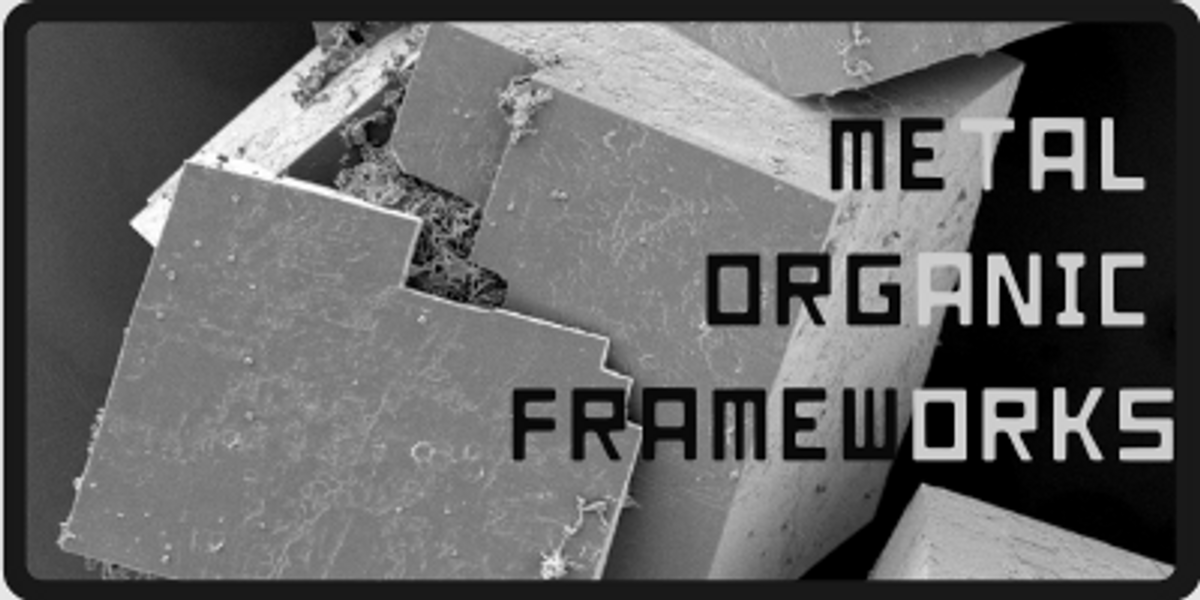
Metal-Organic Frameworks (MOFs) Explained: Structure, Synthesis & Applications
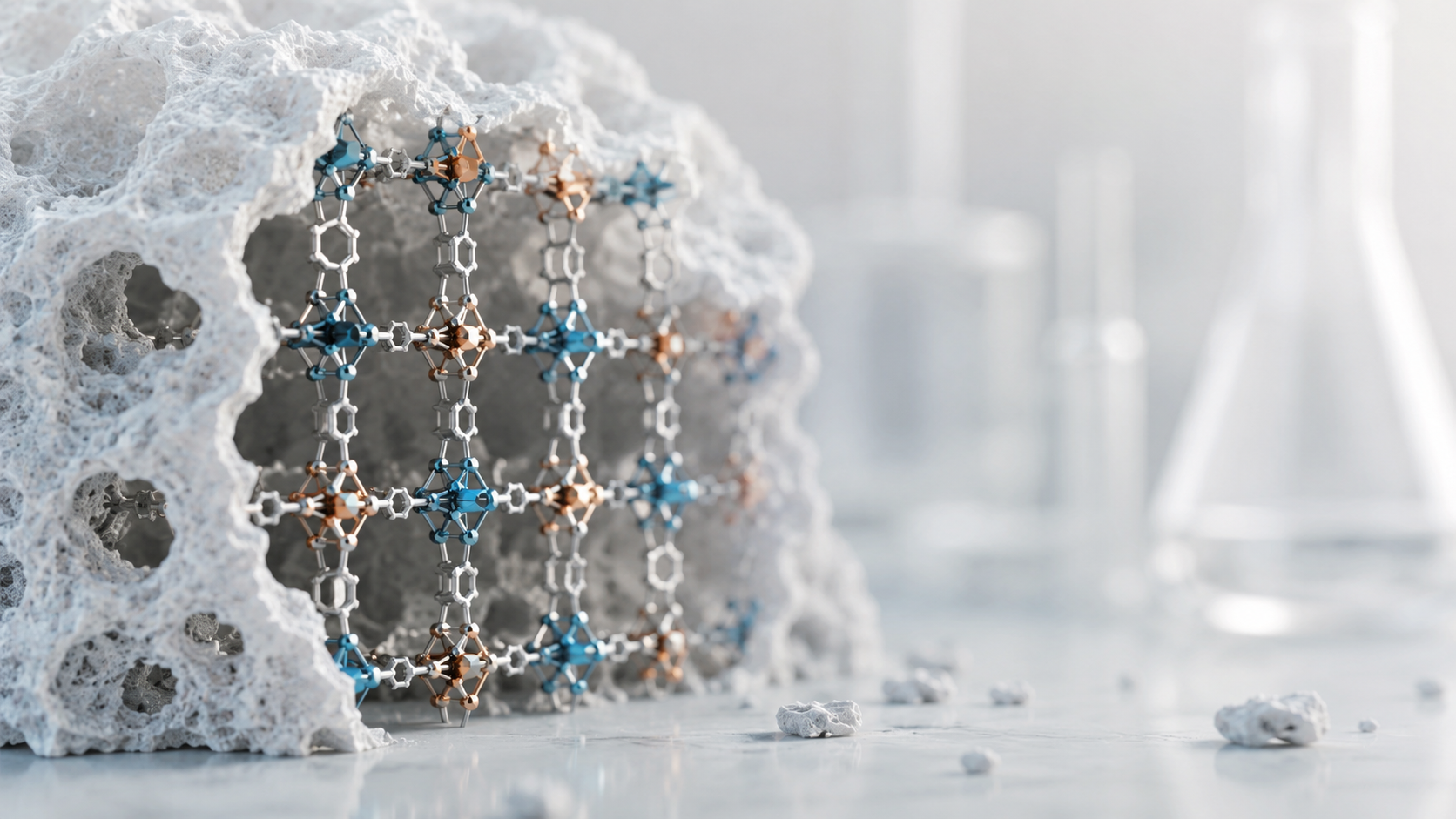
Metal-organic frameworks (MOFs) are a class of crystalline porous materials built from positively charged metal centers, known as secondary building units (SBUs), linked together by organic molecules called linkers. The arrangement of SBUs and linkers creates a regular network of nanoscale pores, and because both the metal and the linker can be swapped out almost independently, chemists can dial in the pore size, shape, and surface chemistry of a MOF far more precisely than is possible with older porous materials such as zeolites or activated carbons. That tunability, combined with genuinely enormous internal surface areas, some MOFs exceed 5,000 square meters of surface area per gram, is why the field has grown from a handful of published structures in the 1990s to tens of thousands of distinct MOFs reported today.
The importance of this design principle was formally recognized in 2025, when the Nobel Prize in Chemistry was awarded jointly to Susumu Kitagawa, Richard Robson, and Omar M. Yaghi for developing metal-organic frameworks, work the Nobel committee credited with opening the door to materials now being used to harvest water from desert air, capture carbon dioxide, and separate industrially important gases. Robson first proposed the idea of linking metal ions with rigid organic struts in the late 1980s, while Kitagawa and Yaghi, working independently through the 1990s and early 2000s, showed that these frameworks could be made robust enough to survive the removal of their synthesis solvent and reused repeatedly without collapsing, the breakthrough that turned MOFs from a laboratory curiosity into a practical materials platform.
What Makes a MOF a MOF
Every MOF structure has two structural components. The secondary building units act as the directional anchor points around which the rest of the structure assembles, and are most commonly divalent transition metals such as Zn2+, Cu2+, Fe2+, Ni2+, or Co2+, though trivalent metals like Fe3+, Cr3+, and Al3+, along with lightweight ions such as Li+ and lanthanide series elements prized for their coordination behavior, are also widely used. The organic linkers are ions or neutral molecules, typically carboxylates or heterocyclic compounds, that act as Lewis bases and bond directly to the metal centers, and it is the enormous variety of available linker chemistry that lets researchers construct MOFs with such a wide range of pore geometries and functional properties.
Pore shape in MOF structures is most commonly cubic, triangular, or hexagonal, and the resulting units can assemble further into cage-type, channel-type, or chiral architectures. Pore size, however, tends to matter more for real-world performance than pore shape: MOFs are broadly split into microporous structures (pore size below 2 nm), which make up the majority of MOFs studied to date, and mesoporous structures (2 to 50 nm), a more recent area of research interest. Smaller pores are generally favored for gas storage, where the goal is to maximize the density of adsorbed gas molecules per gram of material, while larger pores tend to suit catalytic applications that need to accommodate bulkier reactant molecules moving in and out of the framework.
The Major MOF Families
MOFs are typically grouped by the institution or research group where they were first reported, which is why so many family names double as an informal timeline of the field.
HKUST-1 and UiO
HKUST-1, also known as Cu-BTC (copper benzene-1,3,5-tricarboxylate), remains one of the most studied structures and illustrates the core properties that made the field attractive in the first place: high surface area, large pore volume, and strong adsorption capacity, along with Lewis-acid sites that make it useful as an acidic catalyst in reactions such as isomerization and cyanosilylation. The UiO series, built around zirconium clusters, is prized for exceptional thermal and chemical stability compared to many other MOF families, which has made it a common reference point whenever a process needs to survive repeated heating or aggressive chemical environments.
MIL: Materials of Institute Lavoisier
The MIL series was first developed by Férey and coworkers and includes water-stable iron-based structures built for demanding environments. MIL-101(Fe) is the best-known example, combining iron clusters with 1,4-benzenedicarboxylate linkers into a giant-cell structure whose large mesoporous cages give it one of the highest surface areas of any commercially available MOF. Because it holds up well in humid or aqueous conditions, unlike many earlier MOFs that degrade on contact with moisture, MIL-101(Fe) has become a popular starting point for heterogeneous catalysis, phosphate removal from water, and CO2 and H2 storage.
ZIF: Zeolitic Imidazolate Frameworks
ZIFs are formed from Zn2+ or Co2+ coordinated with imidazolate-type linkers, which gives them a zeolite-like topology combined with the composition-level tunability of a MOF, and they have become a particular focus of sensor, catalysis, and gas-separation research. Zinc-based ZIF-8 is prized for its pH-responsive behavior and is one of the most widely studied MOFs in drug-delivery research, since it can be designed to break down and release a payload under the mildly acidic conditions found in some biological environments. Its cobalt-based counterpart, ZIF-67, swaps in strong catalytic activity from the cobalt centers, making it useful in oxidation and hydrogenation reactions as well as a precursor for cobalt-oxide electrodes in supercapacitors and lithium-ion batteries.
This diversity of commercially available families, from HKUST-1 through ZIF-8, ZIF-67, and MIL-101(Fe), reflects just how far the field has moved from a handful of laboratory curiosities to a genuine materials catalog for research and industrial-scale evaluation alike.
How MOFs Are Synthesized
MOF synthesis requires the inorganic SBU, the organic linker, and, in most cases, a solvent that does more than just dissolve the reactants: it also influences the coordination behavior of the metal centers and can act as a structure-directing agent in its own right. Several synthesis routes have matured alongside the field, and the right one usually depends on whether the goal is single-crystal quality, production speed, or industrial scalability.
- Solvent evaporation remains the most widely used method, growing crystals gradually from a saturated solution as solvent is allowed to evaporate over subsequent days; the evaporation rate itself becomes a lever for tuning crystal quality.
- Diffusion methods rely on controlling how two reactant-bearing solvent layers mix, either through simple density-driven liquid diffusion or through a physical barrier such as a gel, and are especially useful when the goal is growing single crystals suitable for structural analysis.
- Hydro(solvo)thermal synthesis, adapted from earlier zeolite chemistry, seals the precursor mixture in an autoclave at 80 to 260 degrees Celsius, with cooling rate and pH acting as the main levers on product quality.
- Microwave-assisted synthesis doesn't grow crystals directly but instead creates nucleation sites through a rapid, localized temperature spike, which can then be carried forward into solvent evaporation or hydrothermal crystallization, primarily valued for cutting overall synthesis time.
- Electrochemical synthesis drives crystallization by applying current directly to the reaction solution, avoids introducing anions such as nitrates from metal salts, and is generally the preferred route when producing MOF powders at industrial scale, since simply adjusting voltage or applying pulses gives an additional way to tune the resulting framework.
- Mechanochemical synthesis breaks intermolecular bonds using mechanical force alone, requiring no bulk solvent, which makes it attractive on environmental grounds and allows the use of low-solubility metal oxides that don't work well in solvent-based routes; a small amount of solvent can still be added to speed up the reaction, a variant known as liquid-assisted grinding.
- Ultrasonic synthesis uses high-energy ultrasound to promote reactant dissolution, offering a fast, energy-efficient, and environmentally friendly route to MOF production under ambient conditions.
Because these routes trade off crystal quality, production speed, and scalability so differently, the engineering decisions behind MOF synthesis have themselves become a research topic in their own right, one that increasingly spans everything from intelligent porosity engineered for carbon capture through to quantum-scale device applications.
Application Areas
The properties that make MOFs valuable, high surface area, tunable porosity, and surface chemistry that can be matched to a specific target molecule, translate into a genuinely broad application footprint: gas storage and separation, heterogeneous and photocatalysis, energy storage, proton conductivity, chemical and biomolecule sensing, and biomedicine. Composite MOF structures extend this list further, since polymers, metal nanoparticles, quantum dots, carbon nanotubes, graphene, and even enzymes can all be combined with a MOF scaffold to add functionality that the base framework doesn't have on its own, and researchers evaluating any of these routes can draw on the wider range of metal-organic frameworks available for side-by-side testing beyond the handful of families discussed here. A closely related class worth understanding alongside MOFs is metal-halide perovskites, which are revolutionizing energy conversion technologies of their own through a different but comparable strategy: engineering a crystalline framework around a functional ion rather than around a pore.
The practical significance of this versatility comes with real limits still standing between MOFs and even wider industrial deployment, among them the applications of metal-organic frameworks that remain bottlenecked by long-term stability, scalable manufacturing, and cost rather than by chemistry alone. Whether that trade-off is worth it depends heavily on the importance of metal-organic frameworks to the specific problem at hand, since a material this tunable rarely competes on a single axis of performance. Readers approaching the field for the first time often find that understanding metal-organic frameworks becomes considerably easier once the SBU-linker relationship described above is seen through a second, more applied set of worked examples.
Frequently Asked Questions
What is the difference between a MOF and a zeolite? Both are porous crystalline materials, but zeolites are built from a comparatively narrow set of inorganic aluminosilicate frameworks, while MOFs combine metal centers with an essentially unlimited variety of organic linkers, giving MOFs far greater tunability in pore size, shape, and surface chemistry.
Are MOFs stable in water and air? Stability varies enormously by family. Many early MOFs degrade when exposed to moisture, but families such as the zirconium-based UiO series and iron-based MIL structures were specifically developed for strong chemical and thermal stability, including in humid conditions.
What is the most common MOF synthesis method? Solvent evaporation is the most widely used method for laboratory-scale synthesis, while electrochemical and mechanochemical methods are more common when producing MOF powders at industrial scale.
Why did MOFs win the 2025 Nobel Prize in Chemistry? Susumu Kitagawa, Richard Robson, and Omar M. Yaghi were recognized for developing metal-organic frameworks as a robust, reusable class of materials, work that established the design principles now used to build tens of thousands of distinct MOFs for applications from carbon capture to water harvesting.
What is the difference between microporous and mesoporous MOFs? Microporous MOFs have pores smaller than 2 nanometers and are generally preferred for gas storage, where maximizing adsorption density matters most, while mesoporous MOFs (2 to 50 nanometers) are better suited to catalytic applications involving bulkier molecules.
References
American Chemical Society. (2025). The 2025 chemistry Nobel goes to MOFs. Chemical & Engineering News. https://cen.acs.org/people/nobel-prize/The-2025-chemistry-Nobel-goes-to-MOFs/103/web/2025/10
Chemistry World. (2025). Nobel chemistry prize 2025: Metal-organic frameworks win for Kitagawa, Robson and Yaghi. https://www.chemistryworld.com/news/2025-chemistry-nobel-prize-goes-to-the-scientists-behind-metal-organic-frameworks/4022287.article
Furukawa, H., Cordova, K. E., O'Keeffe, M., & Yaghi, O. M. (2013). The chemistry and applications of metal-organic frameworks. Science, 341(6149), 1230444.
Nobel Prize Outreach. (2025). Press release: The Nobel Prize in Chemistry 2025. NobelPrize.org. https://www.nobelprize.org/prizes/chemistry/2025/press-release/
Nobel Prize Outreach. (2025). Popular information: The Nobel Prize in Chemistry 2025. NobelPrize.org. https://www.nobelprize.org/prizes/chemistry/2025/popular-information/
Zhou, H.-C., Long, J. R., & Yaghi, O. M. (2012). Introduction to metal-organic frameworks. Chemical Reviews, 112(2), 673-674.
Recent Posts
-

MXene for EMI Shielding: Materials, Mechanisms and Applications
Electromagnetic interference has become a design constraint rather than an afterthought. Densely pac …10th Sep 2026 -
Handling and Storage Best Practices for Metal Oxide Nanopowders
A metal oxide nanopowder is bought for a property that a coarse powder cannot deliver: a specific su …1st Sep 2026 -

Activated Carbon vs Zeolites vs MOFs: Which Adsorbent Material Should You Choose?
Activated carbon, zeolites and metal-organic frameworks (MOFs) represent three distinct adsorbent cl …20th Aug 2026