
The 10 Strongest Advanced Materials of All Time (2026 Guide)
The phrase "strongest material" is more ambiguous than it first appears. In materials science, mechanical superiority is described through several distinct, often uncorrelated parameters: tensile strength (the maximum stress sustained before failure under axial tension), hardness (resistance to localized plastic deformation or scratching), elastic modulus (stiffness), and fracture toughness (resistance to crack propagation). A material that excels in one parameter may be unremarkable, or even fragile, in another. Diamond, for example, is widely recognized as one of the hardest known natural materials (Mohs 10), yet it is graphene that defines the upper limit of intrinsic tensile strength.
This guide ranks ten advanced materials primarily by tensile strength, expressed in gigapascals (GPa), while noting hardness and stiffness where they are the more relevant figures of merit. A deliberate emphasis is placed on the nanoscale form of each material. Confinement to one or two dimensions drastically reduces defect density that govern bulk fracture, allowing these materials to approach their theoretical strength limits. This is precisely why nanomaterials, rather than their bulk counterparts, underpin the most demanding composite, electronic, and energy applications. Each entry below is also a commercially available material, so the discussion connects directly to materials that can be specified and sourced for research or production.
1. Graphene (~130 GPa)
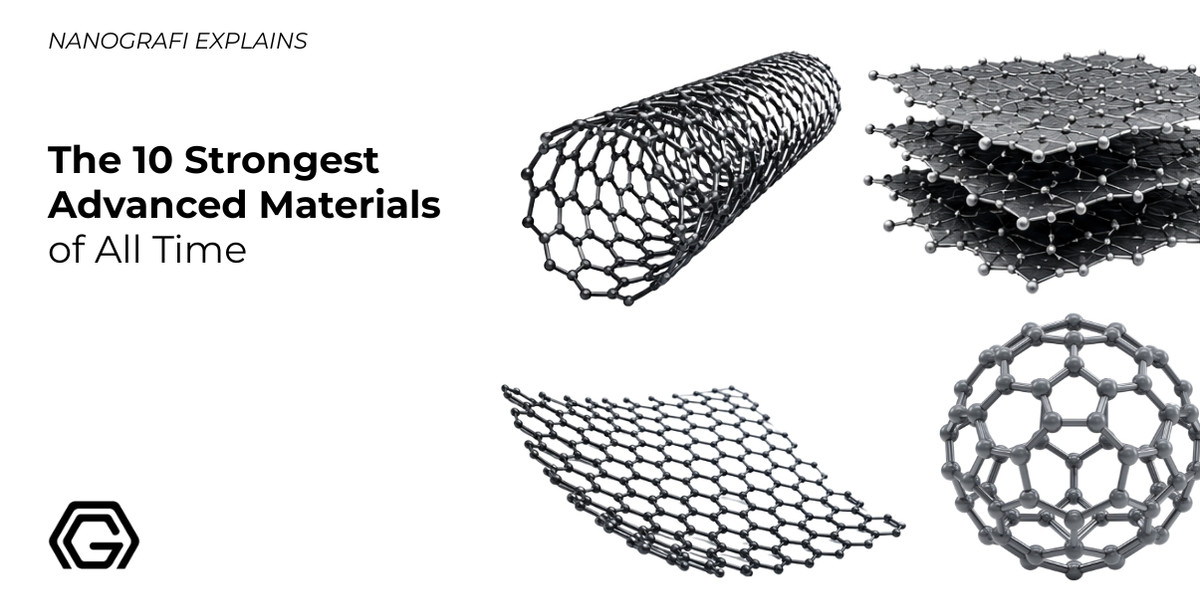
Graphene is the strongest material yet characterized. A single layer of sp²-hybridized carbon atoms arranged in a hexagonal lattice, it was measured by nanoindentation to have an intrinsic tensile strength of approximately 130 GPa and a Young's modulus near 1 TPa (Lee et al., 2008), roughly two orders of magnitude stronger than structural steel in terms of intrinsic strength. These values approach the theoretical limit of the carbon–carbon σ-bond network, meaning the measured strength is dictated by the intrinsic bond stiffness rather than by extrinsic flaws.
The in-plane σ-bond network responsible for this mechanical performance coexists with a delocalized π-electron system that yields exceptional electrical and thermal conductivity, making graphene a multifunctional multifunctional component. For high-performance composites, conductive coatings, and electrode architectures, graphene is available in flake, powder, sheet, and dispersion forms tailored to specific processing routes.
Primary applications: aerospace composites, energy storage electrodes, sensors, conductive inks, and biomedical scaffolds.
2. Carbon Nanotubes (~63 GPa)
Carbon nanotubes (CNTs) are seamless cylinders of rolled graphene. Direct tensile testing of multi-walled CNTs has reported strengths up to 63 GPa, with individual shells approaching the theoretical ceiling near 100 GPa, and an elastic modulus of up to approximately 950 GPa (Yu et al., 2000). On a specific-strength basis (strength normalized to density), CNTs substantially outperform high-carbon steel, which is the property of interest for lightweight structural reinforcement. A more detailed treatment of their structure–property relationships is available in this overview of the fundamentals and industrial applications of carbon nanotubes.
CNTs are produced as single-walled (SWCNT) and multi-walled (MWCNT) variants. SWCNTs offer superior, chirality-dependent electronic behavior, whereas MWCNTs provide effective bulk mechanical reinforcement at lower cost. Because the optimal choice is application-specific, sourcing from a supplier offering the full range of carbon nanotubes, including powders, films, and buckypaper, is advantageous.
Primary applications: composite reinforcement, conductive films, energy storage, thermal management, and high-sensitivity sensing.
3. Boron Nitride Nanotubes (~33 GPa)
Boron nitride nanotubes (BNNTs) are the isostructural analog of CNTs, formed by rolling hexagonal boron nitride sheets. Their reported tensile strength is near 33 GPa, with a Young's modulus experimentally reported up to ~0.9 TPa, with theoretical values near 1.2 TPa (Chopra & Zettl, 1998). The defining distinction is functional stability rather than peak strength: the partially ionic B–N bond confers oxidation resistance up to ~900 °C, wide-bandgap electrical insulation, and a high neutron-absorption cross-section especially when enriched with the boron-10 isotope.
These attributes make BNNTs preferable to carbon analogs in oxidizing, high-temperature, or radiation environments, and they exhibit a higher propensity for functionalization, facilitating stronger interfacial bonding with polymer matrices. Boron nitride nanomaterials are accordingly favored for thermal management and shielding applications where CNTs would degrade.
Primary applications: thermal-management composites, dielectric insulators, neutron shielding, and polymer/ceramic/metal reinforcement.
4. Reduced Graphene Oxide (rGO)
Reduced graphene oxide occupies the practical middle ground between performance and processability. Chemical or thermal reduction of graphene oxide partially restores the
conjugated sp² network, recovering a moderate fraction of pristine graphene's mechanical and electrical properties while retaining solution processability. As a reinforcing phase, rGO measurably Enhances the tensile strength and modulus of polymer matrices, as well as the fracture toughness of ceramic matrices. These characteristics have made rGO and graphene oxide workhorse materials for scalable composite and electrode manufacturing.
Primary applications: energy storage electrodes, conductive composites, sensors, functional coatings, and water treatment.
5. Graphene Aerogel
Graphene aerogel is included not for absolute tensile strength but for an exceptional compressive strength-to-weight ratio at extreme low density, ranking among the lightest ultra-low-density materials ever synthesized. Its three-dimensional, interconnected porous network supports loads many times its own mass while remaining thermally stable to high temperatures. This combination is decisive in mass-critical applications. Nanografi supplies graphene aerogels in ultralight, structural, and magnetic grades for these uses.
Primary applications: thermal insulation, sorbents for oil and pollutant capture, lightweight energy storage, and aerospace structures.
6. Silicon Carbide (Mohs 9.5)
Silicon carbide (SiC) is one of the hardest and most wear-resistant materials on this list. With a Mohs hardness of 9.5, a decomposition temperature above 2800 °C, and a wide semiconductor bandgap, it integrates high mechanical strength with thermal stability, oxidation resistance, and high Electron saturation velocity. At the nanoscale, SiC exhibits increased fracture toughness and reinforcing efficiency, which is why silicon carbide in nano- and micron-scale powders serves both structural ceramics and power-electronics applications.
Primary applications: abrasives and cutting tools, high-temperature ceramics, semiconductor wafers and power devices, armor composites, and brake systems.
7. Fullerene (C60)
Fullerene-C60 ("buckminsterfullerene") is a closed cage of 60 carbon atoms arranged as a truncated icosahedron of interlocking hexagons and pentagons. Its high molecular symmetry confers notable stability and makes it a foundational zero-dimensional building block in carbon nanotechnology, complementary to two-dimensional graphene and one-dimensional nanotubes. Research applications that exploit this cage geometry rely on high-purity Fullerene-C60.
Primary applications: photovoltaics, lubricant additives, drug-delivery vectors, and fundamental materials research.
8. Graphitic Carbon Nitride (g-C₃N₄)
Graphitic carbon nitride is a robust, layered two-dimensional semiconductor and, notably, one of the few metal-free photocatalysts. It combines chemical stability and high thermal resistance with a moderate bandgap (~2.7 eV) suited to visible-light-driven photocatalysis, positioning it as a low-cost metal-free alternative to traditional metal-oxide semiconductors in energy and environmental systems. g-C₃N₄ powder is available among Nanografi's newest materials.
Primary applications: photocatalytic hydrogen evolution, pollutant degradation, and energy conversion.
9. CNT–Graphene Hybrids
Covalently or non-covalently coupling carbon nanotubes with graphene yields hybrid architectures that combine the one-dimensional transport pathways of CNTs with the two-dimensional surface area of graphene. As composite fillers, these hybrids simultaneously enhance tensile strength, modulus, toughness, and electrical conductivity, mitigating the restacking of graphene and the entanglement/aggregation of CNTs that limit each constituent alone. This synergy explains why such CNT-graphene hybrid structures are widely adopted in battery and supercapacitor electrode research.
Primary applications: lithium-ion batteries, supercapacitors, structural composites, biosensors, and catalysis.
10. Graphene Nanoplatelets (GNP)
Graphene nanoplatelets (GNPs) are stacks of a few graphene layers with high aspect ratio and moderate surface area. They deliver a significant fraction of graphene's stiffness, barrier, and conductivity benefits in a form that is more economical and more economically processed at scale. For reinforcement applications that do not require a single pristine monolayer, graphene nanoplatelets represent an efficient balance of performance and cost.
Primary applications: composite reinforcement, conductive coatings, thermal-interface materials, and anti-corrosion coatings.
Conclusion
Ranking advanced materials by strength requires first specifying which mechanical property is being optimized, since tensile strength, hardness, stiffness, and toughness are governed by different structural mechanisms and inherently exhibit strong physical trade-offs. Across the tensile-strength axis, low-dimensional carbon and boron nitride nanostructures dominate the upper range, with graphene at the theoretical ceiling near 130 GPa, followed by carbon nanotubes and boron nitride nanotubes. Where the operative requirement shifts, whether to hardness, to thermal and oxidative stability, or to minimal density, silicon carbide, BNNTs, and graphene aerogel respectively become the more rational selection.
The recurring theme is that mechanical performance is realized at the nanoscale, where the statistical probability of defects is structurally minimized and intrinsic bond strength is approached. Translating that intrinsic performance into engineered components requires overcoming macro-scale integration and alignment challenges. As a manufacturer and supplier of high-purity advanced nanomaterials across research and industrial volumes, Nanografi provides each material discussed here, from graphene and carbon nanotubes to silicon carbide and specialty derivatives, with worldwide shipping and material-specific documentation. For custom specifications or bulk quotations, the Nanografi team can provide tailored support.
Summary comparison
|
Rank |
Material |
Tensile Strength |
Governing Property |
Available at Nanografi |
|
1 |
Graphene |
~130 GPa |
Highest intrinsic tensile strength |
Yes (powder, sheets, dispersions) |
|
2 |
Carbon Nanotubes (CNT) |
~63 GPa |
High specific strength, ~1 TPa modulus |
Yes (SWCNT, MWCNT, films) |
|
3 |
Boron Nitride Nanotubes (BNNT) |
~33 GPa |
Thermal/oxidative stability, neutron shielding |
Yes (BN nanomaterials) |
|
4 |
Reduced Graphene Oxide (rGO) |
~0.2–0.5 GPa (bulk film) |
Scalable, solution-processable |
Yes (rGO, GO) |
|
5 |
Graphene Aerogel |
Minimal / Compressive-dominant |
Compressive Sctrength-to-weight ratio |
Yes (multiple grades) |
|
6 |
Silicon Carbide (SiC) |
210–370 MPa (flexural, sintered) |
Hardness and thermal resistance |
Yes (nano/micron powder, wafers) |
|
7 |
Fullerene (C60) |
Cage-stable |
Molecular symmetry, 0D building block |
Yes (C60 powder) |
|
8 |
Graphitic Carbon Nitride (g-C₃N₄) |
Bulk/Powder form |
Metal-free photocatalysis |
Yes (powder) |
|
9 |
CNT–Graphene Hybrids |
Enhanced |
Combined conductivity and strength |
Yes (Hybrid/integrated range) |
|
10 |
Graphene Nanoplatelets (GNP) |
Reinforcing |
Cost-effective reinforcement |
Yes (multiple sizes) |
Reported tensile-strength values correspond to idealized or nanoscale forms and vary with synthesis method, purity, defect density, and measurement technique. Contact us for material-specific datasheets and certificates of analysis.
References
- Lee, C., Wei, X., Kysar, J. W., & Hone, J. (2008). Measurement of the elastic properties and intrinsic strength of monolayer graphene. Science, 321(5887), 385–388.
- Yu, M. F., Lourie, O., Dyer, M. J., Moloni, K., Kelly, T. F., & Ruoff, R. S. (2000). Strength and breaking mechanism of multiwalled carbon nanotubes under tensile load. Science, 287(5453), 637–640.
- Chopra, N. G., & Zettl, A. (1998). Measurement of the elastic modulus of a multi-wall boron nitride nanotube. Solid State Communications, 105(5), 297–300.
- Wei, X., Wang, M.-S., Bando, Y., & Golberg, D. (2010). Tensile tests on individual multi-walled boron nitride nanotubes. Advanced Materials, 22(43), 4895–4899.
- Stankovich, S., Dikin, D. A., Dommett, G. H. B., et al. (2006). Graphene-based composite materials. Nature, 442(7100), 282–286.
- Wang, X., Maeda, K., Thomas, A., et al. (2009). A metal-free polymeric photocatalyst for hydrogen production from water under visible light. Nature Materials, 8(1), 76–80.
- Class for Physics of the Royal Swedish Academy of Sciences. (2010). Scientific background on the Nobel Prize in Physics 2010: Graphene.
- Magagnosc, D. J., & Schuster, B. E. (2019). Fracture strength of hot-pressed silicon carbide at the microscale. Materials Science and Engineering: A, 765, 138297.
Recent Posts
-

Biomaterials for Implants: Titanium vs Nitinol vs Hydroxyapatite Coatings
Implantable medical devices operate under very different mechanical and biological conditions. A hip …7th Oct 2026 -

CNT Paste vs Silver Paste vs Carbon Paste: Which Conductive Adhesive Should You Use?
Conductive pastes quietly hold much of modern electronics together. They bond chips to substrates, d …1st Oct 2026 -
ZnO Nanoparticles in OLED and Perovskite Solar Cells
Many printed solar cells and inverted display stacks need a layer that collects electrons and passes …23rd Sep 2026