
Self-Healing MXene-Based Conductive Networks for Flexible and Wearable Electronics
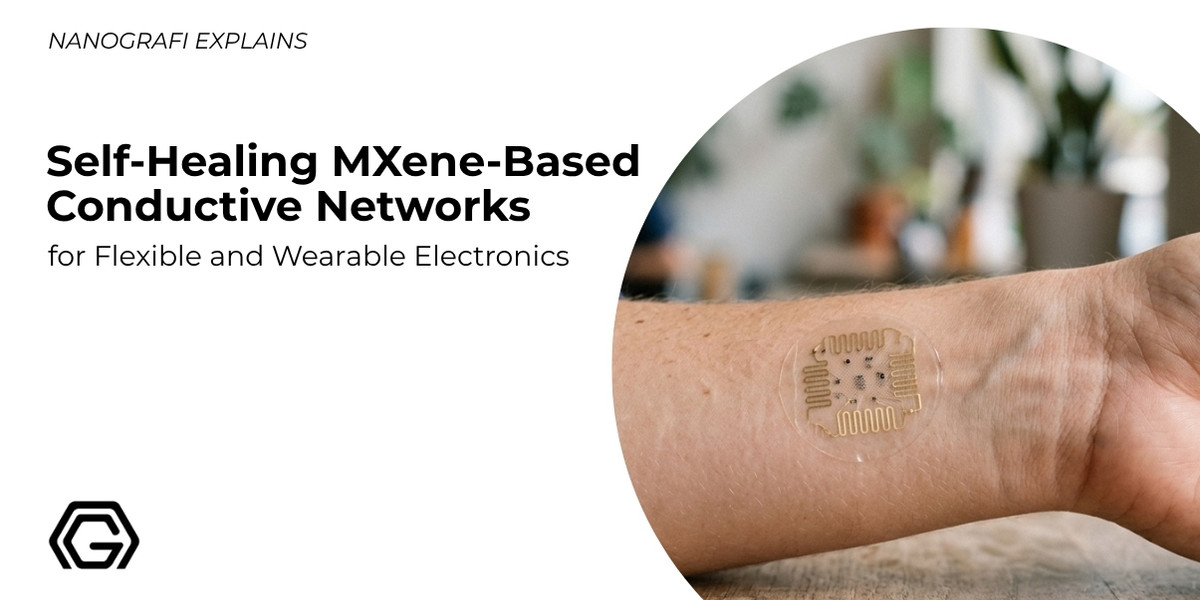
Imagine a health sensor wrapped around your wrist, one that bends with every movement, survives a hard knock, and maintains its electrical percolation even after being damaged. Minimal maintenance, no manual repair, and no downtime, the material simply recovers its structural and functional integrity and carries on.
This is not a concept. It is where MXene-based conductive network research currently stands, and it may be the most important development in multifunctional wearable electronics materials of the past decade.
Why Conventional Flexible Electronics Keep Failing
The core problem with wearable electronics has never been miniaturization — it has been mechanical durability and interfacial stability. Intrinsic conductive materials propagate micro-cracks under repeated bending. Electrodes delaminate after prolonged skin contact. Sensors exhibit signal drift after a few thousand strain cycles. Every one of these failure modes traces back to the same root cause: high-modulus conductive components inside systems that are expected to match the low-modulus, viscoelastic behavior of human skin.
The industry response has been to engineer around this limitation by encapsulation layers, reducing device thickness, or simply accepting a shorter device lifespan. But a growing body of materials research is pursuing a fundamentally different answer: what if the conductive network could autonomously repair itself?
MXene: The Material That Makes Self-Healing Conductors Possible
MXenes are two-dimensional transition metal carbides and nitrides synthesized from layered MAX phase precursors through selective topochemical etching. The most studied member of this family, Ti₃C₂Tₓ, offers a combination of properties that makes it uniquely suited for flexible and self-healing applications.
Its electrical conductivity exhibits metallic behavior due to its high density of states at the Fermi level. Its surface is naturally hydrophilic, which allows MXene nanosheets to disperse uniformly throughout polar polymer and hydrogel matrices. And crucially, its surface chemistry is defined by terminal hydroxyl, oxygen, and fluoride groups that enable strong interactions with surrounding polymer chains through hydrogen bonding and electrostatic forces. That molecular-level adhesion is what ties MXene to self-healing behavior.
When MXene nanosheets are embedded above the percolation threshold within a flexible matrix, they form a continuous three-dimensional conductive network. The material can be stretched, compressed, or twisted while maintaining electrical function. And when that matrix is designed with dynamic cross-links reversible bonds the kind that spontaneously reform after being broken — the conductive network can be restored after damage without any external input.
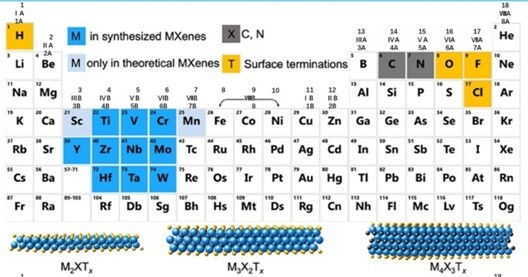
Figure 1. Schematic representation of the chemical composition and general formula (Mₙ₊₁XₙTₓ) of the MXene family. Here, M denotes transition metals, X represents carbon and/or nitrogen, and Tₓ indicates surface terminations (–O, –OH, –F). This surface chemistry enables strong interactions with polymer matrices, facilitating the formation of self-healing conductive networks.
How Self-Healing Works in Practice
The healing mechanism in these systems does not come from the MXene itself. It comes from the polymeric or hydrogel matrix that acts as a scaffold for the nanosheets. When the material is cut or fractured, the dynamic Supramolecular bonds - such as hydrogen bonds, electrostatic interactions, and in some designs, reversible covalent crosslinks — reform as the broken surfaces are pressed back into contact. The polymer network re-establishes its cross-linked structure and because MXene is homogeneously distributed within that network, the conductive percolation pathways are restored.
What makes this genuinely remarkable is the breadth of architectures that work. Hydrogels combining MXene with polyacrylamide and chitosan have demonstrated extreme stretchability alongside autonomous healing and Bio-adhesive properties. Fiber-based composites where MXene-coated electrospun fibers sit inside a thermoplastic matrix can heal spontaneously when the device reaches activation making them natural candidates for skin-contact heaters and thermal therapy patches.
In each case, the design logic is the same: MXene provides the electrical performance, the polymer provides the mechanical adaptability, and the interfacial compatibility between the two determines the healing efficiency of the system.
Sensing Performance After Self-Healing
A self-healing material is only valuable if it recovers its transduction function, not just its shape. The consistent finding across different MXene-based self-healing systems is that electrical conductivity recovery after healing is high — often approaching the original baseline — and that sensing metrics such as sensitivity, response speed, and detection range remain stable through repeated damage-and-recovery cycles.
These systems have been validated across a wide range of physiological signals: pulse waveforms, finger and wrist movement, breathing patterns, thermometric changes, and even subtle muscle contractions. The combination of high sensitivity and mechanical resilience makes MXene-based self-healing sensors genuinely competitive for continuous health monitoring applications — the kind of presistent, skin-worn devices that clinical-grade remote patient monitoring will eventually require.
Beyond Strain Sensing: A Multifunctional Platform
One of the most compelling aspects of MXene-based conductive networks is how naturally they extend into applications beyond simple piezoresistive strain sensing.
Energy harvesting is one of the most active directions. When MXene hydrogels are integrated into triboelectric nanogenerator architectures, the same network that detects motion also converts mechanical energy into electrical potential. This creates a self-powered sensing system that draws its operating energy directly from the wearer’s biomechanical movement. For truly maintenance-free wearables, this combination of self-healing and self-powering is close to ideal.
Antibacterial function is another property that emerges from certain MXene composite designs without requiring additional active agents. Devices intended for prolonged skin contact or wound monitoring benefit significantly from this —inhibiting microbial growth without compromising the electrical performance that makes the sensor useful.
Electromagnetic interference (EMI) shielding is a third direction, relevant for wearable devices that need to maintain a high signal-to-noise ratio by avoiding interference from nearby electronics. MXene's combination of high metallic conductivity and multi-layered internal reflection architecture makes it one of the most effective EMI shielding materials per unit thickness available today.
What Still Needs to Be Solved
Honest assessment of the field requires acknowledging the challenges that remain. Spontaneous MXene oxidation in ambient air transforms conductive carbides into non-conductive oxides, which degrades conductivity over time. This is perhaps the most significant chemical stability problem, and while encapsulation and co-component strategies partially address it, a robust long-term solution is still an active research target.
Scalable fabrication is a second constraint. Producing MXene-based composite hydrogels with repeatable rheological and electrical properties at industrial volume is meaningfully harder than the laboratory synthesis. The liquid-phase exfoliation and dispersion processes that yield excellent performance in small batches do not always translate cleanly to high-throughput manufacturing.
And biocompatibility profiles for long-term skin contact — let alone implantable configurations — is still building. While, acute biocompatibility results are encouraging, but the evidence base for chronic toxicity is thin.
None of these are reasons to be pessimistic. They are the normal friction of taking a genuinely new class of materials from discovery toward deployment.
Conclusion: A Material Class Ready for Serious Application Development
MXene-based self-healing conductive networks have moved well past the proof-of-concept stage. The combination of recoverable electrical percolation, extreme mechanical flexibility, multifunctional sensing, and — in some designs — autonomous repair makes this one of the most technically coherent materials platforms for next-generation wearable electronics.
For researchers entering this space, the foundation is access to well-characterized starting materials. Nanografi supplies Ti₃C₂Tₓ MXene Phase Powder and Single Layer Ti₃C₂Tₓ MXene Suspension for direct use in composite and hydrogel fabrication, alongside Ti₃AlC₂ MAX Phase Powder for groups synthesizing MXene from scratch.
For deeper background on MXene synthesis and properties,
Nanografi's MXenes from MAX Phases blog post covers the full synthesis-to-application landscape.
The wearable electronics context is explored further in Utilization of Graphene on Wearable Technologies and Applications of 2D Nanomaterials Beyond Graphene.
References
- Yang, W. et al. MXene-based flexible sensors for wearable applications. Soft Science, 5, 33 (2025). https://www.oaepublish.com/articles/ss.2025.12
- Huang, M. et al. Multimodal sensing conductive organohydrogel electronics based on chitosan-encapsulated MXene nanocomposites. Soft Science (2025). https://doi.org/10.20517/ss.2025.07
- Pan, W. et al. Thermosensitive MXene-based flexible wearable sensors for multifunctional human signals monitoring. ACS Applied Polymer Materials (2024). https://pubs.acs.org/doi/10.1021/acsapm.4c01225
- Autonomous self-healing wearable flexible heaters enabled by MXene/PCL composite fibrous networks and silver nanowires. Advanced Composites and Hybrid Materials (2023). https://link.springer.com/article/10.1007/s42114-023-00809-y
- Biomedical potentials of MXene-based self-powered wearable devices. RSC Advances (2025). https://pmc.ncbi.nlm.nih.gov/articles/PMC12439251/
- Hot-humid tolerant and antibacterial MXene-based hydrogel sensor for real-time cardiorespiratory monitoring. Microsystems & Nanoengineering (2025). https://www.nature.com/articles/s41378-025-01102-2
- MXene-based elastomer mimetic stretchable sensors. Nano-Micro Letters (2024). https://link.springer.com/article/10.1007/s40820-024-01349-w
Recent Posts
-

Advanced Materials for Humanoid Robots: Actuators, Sensors and E-Skin
Humanoid robots are leaving the lab. They now walk warehouse floors, handle parts on assembly lines …23rd Oct 2026 -

What Is Conductive Masterbatch? CNT, Carbon Black and Graphene Compared
A conductive masterbatch is a concentrated blend of a conductive carbon additive and a carrier polym …14th Oct 2026 -

Biomaterials for Implants: Titanium vs Nitinol vs Hydroxyapatite Coatings
Implantable medical devices operate under very different mechanical and biological conditions. A hip …7th Oct 2026