
Cathode Materials for Sodium-Ion Batteries: A Technical Guide
Lithium-ion batteries have dominated the energy storage landscape for decades. Yet rising demand for lithium, cobalt, and nickel has exposed the fragility of supply chains and pushed costs upward. Against this backdrop, battery materials science is moving fast—and sodium-ion technology is drawing serious attention for its potential to scale. The key variable? The cathode material.
The cathode directly governs a cell's energy density, cycle life, cost structure, and safety behavior. It is, in short, the component that will make or break sodium-ion technology in the market.
Why Sodium-Ion and Why Now?
As lithium-ion adoption has accelerated, global demand for lithium, cobalt, and nickel has surged. Price volatility and geopolitical supply risks have followed. Sodium offers a different picture: it is abundant in the earth's crust and in seawater, and this abundance is the foundation of the Na-ion cost argument.
At the cell level, sodium-ion cells are projected to be roughly 20-30% cheaper to produce than LFP systems, thanks to lower raw material and extraction costs. At the system level, where BMS and integration costs come in, this advantage narrows -- but independence from critical mineral supply chains remains a compelling long-term asset.
There are genuine technical strengths too. Cobalt-free Na-ion formulations have shown lower thermal runaway risk than some lithium chemistries in laboratory studies -- a meaningful safety advantage for large-scale grid applications. Low-temperature performance is another area where Na-ion holds an edge.
That said, challenges are real. Sodium's larger ionic radius imposes greater mechanical stress on electrode materials, and current energy density figures still lag behind best-in-class lithium-ion systems. Improving cathode performance remains the central scientific challenge.
Why Cathodes Are the Decisive Variable
A battery cell has three core components: cathode, anode, and electrolyte. Of these, the cathode has the greatest influence on energy storage capacity, operating voltage, and overall energy density. For a broader overview of cathode chemistry, see our battery cathode materials guide.
Sodium-ion cathode materials fall into four main categories: layered transition metal oxides, polyanionic compounds (phosphates, sulfates), Prussian blue analogues, and organic materials. Layered transition metal oxides command the most research attention -- their structural similarity to commercial lithium-ion cathodes, high theoretical capacity, and compatibility with established manufacturing processes make them the most direct path to commercial deployment.
Cathode selection is shaped by three performance metrics that typically constrain one another:
- Cost: Tied to the transition metals in the formulation and synthesis conditions. Ni-Mn-based systems are attractive because they avoid cobalt, but require careful engineering for thermal stability and phase transition management.
- Energy density: The product of operating voltage and specific capacity. The central question in cathode design is how well high theoretical capacity translates to real-world, sustained performance.
- Cycle stability: Determined by how well the cathode preserves its crystal structure through charge-discharge cycles. In layered oxides, phase transitions during sodium insertion and extraction can cause lattice strain, microcracking, and capacity fade.
Layered Oxides: P2, O3, and Biphasic Structures
Sodium transition metal oxide cathodes are classified according to the Delmas notation, which describes crystal structure via the sodium coordination environment (P for prismatic, O for octahedral) and the number of MO2 layers per unit cell.
Figure 1. Layered O3, P3, O2 and P2 crystal structures with their respective stacking sequences [1]
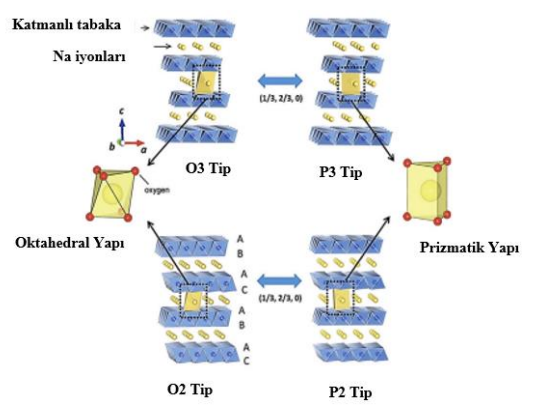
Figure 1. Layered O3, P3, O2 and P2 crystal structures with their respective stacking sequences [1]
P2-Type Cathodes
P2-type cathodes offer a low Na+ diffusion barrier thanks to their prismatic coordination environment, enabling fast sodium-ion transport and good cycle stability. The trade-off is a sodium content of roughly 0.67 -- below stoichiometric -- which can lead to first-cycle capacity loss.
O3-Type Cathodes
O3-type cathodes offer near-stoichiometric sodium content (Na approximately 1), translating to higher theoretical energy density. The challenge: O3-P3-O3' phase transitions during charging drive volumetric change and microcrack formation, degrading cycle stability. High-entropy strategies and multi-dopant approaches are among the most active research directions for addressing this structural degradation.
P2/O3 Biphasic Structures
Biphasic P2/O3 architectures aim to capture the advantages of both structures in a single material. Recent work suggests that biphasic integration can improve both structural stability and electrochemical performance simultaneously -- making this one of the more promising directions in the field.
Why Ni-Mn-Based Systems Lead the Research Agenda
Among layered oxide cathodes, Ni-Mn-based systems sit at the center of the research agenda. For context on how nanoparticle engineering fits into battery design, see our nanoparticles in battery studies overview.
- Cobalt-free: They deliver competitive performance without cobalt -- a strategic advantage for both cost and supply chain independence.
- Rich redox chemistry: Nickel's Ni2+/Ni3+/Ni4+ redox couples provide active capacity. Manganese primarily acts as a structural stabilizer, with Mn3+/Mn4+ transitions contributing partial capacity in a secondary voltage window.
- Synthesis maturity: These materials are well-understood across solid-state, sol-gel, and co-precipitation synthesis routes -- providing a solid foundation for scale-up work.
Doping and Coating Strategies
Base Ni-Mn cathodes show promising initial capacities but face structural challenges in long-term cycling: Jahn-Teller distortion from Mn3+ ions, irreversible phase transitions at high voltage, surface degradation at the electrolyte interface, and air stability issues. This means the base material needs a second layer of engineering.
Doping Approaches
- Ti substitution: Suppresses Jahn-Teller distortion by reducing Mn3+ concentration and stabilizes lattice parameters. Ti4+ incorporation can also improve sodium-ion transport by organizing Na+ diffusion pathways.
- Fe substitution: Offers a cost advantage while providing shared redox contribution with Mn. In systems co-doped with Li, additional capacity via a Li2MnO3-like mechanism has been observed, though the interpretation remains an active area of debate.
- Mg, Cu, Zn substitution: Electrochemically inactive dopants that mechanically stabilize lattice parameters and disrupt Na+/cation ordering to reduce phase transition abruptness.
Surface Coating Approaches
Surface coating involves depositing a thin functional layer on cathode particles. This suppresses degradation reactions at the electrolyte-electrode interface, protects against moisture and air exposure, and in some cases accelerates ion transport.
Magnesium oxide (MgO) nanoparticles, aluminum oxide (Al2O3) nanoparticles, and various phosphate coatings are among the leading candidates. Critically, doping and coating are not mutually exclusive: combining both strategies delivers performance gains that neither approach achieves on its own.
For a deeper look at MgO nanoparticle properties and applications, see our MgO nanoparticles blog post.
Structural Characterization
Demonstrating that a cathode material has the correct phase structure, that dopants have genuinely entered the crystal lattice, and that electrochemical performance gains are tied to structural causes requires systematic characterization.
- X-ray diffraction (XRD): The primary tool for phase identification, lattice parameter calculation, and phase purity assessment. In situ XRD tracks phase transitions in real time during charge-discharge.
- SEM and TEM analysis: Reveal particle morphology, size distribution, and coating homogeneity. EDS/EDX confirms whether dopant or coating elements are uniformly distributed throughout the particle.
- X-ray photoelectron spectroscopy (XPS): Resolves surface metal oxidation states, enabling determination of Ni2+/Ni3+/Ni4+ and Mn3+/Mn4+ ratios -- essential for understanding the cathode's redox mechanism.
- Key precursor materials: Browse manganese oxide nanoparticles and nickel oxide nanoparticles used in cathode synthesis.
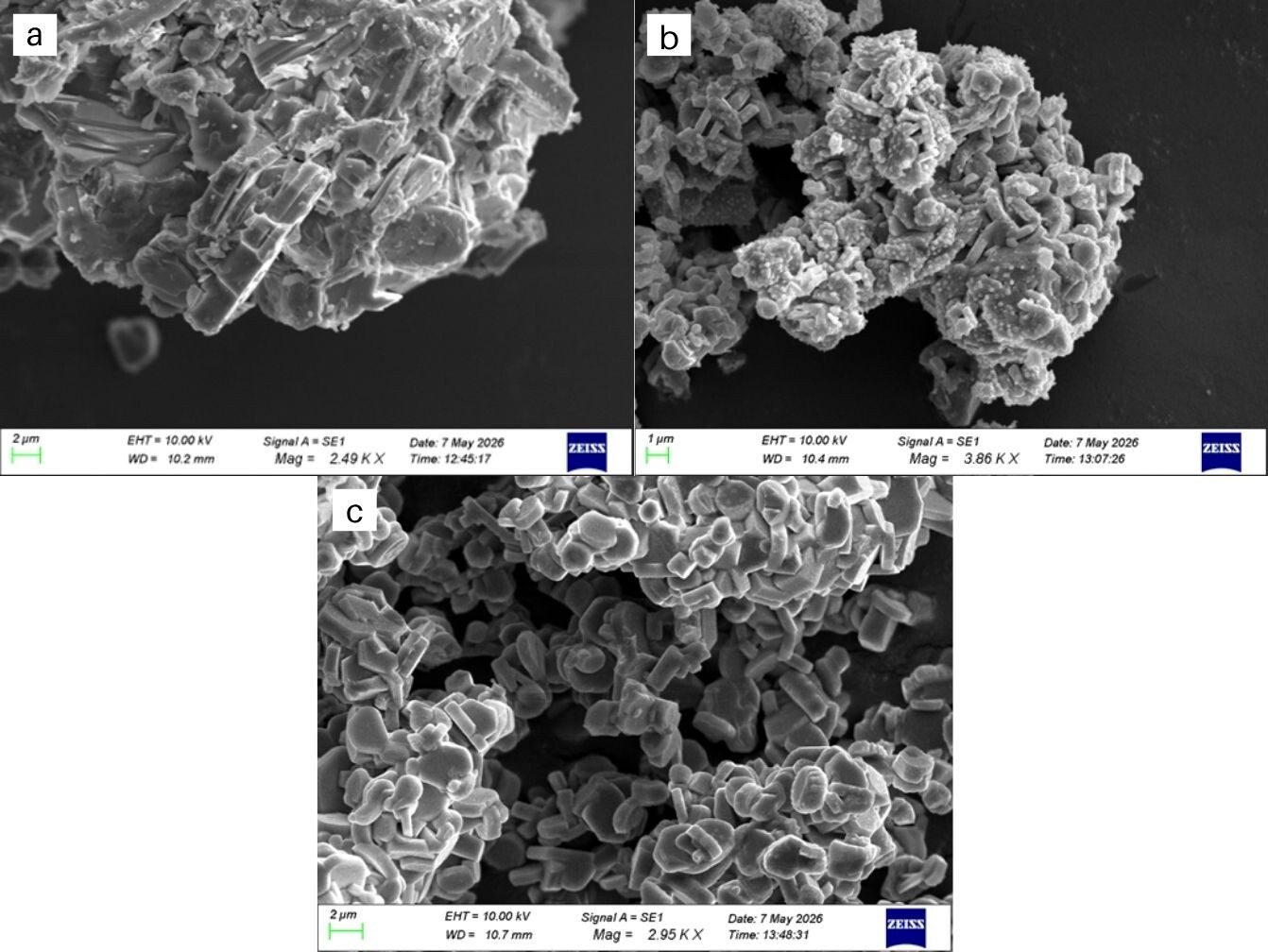
Figure 2. SEM micrographs of (a) NLNM-Fe (Na₀.₈₀Li₀.₁₃Ni₀.₂₀Fe₀.₁Mn₀.₅₇O₂), (b) NNM-MgO (Na₀.₆₇Ni₀.₃₃Mn₀.₆₇O₂ with MgO coating), and (c) NNM–Ti (Na₀.₇Ni₀.₄Mn₀.₄Ti₀.₂O₂) cathode materials synthesized by Nanografi.
Nanografi's Approach
Nanografi is one of the few organizations capable of carrying the advanced cathode materials required by the sodium-ion battery ecosystem from the research laboratory to industrial scale. Our expertise in this field is structured around four core capabilities.
Ni-Mn-Based Cathode Synthesis
We produce Ni-Mn-based cathode materials in P2 and O3 phase structures with different stoichiometries. Our team has strong know-how in solid-state, sol-gel, and co-precipitation synthesis routes, enabling flexible work at both research scale and pilot production volumes. At a time when demand for cobalt-free formulations is increasing rapidly, Nanografi’s synthesis portfolio is well positioned to support this transition.
Doping and Coating Services
We conduct systematic doping studies with various elements, particularly Ti, Fe, and Mg, and apply MgO, Al₂O₃, and related oxide coatings to cathode particles. These studies go beyond a standard service model: each formulation is developed through an optimization process supported by structural data. We design customized doping–coating combinations according to our customers’ target cycle stability and air stability requirements.
Comprehensive Structural Characterization
Every material we produce goes through a systematic characterization process, including XRD analysis for phase purity and lattice parameter verification, SEM/TEM analysis for morphology and coating homogeneity, and XPS analysis for determining surface oxidation states. This approach grounds performance claims in structural evidence and enables us to deliver reproducible, well-documented results to our customers.
Custom Formulation and R&D Collaboration
In addition to our standard product portfolio, we offer custom formulation development services for research groups and industrial partners. These collaborations are designed according to target application, performance criteria, and production constraints, and are supported by Nanografi’s technical infrastructure from the concept stage to prototype validation. For organizations aiming to achieve a competitive position in sodium-ion cathode technology, Nanografi serves as a reliable R&D partner.
Frequently Asked Questions
Will sodium-ion batteries replace lithium-ion batteries?
Full displacement is unlikely in the near term. Sodium-ion is positioning as a strong complementary technology -- particularly for grid-scale energy storage and cost-sensitive applications. The potential to formulate without cobalt or lithium supports long-term competitiveness.
P2 or O3 -- which cathode type is better?
Both have real trade-offs. P2-type offers advantages in rate performance and cycle stability but has limited energy density. O3-type offers higher theoretical capacity but presents harder phase transition management challenges. Current research suggests that biphasic P2/O3 architectures may offer the best balanced performance profile.
Can doping and coating be applied together in the same material?
Yes. Doping stabilizes the crystal structure from within; coating protects the surface interface from without. The synergy between these two approaches consistently outperforms either strategy alone.
What is the biggest technical challenge for Ni-Mn-based cathodes?
Air and moisture stability is a significant practical challenge. Many Ni-Mn-based cathode materials are prone to surface degradation in humid environments, which complicates storage and cell manufacturing. Functional surface coatings like MgO and structural modification with elements like Ti are the most effective tools for improving air stability and making industrial production viable.
Conclusion
The future of sodium-ion battery technology depends heavily on advances in cathode materials. Layered transition metal oxides -- particularly Ni-Mn-based systems -- are at the center of that work. P2 and O3 structures offer distinct performance profiles, while biphasic integration holds the promise of combining the best of both.
Doping and coating strategies provide a second engineering layer on top of base material performance. Ti, Fe, and Mg dopants alongside MgO and Al2O3 coatings offer proven pathways to improved cycle stability and air robustness.
Browse Nanografi's cathode materials and our full battery materials portfolio.
References
- Ahangari, M., Zhou, M., and Luo, H. (2025). Review of Layered Transition Metal Oxide Materials for Cathodes in Sodium-Ion Batteries. Micromachines, 16(2), 137.
- Huang, Y., et al. (2024). Na-deficient P2-type layered oxide cathodes for practical sodium-ion batteries. Microstructures, 4(3), 2024027.
- Shahzadi, I., et al. (2025). Advancing Sodium-Ion Battery Performance: Innovative Doping and Coating Strategies. Advanced Sustainable Systems.
- Lavela, S., et al. (2024). Improving the Performance of the Layered Nickel Manganese Oxide Cathode. ACS Applied Materials and Interfaces, 16(41).
- Saxena, S., et al. (2025). Probing the Compositional and Structural Effects on Na(Mn-Fe-Ni)O2 Cathodes. Battery and Energy Technology, 2(1).
- Ahmad, N., et al. (2025). Dual-Pillar Effect in P2-Type Na0.67Ni0.33Mn0.67O2. Advanced Energy Materials, 15(20).
- Frontiers in Energy Research (2022). Layered P2-NaxMn3/4Ni1/4O2 Cathode Materials for Sodium-Ion Batteries.
- Aziz, I., et al. (2024). Advancements in cathode technology, recycling strategies, and market dynamics. Separation and Purification Technology.
Recent Posts
-
What Is Conductive Masterbatch? CNT, Carbon Black and Graphene Compared
A conductive masterbatch is a concentrated blend of a conductive carbon additive and a carrier polym …14th Oct 2026 -

Biomaterials for Implants: Titanium vs Nitinol vs Hydroxyapatite Coatings
Implantable medical devices operate under very different mechanical and biological conditions. A hip …7th Oct 2026 -
CNT Paste vs Silver Paste vs Carbon Paste: Which Conductive Adhesive Should You Use?
Conductive pastes quietly hold much of modern electronics together. They bond chips to substrates, d …1st Oct 2026