
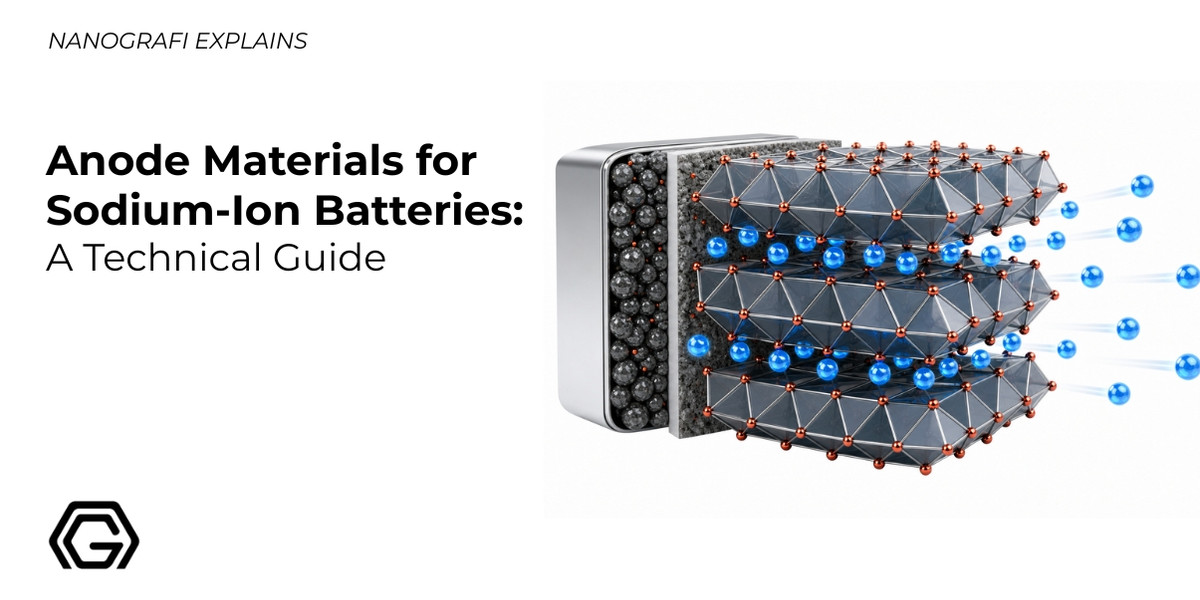
Anode Materials for Sodium-Ion Batteries: A Technical Guide
Sodium-ion batteries are gaining serious commercial momentum. First-generation cells are already reaching the market: but the anode side of the equation remains an active engineering challenge. While cathode materials for sodium-ion batteries have received significant research attention, the anode is equally decisive for overall cell performance, safety, and commercial viability.
The anode governs how sodium ions are stored and released during charge-discharge cycles. It determines first-cycle efficiency, rate capability, long-term cycling stability, and the low-voltage behavior that directly affects energy density. Getting the anode right is as important as getting the cathode right: and in sodium-ion systems, the challenge is different in almost every respect from what the lithium-ion field has already solved.
Why Sodium-Ion Batteries Require a Distinct Anode Chemistry
Lithium-ion batteries use graphite as a near-universal anode. Sodium-ion batteries cannot. The thermodynamic and structural incompatibility—arising from the large ionic radius of Na+ and the narrow interlayer spacing of graphite, prevents the formation of stable sodium-graphite intercalation compounds. This forces the sodium-ion field to develop its own anode chemistries from the ground up: a constraint that has driven substantial and still-ongoing research across four main material families.
For a broader view of where sodium-ion technology stands, see our battery materials portfolio overview.
The Four Anode Material Families
1. Hard Carbon: The Commercial Frontrunner
Hard carbon is the only anode material currently deployed in commercial sodium-ion cells. It is a non-graphitizable carbon material with a turbostratic structure: randomly oriented graphene like layers interspersed with closed and open nanopores. This structural disorder, which makes graphitization impossible, is precisely what makes hard carbon useful for sodium storage: sodium ions can be accommodated in the defect sites, interlayer spaces, and nanopores that the disordered structure provides.
Sodium Storage Mechanism: The Ongoing Debate
The mechanism by which hard carbon stores sodium has been debated for years, and research published through 2025 has significantly refined the picture. The dominant framework now describes a three-stage process:
- Slope region (high voltage, ~1.2–0.1 V vs. Na/Na⁺): Sodium ions adsorb at defect sites, heteroatom functional groups, and interlayer spaces. A fast-capacitive mechanism dominates, and recent electron paramagnetic resonance (EPR) studies have identified Na⁺–solvent co-intercalation events in this region alongside conventional intercalation. In-plane Stone-Wales transition to quasi-metallic sodium states during this stage.
- Early plateau region (~0 1–0.01 V): Faradaic charge-transfer reactions become significant at the inner surfaces of carbon micropores. Sodium ions begin to cluster, and repulsion effects slow the kinetics.
- Late plateau region (near 0 V): Micro- and slit-pore filling dominates, multilayer clustering of quasi-metallic sodium inside closed nanopores drives this stage.
This three-stage adsorption-accumulation-filling model, confirmed by operando small-angle X-ray scattering (SAXS) and wide-angle X-ray scattering (WAXS), now represents the most comprehensive mechanistic picture available.
The engineering implication is direct: plateau capacity correlates with closed-pore volume, while slope capacity correlates with surface area, defect density, and heteroatom content. Designing hard carbon for sodium-ion batteries means controlling both structural parameters simultaneously.
Precursor Engineering and Carbonization
Hard carbon can be derived from a wide range of precursors: biomass sources (cellulose, lignin, sucrose), synthetic polymers (resin, PAN), and pitch-based materials. Precursor chemistry and carbonization temperature are the primary levers for tuning microstructure:
- Higher carbonization temperatures (900–1300 °C) increase graphitic order, reduce interlayer spacing (d₀₀₂), and shift sodium storage toward the plateau region.
- Lower carbonization temperatures (600–900 °C) produce more disordered, defect-rich carbons with higher slope capacity but lower first-cycle efficiency (ICE).
- Co-carbonization strategies combining hard and soft carbon precursors can engineer closed-pore architectures that boost plateau capacity without sacrificing efficiency.
Recent work has demonstrated that steric bridging strategies: using molecules with branched carboxyl groups as cross-linking agents during carbonization: can precisely control pseudographitic crystallite size and interlayer spacing, enabling rational tuning of the slope-to-plateau ratio.
Key Performance Benchmarks
Leading hard carbon anodes in 2024–2025 report reversible capacities in the 300–450 mAh g⁻¹ range, with first-cycle ICE values of 75–90%. Rate performance and cycling stability remain the primary differentiators between formulations. For electrode fabrication, carbon nanoparticles and conductive additives play an important supporting role.
2. Alloy-Type Anodes: High Capacity, Demanding Engineering
Alloy-type anodes are based on elements that react with sodium to form intermetallic compounds: primarily tin (Sn), antimony (Sb), bismuth (Bi), and phosphorus (P). Their appeal is straightforward: theoretical capacities substantially exceed those of hard carbon:
|
Material |
Reaction Product |
Theoretical Capacity |
|
Sn |
Na₁₅Sn₄ |
~847 mAh g⁻¹ |
|
Sb |
Na₃Sb |
~660 mAh g⁻¹ |
|
Bi |
Na₃Bi |
~385 mAh g⁻¹ |
|
Red P |
Na₃P |
~2596 mAh g⁻¹ |
The engineering challenge is severe. Volume expansion during sodiation reaches 350-450% for tin and antimony, and exceeds this for phosphorus. This mechanical stress drives particle cracking, electrode delamination, loss of electrical contact, and rapid capacity fade without careful material design.
Tin-Based Anodes
Tin's redox chemistry proceeds through a multi-step alloying reaction (Sn → NaSn → Na₉Sn₄ → Na₁₅Sn₄), each step associated with volumetric change. The key engineering responses are nanostructuring and carbon matrix confinement:
- 2D layered Sn architectures with hard carbon buffer layers (SnHT/HC) have demonstrated initial capacities of ~470 mAh g⁻¹ with retention of ~438 mAh g⁻¹ after 3000 cycles at 0.2C and 99% Coulombic efficiency: a significant advance for practical applicability.
- Embedding tin nanoparticles in carbon matrices confines volumetric expansion and maintains electrical connectivity through cycling.
Antimony-Based Anodes
Antimony has received substantial research attention due to its relatively high electrical conductivity (~2.56 × 10⁶ S m⁻¹), suitable theoretical capacity (660 mAh g⁻¹ for Na₃Sb), and moderate operating potential (~0.5 V vs. Na/Na⁺). The two-step sodiation pathway (Sb → NaSb → Na₃Sb) is well characterized.
Recent advances include:
- N-doped 3D porous carbon network-confined FeSb alloy composites (3DFeSb@NC) with robust Fe–N–C bonds, which mitigate volume expansion while maintaining high capacity.
- Morphologically controlled Sb films via electrodeposition with surfactant additives (CTAB-assisted synthesis), achieving capacities above 190 mAh g⁻¹ at 5C rate.
- Nanocomposite architectures where Sb is dispersed within nitrogen-doped graphene frameworks, improving both kinetics and structural integrity.
For alloy anode research, antimony nanoparticles and bismuth nanoparticles are available through our materials portfolio.
Phosphorus-Based Anodes
Red phosphorus offers the highest theoretical capacity of any practical sodium anode material, but its near-zero electrical conductivity makes it impractical as a standalone electrode. Composite strategies: mixing red P with carbon black, reduced graphene oxide (rGO), or CNTs: are the standard engineering response. Carbon nanotube composites, in particular, have shown promising rate performance by providing a conductive network that compensates for phosphorus's insulating character. Explore our carbon nanotubes and MWCNT portfolio for relevant conductive additives.
3. Conversion-Type Anodes: Metal Oxides, Sulfides, and Selenides
Conversion-type anodes store sodium through reversible chemical transformation rather than intercalation or alloying. Metal oxides, metal sulfides, and metal selenides react with sodium to form sodium oxide (Na2O) (or Na₂S, Na₂Se) alongside the reduced metal. Theoretical capacities are high, but conversion reactions are associated with large voltage hysteresis, low first-cycle efficiency, and significant volume change.
Metal Oxides
Transition metal oxides (Fe₂O₃, Fe₃O₄, Co₃O₄, MoO₃, SnO₂) have been extensively studied. SnO₂ undergoes both a conversion reaction and an alloying reaction with sodium, making it a dual-mechanism anode with high theoretical capacity. Key challenges are low intrinsic conductivity and mechanical degradation. Nanostructuring and carbon compositing are the primary mitigation strategies.
Iron oxide nanoparticles: both Fe₂O₃ and Fe₃O₄: are available for battery research applications. Molybdenum trioxide nanoparticles and tin dioxide nanoparticles are similarly available.
Metal Sulfides and Selenides
MoS₂ has a layered structure with an interlayer spacing of ~6.2 Å: large enough to accommodate Na⁺: and undergoes an intercalation-then-conversion reaction pathway. FeS₂, CoS₂, and related compounds follow pure conversion mechanisms. Molybdenum disulfide in both nanoparticle and microparticle forms is available: MoS₂ nanoparticles and MoS₂ micron powder.
4. Emerging Anodes: MXenes, Organics, and Beyond
MXenes
MXenes: two-dimensional transition metal carbides and nitrides of the general formula M_{n+1}X_nT_x: have attracted growing interest as sodium-ion anode materials. Ti₃C₂T_x is the most studied composition. Their appeal comes from a combination of intrinsic metallic conductivity, tunable surface chemistry (T_x functional groups: –OH, –F, –O), and a layered structure with adjustable interlayer spacing.
The sodium storage mechanism in Ti₃C₂T_x involves both surface adsorption (capacitive) and interlayer intercalation (Faradaic) contributions. In situ XAS studies have confirmed Ti oxidation state changes during sodiation, and Bader charge analysis shows that the formal oxidation state framework underestimates actual charge transfer at Ti–C bonds. The mechanism is complex and remains an active research area.
Key practical challenges include MXene restacking (which eliminates interlayer spacing and blocks ion-transport channels), surface oxidation during cycling, and long-term stability. Engineering solutions include intercalating nanoparticles as spacers between MXene layers: Cu₂₋ₓSe@Ti₃C₂T_x heterostructures, for example, have demonstrated 248 mAh g⁻¹ at 10 A g⁻¹ with 92% capacity retention after 750 cycles. Our MXene powders and MXene suspensions support this research direction.
Organic and MOF-Based Anodes
Organic anodes based on carbonyl compounds (quinones, carboxylates, imides) offer structural flexibility, low cost, and tunable redox potential. Their main limitations are high solubility in liquid electrolytes and relatively low volumetric energy density. Metal-organic framework (MOF)-derived carbons are an increasingly active research area, with the porous, heteroatom-rich carbon networks obtained by MOF pyrolysis offering a middle ground between hard carbon and conversion-type behavior. Our metal-organic frameworks portfolio supports precursor-level research in this direction.

Nanostructuring Strategies: The Cross-Cutting Theme
Across all four anode families, nanostructuring is the primary engineering lever for addressing the core challenges of sodium storage. The strategies are material-specific but conceptually unified:
For alloy and conversion-type anodes, nanostructuring reduces absolute volume change per particle and shortens ion-transport pathways. Particles below ~100 nm are subjected to lower mechanical stress and exhibit lower fracture susceptibility during expansion–contraction cycling. Embedding active nanoparticles within carbon matrices provides a mechanical buffer and maintains electrical connectivity even after particle fracturing.
For hard carbon, nanostructuring is more about controlling pore architecture than particle size. Closed-pore volume engineering: through precursor selection, carbonization temperature, and cross-linking chemistry: directly controls plateau capacity and first-cycle efficiency.
For MXenes, preventing restacking through spacer intercalation is the dominant nanostructuring challenge, as sheet-to-sheet contact eliminates the accessible interlayer space that enables ion storage.
Key precursor materials for nanostructured anode development include silicon nanoparticles, iron oxide nanoparticles, and titanium dioxide nanoparticles.
Structural Characterization
Establishing structure–performance relationships in sodium-ion anodes requires systematic characterization at multiple length scales. The cathode characterization toolkit: described in our cathode materials guide: applies here too, with some anode-specific additions:
X-ray diffraction (XRD): For hard carbon, the d₀₀₂ interlayer spacing (from the broad (002) peak) and the L_a and L_c crystallite dimensions directly correlate with electrochemical behavior. For alloy anodes, in situ XRD tracks phase evolution through the sodiation/desodiation sequence and identifies irreversible phase transformations.
Small-angle X-ray scattering (SAXS): Critical for hard carbon: SAXS directly probes closed-pore size distributions, which are the structural determinant of plateau capacity. Operando SAXS during cycling directly links pore filling to electrochemical response.
Raman spectroscopy: The D/G band ratio quantifies graphitic disorder in carbon anodes. Operando Raman tracks structural evolution during cycling and can detect metallic sodium plating at low potentials.
SEM and TEM: Reveal particle morphology, cracking behavior after cycling, and coating/composite homogeneity. EDS/EDX confirms elemental distribution in composite anodes.
XPS: Resolves the solid electrolyte interphase (SEI) composition on anode surfaces: critical for understanding first-cycle losses and electrolyte compatibility.
Electron Paramagnetic Resonance (EPR): A more recent addition to the toolkit, EPR has proven capable of identifying quasi-metallic sodium states and distinguishing between different intercalation mechanisms in hard carbon: a capability that conventional diffraction and spectroscopy techniques cannot provide.
Nanografi's Approach
Nanografi's capabilities in the sodium-ion battery anode space span both the materials themselves and the research infrastructure needed to develop and characterize them.
Carbon Precursor and Hard Carbon Development
We supply a range of carbon-based materials relevant to hard carbon anode development, including carbon nanoparticles, graphite micron powder, and graphene oxide as precursor and additive materials. For composite electrode fabrication, our MWCNT and SWCNT portfolios provide conductive network materials with well-characterized surface chemistry.
Alloy Anode Precursor Materials
For alloy-type anode research, we supply tin nanoparticles, antimony micron powder, bismuth nanoparticles, and phosphorus micron powder: the primary active materials for this class of anodes.
Conversion-Type Anode Materials
Our oxide and sulfide nanoparticle portfolio covers the key conversion-type anode chemistries: iron oxide nanoparticles, Fe₃O₄ magnetic nanoparticles, molybdenum disulfide nanoparticles, and tin dioxide nanoparticles.
MXene Materials
We supply MXene powders and MXene suspensions derived from MAX phase precursors, supporting both fundamental MXene research and composite electrode development for sodium-ion applications.
Battery Cell Assembly Infrastructure
Research-scale anode evaluation requires the right cell hardware. Our coin cell materials, copper foil current collectors, battery separators, and battery lab equipment provide the full infrastructure for half-cell and full-cell sodium-ion testing.
Custom R&D Collaboration
For research groups and industrial partners working on anode development, Nanografi offers custom material synthesis and formulation services. Whether the requirement is a specific particle size distribution for a nanocomposite anode, a surface-functionalized carbon material for improved SEI chemistry, or a systematic precursor study for hard carbon optimization, our technical team can support the development from concept to prototype validation.
Frequently Asked Questions
Why can't sodium-ion batteries use graphite anodes? Graphite intercalates lithium ions efficiently because Li⁺ fits within the graphene interlayer spacing (0.335 nm) and forms stable intercalation compounds (LiC₆). Sodium's larger ionic radius (~1.02 Å vs. Li's ~0.76 Å) means the thermodynamics of Na⁺ intercalation into graphite are unfavorable: the interlayer spacing is too small, and the Na-graphite intercalation compounds are thermodynamically unstable. Hard carbon's turbostratic, expanded interlayer structure is what makes sodium storage possible.
Is hard carbon ready for commercial use? Yes: hard carbon is already deployed in first-generation commercial sodium-ion cells from manufacturers including CATL and HiNa Battery. The primary ongoing challenges are improving first-cycle efficiency (ICE, currently 75– 90% in commercial materials), increasing plateau capacity, and ensuring precursor consistency at manufacturing scale. The sodium storage mechanism debate also has practical implications: SEI formation chemistry and electrolyte compatibility depend on whether storage occurs in the slope or plateau region.
What is the main challenge for alloy anodes? Volume expansion is the defining challenge. Tin expands by over 400% during full sodiation. Without nanostructuring or matrix confinement, this expansion causes particle cracking, electrode delamination, and rapid capacity fade. The field's response: embedding active nanoparticles in carbon matrices, engineering 2D layered architectures, and developing binder systems that accommodate expansion: has produced materials with promising cycle life (>1000 cycles in research settings), but scaling these approaches while maintaining capacity is the active engineering challenge.
Can different anode types be combined? Yes. Hard carbon/alloy composite anodes are an active research direction. Embedding alloy materials (Sn, Sb) at specific ratios within hard carbon matrices provides capacity enhancement from the alloying component while the carbon matrix buffers volume expansion. The engineering goal is to capture the high capacity of alloy materials without sacrificing the cycle stability of hard carbon.
How does the anode affect full-cell performance? The anode's first-cycle efficiency (ICE) directly determines how much sodium is irreversibly consumed on the first cycle, reducing full-cell capacity. Low ICE (< 80%) requires pre-sodiation strategies or cathode capacity excess to compensate. Anode operating potential window also affects full-cell voltage and safety: anodes operating near 0 V vs. Na/Na⁺ (plateau region of hard carbon) risk sodium plating under fast-charge conditions.
Conclusion
The anode side of sodium-ion battery technology is more varied and technically challenging than the cathode side. Hard carbon has established commercial viability but continues to be refined through microstructure engineering. Alloy-type anodes offer a path to substantially higher energy density but require material engineering solutions to manage volume expansion. Conversion-type and emerging anodes extend the design space further, with MXenes and MOF-derived carbons among the most actively researched directions.
Across all of these, nanostructuring: whether particles, pore architecture, or 2D layer stacking: is the primary tool for translating theoretical capacity into practical performance.
Browse Nanografi's anode materials, battery materials portfolio, and related nanoparticle and carbon nanotube offerings to support your sodium-ion battery research.
References
- Pei, F., et al. (2025). Hard Carbon for Sodium-Ion Batteries: From Fundamental Research to Practical Applications. Advanced Materials, 202504574.
- Xia, Y., et al. (2025). Elucidating Sodium Ion Storage Mechanisms in Hard Carbon Anodes at the Electronic Level. Advanced Functional Materials, 202421976.
- Tratnik, B., et al. (2025). An enhanced three-stage model for sodium storage in hard carbons. RSC Energy & Environmental Science.
- Wang, F., et al. (2025). Pushing slope- to plateau-type behavior in hard carbon for sodium-ion batteries via local structure rearrangement. Energy & Environmental Science, 18, 4312–4323.
- Shahzad, M., et al. (2025). Designing Tin and Hard Carbon Architecture for Stable Sodium-Ion Battery Anode. Small Structures, 202400367.
- Mallik, A.K.R., et al. (2024). Recent advances in alloying anode materials for sodium-ion batteries. Energy Materials, 4, 400068.
- Wang, X., et al. (2025). Synthesis and regulation strategies for enhancing the electrochemical performance of sodium-ion battery anode materials. Chemical Science.
- Ti₃C₂T_x MXenes as Anodes for Sodium-Ion Batteries: the In Situ Comprehension of the Electrode Reaction. (2025). ACS Applied Energy Materials.
- Advancements in sodium-ion batteries technology: A comprehensive review. (2025). Energy Reports, ScienceDirect.
- Xu, L., et al. (2025). Bridging Structure and Performance: Decoding Sodium Storage in Hard Carbon Anodes. ACS Nano, 19(15), 14627–14651.
Recent Posts
-

MXene for EMI Shielding: Materials, Mechanisms and Applications
Electromagnetic interference has become a design constraint rather than an afterthought. Densely pac …10th Sep 2026 -
Handling and Storage Best Practices for Metal Oxide Nanopowders
A metal oxide nanopowder is bought for a property that a coarse powder cannot deliver: a specific su …1st Sep 2026 -
Activated Carbon vs Zeolites vs MOFs: Which Adsorbent Material Should You Choose?
Activated carbon, zeolites and metal-organic frameworks (MOFs) represent three distinct adsorbent cl …20th Aug 2026