
Vanadium Aluminum Carbide (V2AlC) MAX Phase Micron Powder, APS: 325 Mesh, Purity: 99+%
(No reviews yet)
Write a Review
- SKU:
- NG01MP0301
- Shipping:
- Calculated at Checkout

Frequently bought together:
Description
25 grams: 70€
100 grams: 160€
500 grams: 390€
1000 grams: 645€
Contact us for tailored quotes on larger quantities & experience exceptional solutions from our experts.
Vanadium Aluminum Carbide (V2AlC) MAX Phase Micron Powder
APS: 325 Mesh, Purity: 99+%
Vanadium Aluminum Carbide is a representative of the 211 MAX phase family, distinguished by its hexagonal P63/mmc space group symmetry. Its microstructure consists of edge-sharing V6C octahedra layers interleaved with sheets of Al atoms. From a materials science perspective, V2AlC is noted for its exceptional damage tolerance and unique kinking non-linear elastic behavior. This allows the material to dissipate significant mechanical energy through the formation of incipient kink bands (IKBs) rather than catastrophic brittle fracture.
Technical Properties
| Compound Formula | V2AlC |
| Purity | 99+% |
| Average Particle Size | 325 mesh |
| Color | Gray |
| CAS No | 12179-42-9 |
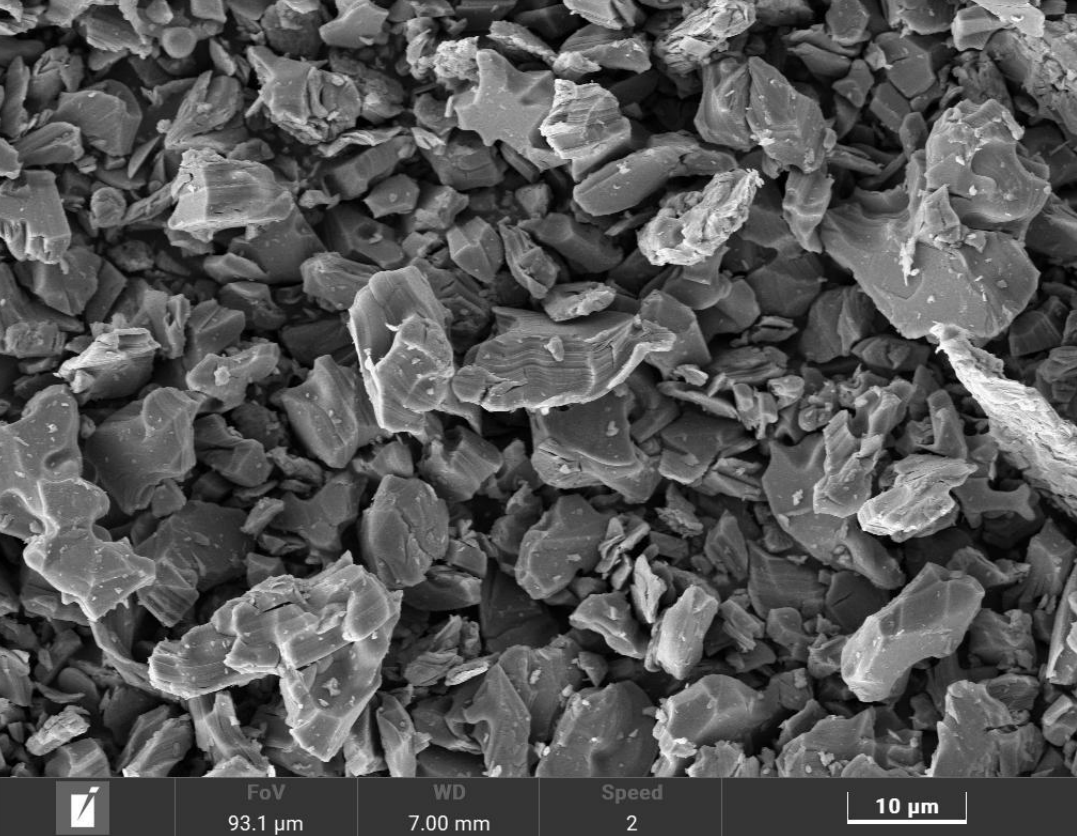
SEM Image
Applications
- MXene Synthesis: V2AlC is the critical precursor for the production of Vanadium Carbide MXenes (V2CTx). Unlike the more common Ti-based MXenes, V-based variants offer higher theoretical capacities for alkali metal ions, making them elite candidates for next-generation ion-battery anodes and pseudocapacitors.
- Electrochemical Sensing and Biosensing: The V-rich surface of this MAX phase and its derived MXenes exhibit high electrocatalytic activity. It is extensively researched for detecting biomolecules (such as glucose or neurotransmitters) and heavy metal ions in environmental monitoring due to its stable signal transduction.
- Nuclear and Radiation Resistance:V2AlC shows significant promise in nuclear engineering. Its layered structure is capable of managing radiation-induced defects and helium sequestration better than traditional ceramics, positioning it as a candidate for cladding materials in Gen-IV nuclear reactors.
- High-Temperature Oxidation Protection: At elevated temperatures, V2AlC can form complex oxide scales. It is utilized in specialized high-temperature coatings where high-density structural integrity and resistance to thermal fatigue are required simultaneously with metallic conductivity.
- Hydrogen Evolution Reaction (HER) Catalysis: The transition metal sites within the V2AlC matrix facilitate efficient charge transfer for water splitting applications. Its chemical resilience allows it to operate as a stable catalyst support in both acidic and alkaline electrolytes.
Related Products
Related Products

Niobium Aluminum Carbide (Nb2AlC) MAX Phase Micron Powder, APS: 325 Mesh, Purity: 99+ %
$80.65
25 grams: 70€100 grams: 160€500 grams: 390€1000 grams: 645€
Contact us for tailored quotes on larger quantities & experience exceptional solutions from our experts.
Niobium Aluminum Carbide (
NG01MP0501

Titanium Aluminum Carbide (Ti2AlC) MAX Phase Micron Powder, APS: 325 Mesh, Purity: 99+ %
$74.89
25 grams: 65€100 grams: 140€500 grams: 295€1000 grams: 490€
Contact us for tailored quotes on larger quantities & experience exceptional solutions from our experts.
Titanium Aluminum Carbide...
NG01MP0201


Titanium Aluminum Carbide (Ti3AlC2) MAX Phase Micron Powder, APS: 325 Mesh, Purity: 99+ %
$74.89
25 grams: 65€100 grams: 140€500 grams: 295€1000 grams: 490€
Contact us for tailored quotes on larger quantities & experience exceptional sol
NG01MP0401

Titanium Tin Carbide (Ti2SnC) MAX Phase Micron Powder, APS: 325 Mesh, Purity: 99+ %
$80.65
25 grams: 70€100 grams: 160€500 grams: 390€1000 grams: 645€
Contact us for tailored quotes on larger quantities & experience exceptional solutions from our experts.
Titanium Tin Carbide (Ti2SnC)...
NG01MP0101
NEW


Chromium Aluminum Carbide (Cr2AlC) MAX Phase Micron Powder, Purity: 99%, Size: -400 mesh
$74.89
25 grams: 65€100 grams: 140€500 grams: 295€1000 grams: 490€
Contact us for tailored quotes on larger quantities & experience exceptional solutions from our experts.
Chromium Aluminum Carbide...
NG10MPW1721