
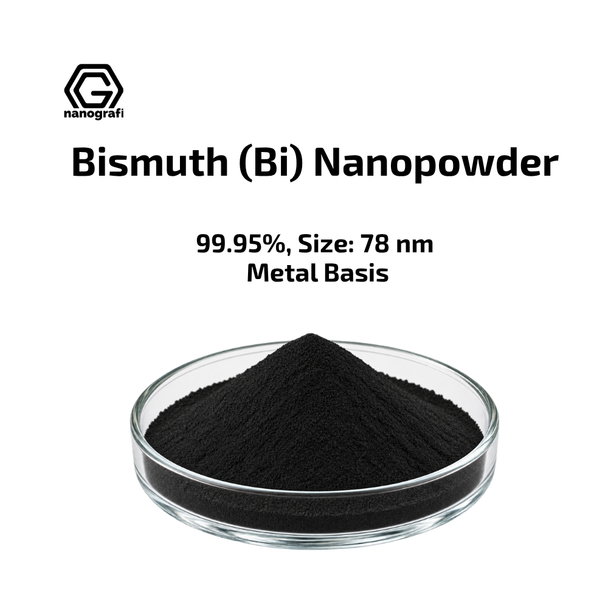
Bismuth (Bi) Nanopowder/Nanoparticles, Purity: 99.95%, Size: 78 nm, Metal Basis
- SKU:
- NG04EO0601
- Shipping:
- Calculated at Checkout

Description
100 grams/486 €
Technical Properties of Bismuth (Bi) Nanopowder, Purity: 99.95%, Size: 78 nm, Metal Basis
| Shape | spherical | ||||||
| Tmelting (oC) | 271 | ||||||
| Tboiling (oC) | 1560 | ||||||
| Average Particle Size (nm) | 78 | ||||||
| Specific Surface Area (m2/g) | 17-28 | ||||||
| Elemental Analysis | Bi | O | S | C | Si | Na | Others |
| ≥99.95 | 0.07 | 0.005 | 0.004 | 0.002 | 0.002 | ≤0.001 |
CAS: 7440-69-9
FAQ
FAQ About Bismuth (Bi) Nanopowder, 99.95% Purity, 78 nm
1) Which specifications are most important when evaluating this bismuth nanopowder?
Key parameters include 99.95% purity, 78 nm average particle size, spherical morphology and a specific surface area of 17-28 m²/g. These values provide a practical basis for comparing the material with other elemental bismuth nanopowders for research and formulation work.
2) Why can spherical morphology matter when selecting a bismuth nanopowder?
Particle shape can influence packing, flow behavior and distribution within a formulation. For Nanografi's 78 nm Bismuth Nanopowder, spherical morphology should therefore be considered together with particle size and surface area when assessing processing requirements.
3) Can this bismuth nanopowder be considered for metallurgical and alloy-development research?
Yes. Elemental bismuth is used in alloying and metallurgical research, including systems where composition and melting behavior are important. The 271°C melting point and defined elemental composition of this grade can be considered when designing a specific alloy or processing route.
4) Is 78 nm bismuth relevant to low-melting alloy and solder research?
Yes. Bismuth is widely used in low-melting alloy and solder systems. When this nanopowder is evaluated for such work, particle size, purity, thermal processing conditions and compatibility with the other alloying elements should be considered together.
5) Can bismuth nanoparticles be evaluated as a lead-free material option?
Yes. Bismuth-based materials are used in research aimed at replacing lead in areas such as ceramics, glazes and related formulations. Researchers comparing available bismuth grades can review Nanografi's range of bismuth nanoparticle materials for additional options.
6) Why is the elemental impurity profile important when selecting a high-purity bismuth nanopowder?
Trace elements can affect reproducibility and downstream material behavior in sensitive formulations. Nanografi specifies Bi at ≥99.95%, together with defined levels for oxygen, sulfur, carbon, silicon, sodium and other residual elements, giving researchers a clearer basis for material comparison.
7) Can this material be evaluated for thermal or heat-transfer research?
Yes. Bismuth nanoparticles are used in research involving thermal and heat-transfer systems. Particle size, specific surface area, dispersion quality and the thermal properties of the complete formulation should all be considered before selecting the material for a specific system.
8) Is Nanografi Bismuth Nanopowder relevant to imaging or radiation-related materials research?
Bismuth-based nanoparticles are widely studied in imaging and radiation-related materials because bismuth has a high atomic number. This elemental nanopowder can be considered as a starting material for research, while formulation design and application-specific validation remain necessary for biomedical or radiation-related use.
9) How is elemental bismuth different from bismuth compounds such as Bi2S3?
Elemental bismuth and bismuth compounds have different chemical compositions and functional behavior, so they should not be treated as interchangeable materials. For example, researchers requiring a compound rather than elemental Bi can compare other compound nanopowders available from Nanografi when selecting the appropriate material chemistry.
10) Where can similar elemental nanopowders be compared?
Researchers comparing metal nanopowders by purity, particle size and elemental composition can explore Nanografi's broader selection of elemental nanoparticles.
11) Where can published studies using Nanografi materials be reviewed?
Researchers looking for documented material-use examples can explore the scientific publications featuring Nanografi materials to review how advanced materials from the portfolio have been used in academic research.
Related Products
Related Products

Silver (Ag) Nanopowder/Nanoparticles, Purity: 99.95%, Size: 48-78 nm, Metal Basis
Chromium (Cr) Nanopowder/Nanoparticles, Purity: 99.95 %, Size: 100 nm, Metal Basis
Silver (Ag) Nanopowder/Nanoparticles, Purity: 99.95+%, Size: 20 nm, Metal Basis

Tungsten (W) Nanopowder/Nanoparticles, Purity: 99.95%, Size: 780 nm, metal basis
