
Boron Nitride (BN) Nanopowder/Nanoparticles, Purity: 98.5+%, Size: 100 nm, Hexagonal

- SKU:
- NG04CO0302
- Shipping:
- Calculated at Checkout

Description
5 grams/45 €
25 grams/100 €
100 grams/215 €
500 grams/780 €
1000 grams/1510 €
Product Overview of Boron Nitride (BN) Nanopowder 98.5+%, Size: 100 nm, Hexagonal
This hexagonal boron nitride (h-BN) is supplied as a white nanopowder with a minimum h-BN content of 98.5% and a median particle size (D₅₀) of approximately 100 nm. Hexagonal boron nitride combines thermal conductivity with electrical insulation, and its layered crystal structure provides solid lubrication. This grade can be evaluated as a filler in thermal management formulations or as an additive in lubricants and low-friction coatings. Performance depends on filler loading, dispersion, and the formulation.
Technical Properties of Boron Nitride (BN) Nanopowder 98.5+%, Size: 100 nm, Hexagonal
| Appearance | White Powder |
|
h-BN Content |
98.5+% |
|
B2O3 Content |
0.2% |
|
Moisture |
0.2% |
|
Average Particle Size |
100 nm |
|
Surface Area |
30-70 m²/g |
|
CAS No |
10043-11-5 |
SEM Image
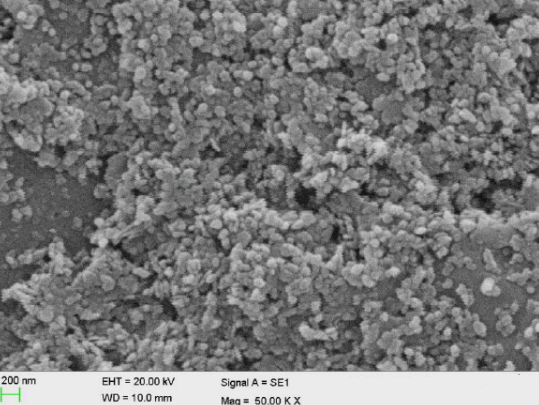
Applications of Boron Nitride (BN) Nanopowder 98.5+%, Size: 100 nm, Hexagonal
- Thermally Conductive Polymer Composites. Can be evaluated as a ceramic filler in polymer compounds designed to transfer heat while maintaining electrical insulation.
- Electronic Encapsulants and Adhesives. Can be evaluated in epoxy encapsulants, potting compounds, and adhesives where heat transfer and electrical insulation are both required.
- Lubricating Oils and Greases. Can be dispersed as a solid lubricant additive in formulations intended to reduce friction and wear between sliding surfaces. Evaluate dispersion stability and tribological performance in the selected base lubricant.
- Low-Friction Coatings. Can be evaluated in resin-based coatings for sliding surfaces where lower friction is a design objective. Assess friction and wear on the cured coating under the intended contact conditions.
FAQ
Frequently Asked Questions About Hexagonal Boron Nitride (h-BN) Nanopowder
1. What is hexagonal boron nitride nanopowder used for?
Hexagonal boron nitride (h-BN) nanopowder is investigated for thermal management materials, electrically insulating composites, protective coatings, ceramic formulations, and solid lubrication. Its layered crystal structure, thermal stability, and electrical insulating properties make it attractive for advanced materials research. Explore NANOGRAFi's Boron Nitride Nanoparticles collection for related materials.
2. Can 100 nm boron nitride nanoparticles improve thermal conductivity in polymer composites?
This grade can be evaluated as a ceramic filler in epoxy, silicone, and selected thermoplastics for applications such as thermal interface materials and electronic encapsulants. The effect on thermal conductivity depends on filler loading, dispersion, particle orientation, and heat transfer across the filler–polymer interface. Measure thermal conductivity and electrical insulation in the finished formulation. For additional background, read NANOGRAFi's guide to boron nitride nanopowder applications.
3. What is the difference between hexagonal boron nitride and cubic boron nitride?
Hexagonal boron nitride (h-BN) has a layered structure and is widely studied for lubrication, thermal management, and electrically insulating composites. Cubic boron nitride (c-BN) has a diamond-like crystal structure and is particularly valued for its high hardness and abrasive performance. For machining and wear-resistant applications, researchers may consider NANOGRAFi's Cubic Boron Nitride Nanopowder (99.9%, <200 nm).
4. How does 100 nm hexagonal BN compare with larger BN particles?
The approximately 100 nm D₅₀ describes the median of the particle-size distribution. Particle size can affect dispersion, agglomeration, viscosity, and packing. Larger particles or blends of different particle sizes may help form heat-transfer pathways in some composites. Compare grades at the same filler loading and under the same processing conditions to assess their effect in your formulation. Researchers can compare this grade with Hexagonal Boron Nitride Powder (790 nm, 99.7%) to evaluate particle-size effects.
5. Is hexagonal boron nitride electrically conductive?
Hexagonal boron nitride is generally an electrical insulator with a wide electronic bandgap. This distinguishes it from electrically conductive carbon-based fillers and makes it attractive for applications requiring heat dissipation without creating conductive pathways. Electrical insulation and thermal performance in finished composites depend on filler concentration, defects, interfaces, and processing conditions.
6. What is the difference between boron nitride and aluminum nitride nanoparticles?
Both boron nitride and aluminum nitride are investigated as thermally conductive ceramic fillers for electronic packaging and polymer composites. Hexagonal BN has a layered structure with anisotropic thermal properties, whereas aluminum nitride has a different crystal structure and thermal transport behavior. Material selection depends on thermal conductivity requirements, moisture sensitivity, electrical insulation, and compatibility with the matrix. Researchers can compare NANOGRAFi's Aluminum Nitride (AlN) Nanopowder, 50 nm for alternative thermal management formulations.
7. How can hexagonal boron nitride nanoparticles be dispersed in polymers or solvents?
Dispersion of h-BN nanoparticles can be challenging because fine particles tend to form agglomerates. Mechanical mixing, controlled ultrasonication, compatible dispersing agents, and suitable surface treatments may improve distribution in selected liquid media and polymer matrices. The appropriate method depends on the solvent, polymer chemistry, particle concentration, and intended application. Uniform dispersion should be verified using suitable characterization methods.
8. Can boron nitride nanopowder be used in high-temperature coatings and ceramic materials?
Hexagonal boron nitride is investigated for high-temperature coatings, ceramic composites, release agents, and protective layers because of its thermal stability, chemical behavior, and lubricating characteristics. However, oxidation resistance depends on temperature, atmosphere, and exposure duration. For researchers evaluating alternative ceramic nanomaterials, NANOGRAFi's Compound Nanopowders category includes other materials for comparative studies.
9. How should hexagonal boron nitride nanopowder be stored and handled?
Boron nitride nanopowder should be stored in a tightly sealed container in a cool, dry environment, following the supplier's recommended storage conditions. Handling procedures should minimize airborne powder generation through suitable containment, ventilation, and personal protective equipment. Researchers should consult the product-specific Safety Data Sheet (SDS) before weighing, transferring, or dispersing the material.
Related Products
Related Products

Boron Nitride (BN) Nanopowder/Nanoparticles, Purity: 99.7%, Size: 790 nm, Hexagonal

Boron Carbide (B4C) Nanopowder/Nanoparticles, Purity: 99.5+%, Size: 40-60 nm, Hexagonal

Boron (B) Nanopowder/Nanoparticles , APS:100 nm, Purity:99.55+%

Boron Oxide (B2O3) Nanopowder/Nanoparticles, Purity: 99.95 %, Size: 50 nm
