
Gold Nanostars, Size: 40-45 nm

- SKU:
- NG04EO0305

Description
Gold Nanostars
Size: 40-45 nm
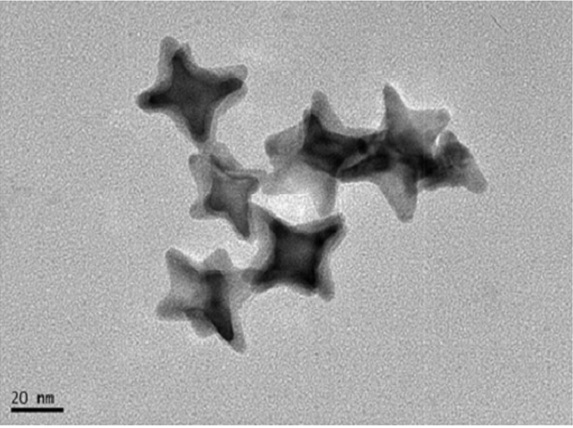
Gold Nanostars are high-performance nanoparticles characterized by multiple sharp, pointed branches that form a distinct star-shaped morphology. This unique anisotropic architecture creates "hot spots" at the branch tips, significantly enhancing their thermoplasmonic and electromagnetic properties compared to spherical nanoparticles. Surface-modified with HEPES and suspended in ultrapure water, these nanostars form a stable, blue-colored colloidal solution with a sharp Surface Plasmon Resonance (SPR) peak at approximately 690 nm. Their high specific surface area allows for easy functionalization with biorecognition molecules, while their ultra-fine dimensions (40-45 nm) ensure excellent biocompatibility. These features make Gold Nanostars a premier choice for advanced medical research, providing a robust platform for high-sensitivity diagnostics, targeted therapies, and precision optical sensing.
Technical Properties
| Composition | Gold nanostars with HEPES in ultrapure water |
| Average Diameter (TEM) | 40–45 nm (projected diameter) |
| Optical Density (OD) | 1 (per cm at SPR peak) |
| SPR Absorption Peak | ~690 nm |
| Appearance | Blue aqueous solution |
| Solution Volume | 10 ml / bottle |
| CAS No | 7440-57-5 |
SEM Image
Applications
- Biosensing and Diagnostics: Utilized in high-sensitivity biosensors and immunosensing platforms for early disease detection, including COVID-19 research. The sharp branches amplify signals, enabling the detection of low-concentration biomarkers.
- Targeted Drug Delivery: Acts as a sophisticated carrier for therapeutic agents. Their high functionalization capability allows for the attachment of specific ligands that target diseased cells while minimizing systemic side effects.
- Cancer Photothermal Therapy: Leverages their strong SPR absorption in the near-infrared (NIR) region to convert light into localized heat. This localized thermoplasmonic effect is used to selectively destroy malignant tumors without damaging surrounding healthy tissue.
- Advanced Spectroscopy (SERS/TERS): Serves as an exceptional substrate for Surface-Enhanced Raman Spectroscopy (SERS) and Tip-Enhanced Spectroscopy (TERS). The "hot spots" at the star tips provide massive electromagnetic enhancement for single-molecule detection.
- Biolabeling and Imaging: Employed as high-contrast biolabels in cellular imaging and medical diagnostics. Their unique optical signatures allow for precise tracking and visualization of biological processes at the nanoscale.
- Optical and Plasmonic Research: Used in the development of next-generation optical limiters, waveguides, and plasmon-enhanced devices where controlled light-matter interaction is critical.
Related Products
Related Products
Magnesium Oxide (MgO) Nanopowder/Nanoparticles, Purity: 99.95%, Size: 45 nm

Barium Titanate (BaTiO3) Nanopowder/Nanoparticles, Purity: 99.95%, Size: 45 nm, Cubic
Zirconium Diboride (ZrB2) Nanopowder/Nanoparticles, Purity: 99.5%, Size: 45 nm, Hexagonal

Tantalum (Ta) Nanopowder/Nanoparticles, High Purity: 99.9%, Size: 45-75 nm
