
Nickel Oxide (NiO) Nanopowder/Nanoparticles, Purity: 99.9%, Size: 10-20 nm
(No reviews yet)
Write a Review

- SKU:
- NG04SO2803
- Shipping:
- Calculated at Checkout

Frequently bought together:
Description
5 grams/ 33 €
25 grams/53 €
100 grams/91 €
500 grams/213 €
1000 grams/415 €
Please contact us for quotes on larger quantities !!!
Nickel Oxide (NiO) Nanopowder/Nanoparticles
Purity: 99.9%, Size: 10-20 nm
Nickel Oxide (NiO) Nanopowder is an ultra-fine, dark grey transition metal oxide material engineered for high-precision advanced applications. Characterized by an exceptionally large specific surface area and high phase purity, it exhibits superior surface reactivity, quantum size effects, and rapid ion transport kinetics. Its extremely small nanoscale dimensions ensure exceptional dispersion stability and uniform sintering dynamics, making it an indispensable component in solid oxide fuel cell anodes, electrochromic smart window coatings, advanced functional nanocomposites, and catalytic systems.
Technical Properties
| Purity (%) | 99.9 |
| Appearance | Dark Gray Powder |
| Particle Size (nm) | 10-20 |
| Surface Area (m2/g) | 80-100 |
| pH | 8-9 |
| L.O.I. (@850℃, 2h) | 1.5% max |
| CAS No | 313-99-1 |
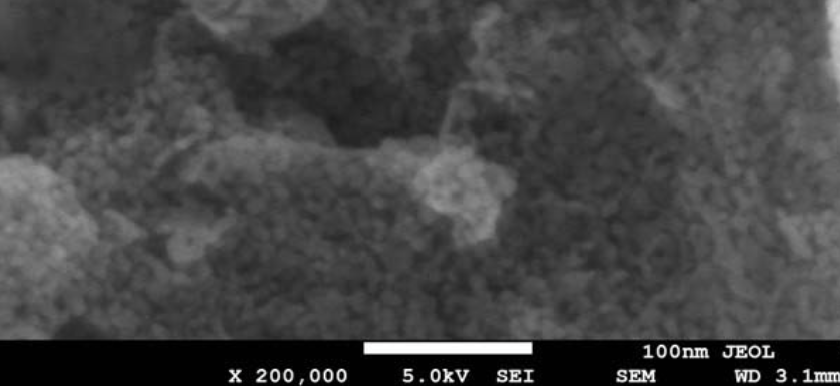
SEM Image
Applications
- Solid Oxide Fuel Cells (SOFCs): Utilized as a key precursor in the preparation of nickel-yttria stabilized zirconia (Ni-YSZ) cermet anode layers. Its high purity and ultrafine 10–20 nm particle size optimize catalytic activity, microstructural uniformity, and triple-phase boundary density for efficient hydrogen oxidation.
- Electrochromic Devices and Smart Windows: Integrated into energy-efficient smart window coatings and automotive rear-view mirrors with adjustable reflectance and absorption. The nanopowder enables reversible optical modulation under electric potential, offering precise light transmission and glare control.
- Advanced Functional Nanostructures and Alloys: Serves as a fundamental building block in the synthesis of specialized nickel-based nanowires, nanofibers, and high-performance alloys. Its large specific surface area (80–100 m²/g) significantly enhances reactivity and structural reinforcement during thermal consolidation.
- Functional Ceramics, Polymers, and Textiles: Incorporated into advanced ceramic matrices, plastics, and technical textiles to impart customized electrical, thermal, and optical properties. The ultra-fine particle dispersion prevents agglomeration, ensuring uniform material characteristics across the final product matrix.
Related Products
Related Products

Nickel Oxide (NiO) Nanopowder/Nanoparticles, Purity: 99.9%, Size: 30 nm
$38.09
5 grams/33 € 25 grams/58
NG04SO2802
POPULAR

Aluminum Oxide (Al2O3) Nanopowder/Nanoparticles, Gamma, Purity: 99.9+%, Size: 10-20 nm
$16.16
1 gram: 14 € 5 grams: 23 € 25 grams: 36 €
NG04SO0107

Antimony Tin Oxide (ATO) Nanopowder/Nanoparticles, Purity: 99.9%, Size: 20-50 nm
$42.71
5 grams/37 €
NG04MO0101

Indium (In) Nanopowder/Nanoparticles, Purity: 99.9%, Size: 50 nm
$1,096.59
100 grams/950 € &
NG04EO1201

Nickel Iron Oxide (NiFe2O4) Nanopowder/Nanoparticles, Purity: 99.5+%, Size: 20 nm
$23.09
1 gram/20 € 5 grams/31 € &
NG04MO1101