
Titanium Dioxide (TiO2) Nanopowder/Nanoparticles, Rutile, Purity: 99.5+%, Size: 30±5 nm

- SKU:
- NG04SO3511
- Shipping:
- Calculated at Checkout

Description
25 grams/57€
100 grams/101 €
500 grams/236 €
1000 grams/370 €
Titanium Dioxide (TiO2) Nanopowder/Nanoparticles
Rutile, High Purity: 99.5+%, Size: 30±5 nm
Rutile titanium dioxide nanoparticles are a stable crystalline form of TiO₂, distinguished by their high refractive index, strong light-scattering ability, and robust dielectric properties. Their nanoscale morphology provides a large surface-to-volume ratio, enhancing interfacial interactions and chemical stability. The rutile phase is particularly valued for its resistance to photodegradation and thermal stress, making it suitable for long-term industrial use. The particles exhibit uniform dispersion and consistent morphology, which supports reliable performance in advanced material systems. Their surface chemistry allows for effective functionalization, enabling integration into diverse composite matrices. High purity ensures minimal contamination, while the rutile structure contributes to mechanical reinforcement and optical clarity.
Technical Properties
| Purity | 99.5+% |
| Particle Size | 30±5 |
| Surface Area | 20-50 mg2/g |
| Crystal Structure | Rutile |
| CAS No | 13463-67-7 |
Applications
- Electronics & Energy Storage: Rutile TiO₂ nanoparticles are used in capacitors and battery electrodes due to their high dielectric constant and stability. The nanoscale size improves ion transport, enhancing performance in lithium-ion batteries and supercapacitors.
- Pigments & Coatings: With strong light scattering and high refractive index, TiO₂ is the main white pigment. In coatings, rutile nanoparticles provide UV resistance, color stability, and long-lasting brightness.
- Photocatalysis & Environmental Uses: Although anatase is more active, rutile TiO₂ can still degrade pollutants under UV light. Its stability makes it suitable for water and air purification coatings.
- Cosmetics & Sunscreens: Rutile TiO₂ nanoparticles block UV rays effectively without leaving a white residue. High purity ensures safety, while nanoscale size allows transparent formulations with strong sun protection.
- Ceramics & Catalysts: TiO₂ improves sintering and mechanical strength in ceramics. As a catalyst support, its surface area helps disperse metals evenly, boosting efficiency in industrial and automotive processes.
- Biomedical & Sensors: Biocompatibility and stability make rutile TiO₂ useful in implant coatings. In sensors, its surface properties enhance sensitivity and signal response for electrochemical detection.
Related Products
Related Products
Titanium Dioxide (TiO2) Nanopowder/Nanoparticles, Rutile, High Purity: 99.5+ %, Size: 28 nm

Titanium Dioxide (TiO2) Nanopowder/Nanoparticles, Anatase/Rutile, Purity: 99.5+%, Size: 18 nm
Titanium Dioxide (TiO2) Nanopowder/Nanoparticles, Rutile, High Purity: 99.5+ %, Size: 45 nm
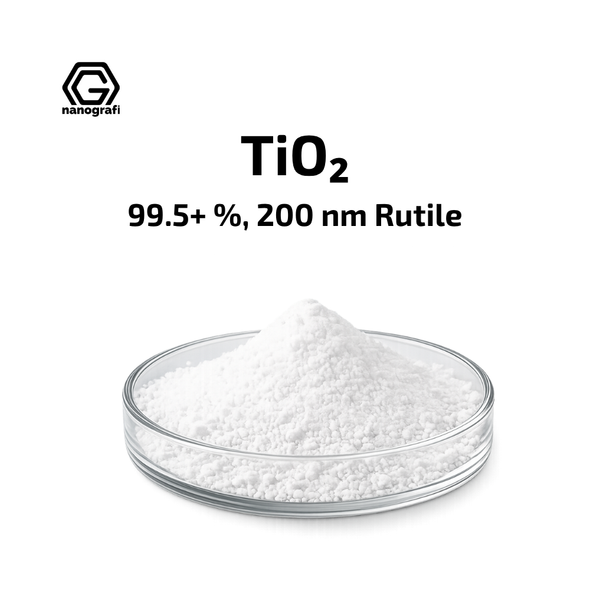
Titanium Dioxide (TiO2) Nanopowder/Nanoparticles, Rutile:99.5+%, Size: 200 nm
