
Titanium Carbide ( Ti3C2Tx) MXene Phase Powder, Purity 98+%, Size: 2-20 µm

- SKU:
- NG10MPW1491
- Shipping:
- Calculated at Checkout


Description
5 grams: 245€
25 grams: 980€
100 grams: 3460€
Contact us for tailored quotes on larger quantities & experience exceptional solutions from our experts.
Product Overview
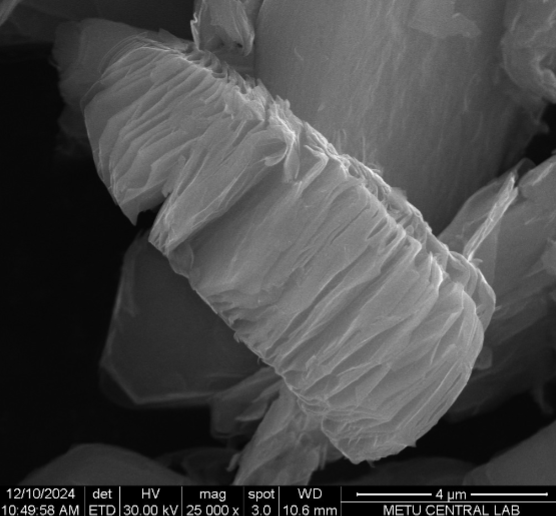
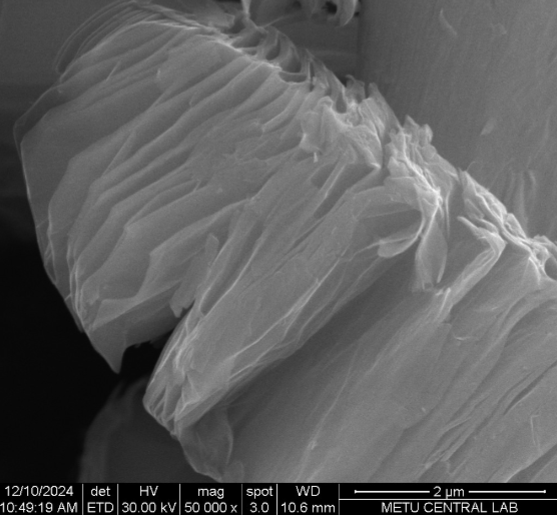
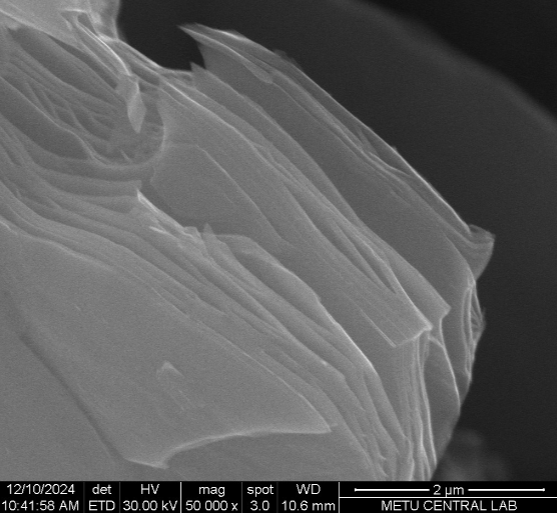
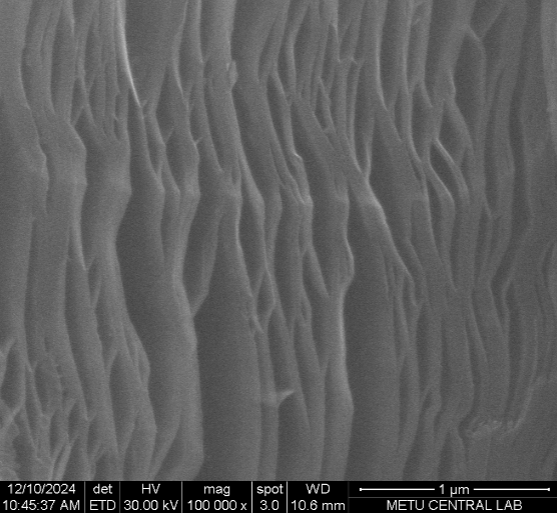
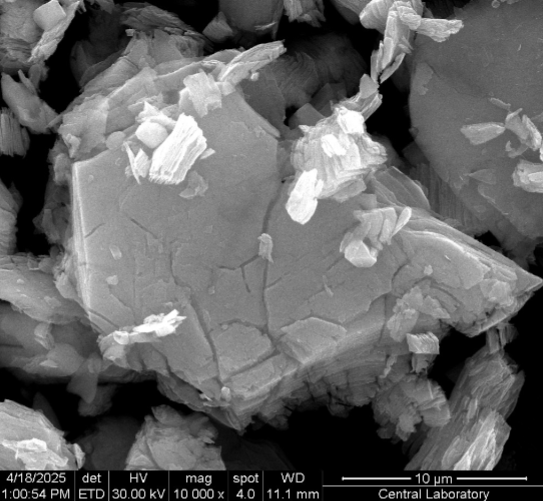
Titanium Carbide MXene is a premier two-dimensional (2D) transition metal carbide characterized by a layered architecture consisting of three titanium (Ti) layers sandwiching two carbon (C) layers. This material is synthesized through the selective hydrofluoric acid (HF) etching of aluminum from its parent Ti3AlC2 MAX phase, resulting in a multilayer, accordion-like morphology. The structural hallmark of Ti3C2Tx is its high metallic conductivity coupled with a hydrophilic surface, a combination derived from its termination groups (–OH, –O, –F). These surface groups allow for exceptional dispersibility in various media and facilitate the tuning of its electronic and chemical properties. Its high surface area and mechanical flexibility make it a cornerstone material for advanced nanostructured systems.
Technical Properties
CAS: 12363-89-2
| Compound Formula | Ti3C2Tx |
| Size | 2 - 20 µm |
| Purity | 98+% |
| Average Lateral Length | 12 - 20 µm |
| Average Lateral Width | 10 - 30 µm |
| Appearance | Black |
SEM Images
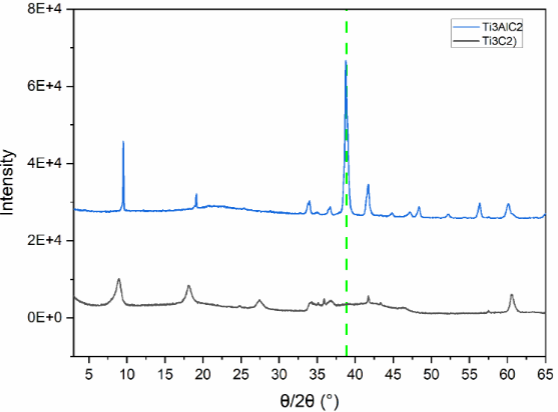
XRD Analysis
Applications
- Energy Storage Systems: Ti3C2Tx serves as a critical active material or conductive additive in lithium-ion and sodium-ion batteries, as well as supercapacitor electrodes. Its layered architecture provides rapid ion transport channels and high surface area, significantly enhancing charge storage capacity and long-term cycling stability.
- Electromagnetic Interference (EMI) Protection: The material's high electrical conductivity and layered morphology allow for superior EMI attenuation. It is incorporated into polymer composites and coatings to protect sensitive electronics across GHz frequency ranges.
- High-Sensitivity Sensors: Utilized in chemiresistive and electrochemical sensors, Ti3C2Tx facilitates fast electron transfer. Its tunable surface terminations allow for the selective and rapid detection of various gases, ions, and biomolecules.
- Catalysis and Electrocatalysis: Ti3C2Tx acts as an efficient support or co-catalyst in reactions such as HER, OER, and CO2 reduction. The metallic conductivity and abundance of functional groups promote the uniform dispersion of active sites and enhance overall catalytic activity.
- Water Treatment and Ion Sieving: Leveraging its hydrophilic nature and precise interlayer spacing, Ti3C2Tx is applied in membrane technologies for heavy metal removal, dye degradation, and desalination.
- Biomedical Engineering: The powder is processed into dispersions for drug delivery, biosensing, and photothermal therapy. Its inherent biocompatibility and surface modifiability make it ideal for interfacing with biological systems.
- Flexible and Wearable Electronics: Ti3C2Tx can be formulated into conductive inks for flexible circuits and stretchable energy devices. It maintains high electrical performance even under significant mechanical deformation.
FAQ
FAQ About Titanium Carbide (Ti3C2Tx) MXene Phase Powder
1) Is this Ti3C2Tx MXene powder multilayer or delaminated single-layer material?
This grade is multilayer Ti3C2Tx. It is produced by selectively etching the aluminium layers from a Ti3AlC2 MAX phase, which leaves the characteristic accordion-like stacked morphology rather than isolated nanosheets. Multilayer powder is the correct starting point for bulk electrodes, composites and further processing. Researchers who require single-layer nanosheets in colloidal form without performing their own delamination should use the single-layer Ti3C2Tx MXene suspension instead.
2) What do the lateral dimensions of this grade mean in practice?
The powder is specified with an average lateral length of 12–20 µm and an average lateral width of 10–30 µm, within an overall particle size range of 2–20 µm. Large lateral dimensions favour flake-to-flake overlap, which supports continuous conductive networks in films, coatings and electrodes and reduces the number of inter-flake junctions a charge carrier must cross. Applications that require thin, uniform coverage generally benefit from these larger flakes; applications requiring high packing density may need additional milling or size fractionation.
3) How do the surface terminations affect dispersion behaviour?
Ti3C2Tx carries mixed –OH, –O and –F surface terminations. These groups make the flake surfaces hydrophilic, which is why Ti3C2Tx disperses readily in water and other polar media without added surfactant, unlike most carbon nanomaterials. The same terminations govern surface charge and interfacial chemistry, so they also determine how the material bonds within polymer matrices and how its electronic and chemical behaviour can be tuned for sensing and catalysis.
4) Can this multilayer powder be delaminated into single-layer nanosheets in the laboratory?
Yes. Multilayer Ti3C2Tx is the standard feedstock for laboratory delamination, typically by intercalating the interlayer gallery and then applying controlled sonication or shear to separate the sheets. Yield and final flake size depend on the intercalant, energy input and handling, so results vary between laboratories. Where reproducibility of the colloid matters more than control of the delamination step itself, starting from a ready-prepared suspension removes that variability.
5) Which applications suit the 2–20 µm particle size of this grade?
This size range suits electromagnetic interference shielding composites, supercapacitor and lithium-ion or sodium-ion electrode formulations, and conductive coatings, where the combination of metallic conductivity, layered architecture and high surface area is the governing property. It is also used as a support in electrocatalysis and in membrane work exploiting the interlayer spacing. Applications demanding optically transparent or ultrathin single-flake films require delaminated material rather than this multilayer powder.
6) How should Ti3C2Tx MXene powder be stored and handled?
Ti3C2Tx is a chemically reactive two-dimensional carbide, and MXene materials in general are sensitive to prolonged exposure to moisture, oxygen and elevated temperature. Store the powder sealed, dry and cool, and minimise repeated opening of the container. The specific handling, exposure and disposal requirements for this product are set out in the MSDS linked on the product page, which should be reviewed before laboratory or production use.
7) How does Ti3C2Tx differ from the Ti3AlC2 MAX phase it is made from?
Ti3AlC2 is a bulk ternary carbide in which aluminium atomic planes are interleaved between titanium-carbide layers. Ti3C2Tx is what remains after those aluminium planes are selectively removed: a two-dimensional, surface-terminated, hydrophilic carbide with an open accordion morphology. The precursor is used for high-temperature structural and tribological work, while the derived MXene is used where two-dimensional conductivity and accessible surface area matter. Groups synthesising their own MXene can start from the Ti3AlC2 MAX phase powder, and the relationship between the two is covered in more depth in MXenes from MAX phases.
8) Is this MXene powder available in research and larger quantities?
Yes. Nanografi supplies Ti3C2Tx MXene phase powder in 5 g, 25 g and 100 g research quantities, and quotes larger volumes on request for scale-up and industrial development programmes. Related grades and forms are listed under MXene powders, which allows a laboratory to move from screening quantities to production volumes without changing material source or specification.
Related Products
Related Products

Multi-Layer Titanium Carbide (Ti2CTx) MXene Phase Powder, Purity: 98+%, Size: 2-20 µm
Titanium Carbide (TiC) Micron Powder, Purity: 99%, Size (fsss): 2-4 µm

Single Layer Titanium Carbide (Ti3C2Tx) MXene Suspension, Concentration: 1 mg/mL

Titanium Carbide (TiC) Micron Powder, Purity: 99.5%, Size: 1-3 µm
