
Zinc Oxide (ZnO) Nanopowder Dispersion in Ethanol, Size: 20-30nm, 20wt%
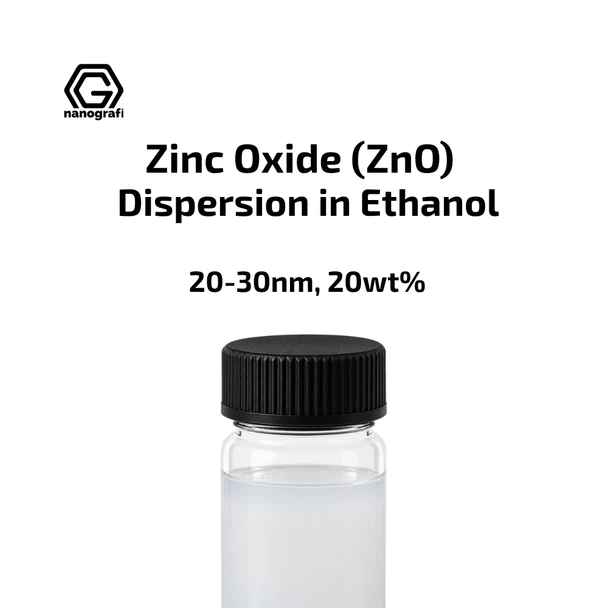
- SKU:
- NG10DNPW0992
- Shipping:
- Calculated at Checkout

Description
30 ml: 35€
60 ml: 60€
120 ml: 95€
500 ml: 295€
1000 ml: 535€
Contact us for tailored quotes on larger quantities & experience exceptional solutions from our experts.
Product Overview of Zinc Oxide (ZnO) Nanopowder Dispersion in Ethanol, Size: 20-30nm, 20wt%
Zinc Oxide Nanopowder Dispersion in Ethanol is a stable, ready-to-use formulation designed for advanced research and industrial integration. The ethanol medium ensures excellent particle distribution, improved processability, and compatibility with organic systems. With controlled stability and uniformity, this dispersion provides a reliable solution for applications requiring precision, reproducibility, and efficient incorporation into complex formulations.
Technical Properties
| Purity | 99.5% |
| Particle Size | 20-30 nm |
| Spesific Surface Area | 30-50 m²/g |
| CAS No | 1314-13-2 |
Applications
- Industrial Manufacturing & Coatings: ZnO ethanol dispersion enhances mechanical strength and thermal stability in coatings, paints, and polymer composites. Its uniform distribution improves durability, wear resistance, and dimensional stability in high-performance materials.
- Electronics & Semiconductors: Leveraging its semiconducting and optoelectronic properties, ZnO dispersion is applied in thin-film transistors, transparent conductive coatings, and sensor technologies. The ethanol medium facilitates integration into organic electronic systems and advanced semiconductor processes.
- Energy & Photocatalysis: ZnO dispersion is widely used in photocatalytic systems for environmental remediation and solar energy conversion. Its fine particle size and ethanol-based stability enhance light absorption, catalytic efficiency, and performance in dye-sensitized solar cells and energy storage devices.
- Chemistry & Catalysis: As a catalyst and catalyst carrier, ZnO dispersion supports photocatalytic degradation of pollutants and organic synthesis. The ethanol medium ensures effective dispersion in chemical processes requiring high surface reactivity and compatibility with organic solvents.
- Health & Biomedical: ZnO dispersion exhibits antimicrobial and UV-protective properties, enabling its use in biomedical coatings, wound care formulations, and personal care products. The ethanol base allows controlled incorporation into specialized healthcare and cosmetic applications.
FAQ
Frequently Asked Questions About Zinc Oxide (ZnO) Nanopowder Dispersion in Ethanol, 20-30 nm, 20 wt%
1. What is ZnO nanopowder dispersion in ethanol used for?
Zinc oxide (ZnO) nanopowder dispersion in ethanol is investigated for functional coatings, thin-film processing, semiconductor research, UV-protective formulations, photocatalysis, and advanced polymer composites. The ethanol carrier makes it relevant to selected solvent-compatible formulations and deposition processes. ZnO is a wide-bandgap semiconductor with optical and surface-reactive properties. Final performance depends on dispersion quality, substrate compatibility, particle loading, and processing conditions. Explore NANOGRAFi's Zinc Oxide Nanoparticles collection for related materials.
2. What does 20 wt% mean in zinc oxide ethanol dispersion?
A concentration of 20 wt% means that zinc oxide accounts for 20% of the total dispersion mass. For example, 100 grams of dispersion nominally contain 20 grams of ZnO and 80 grams of carrier liquid and any additional formulation components. Weight percentage is different from volume percentage and should not be confused with the purity of the ZnO particles. Researchers should consider the dispersion density and any additives when calculating material quantities for coating, composite, or thin-film formulations.
3. What is the difference between ZnO ethanol dispersion and ZnO water dispersion?
The main difference is the liquid medium used to suspend the zinc oxide nanoparticles. Ethanol-based dispersions may be suitable for selected organic-solvent-compatible coatings, rapid-drying deposition processes, and substrates that can tolerate ethanol. Water-based dispersions may be preferable for aqueous formulations and processes where flammable solvents are undesirable. Dispersion stability, wetting behavior, and formulation compatibility must be evaluated separately. Compare this product with NANOGRAFi's ZnO Water Dispersion, 20-30 nm, 20 wt%.
4. How does the 20-30 nm particle size influence ZnO dispersion properties?
The reported 20-30 nm particle size describes the nominal dimensions of the ZnO nanoparticles. Nanoscale dimensions provide a relatively high surface-area-to-volume ratio, which can influence optical absorption, surface reactions, and interactions with surrounding materials. However, nanoparticles can form aggregates or agglomerates in liquid media, so the effective dispersed particle size may differ from the primary particle size. Researchers should evaluate dispersion stability and particle-size distribution under their intended processing conditions. Compare NANOGRAFi's ZnO Nanopowder, 99.5% Purity, 20-30 nm when dry powder processing is preferred.
5. Can ZnO ethanol dispersion be used in UV-protective coatings?
ZnO nanoparticles are investigated for UV-protective coatings because zinc oxide can absorb ultraviolet radiation through its semiconductor electronic structure. Their effectiveness depends on particle concentration, dispersion quality, coating thickness, and the optical properties of the surrounding matrix. Although nanoscale ZnO may support formulations requiring controlled visible-light appearance, optical transparency is not guaranteed. Coating performance should be validated through UV-visible spectroscopy and application-specific durability testing. Explore NANOGRAFi's Metal and Oxide Dispersions for related coating materials.
6. Is ZnO nanopowder ethanol dispersion suitable for semiconductor and thin-film applications?
ZnO is a wide-bandgap semiconductor investigated for ultraviolet photodetectors, sensors, thin-film electronics, and optoelectronic devices. Ethanol-based nanoparticle dispersions may be evaluated in selected solution-processing techniques, including spin coating and other deposition methods, provided the formulation and substrate are compatible. Film properties depend on nanoparticle packing, crystallinity, defects, interfaces, and post-deposition treatment. A nanoparticle coating should not automatically be considered equivalent to a dense, electrically optimized semiconductor film. Researchers can explore NANOGRAFi's Nanomaterial Dispersions collection for alternative formulations.
7. Can ZnO nanoparticles dispersed in ethanol be used for photocatalysis?
Zinc oxide is widely investigated as a photocatalytic semiconductor for light-driven reactions, including the degradation of selected organic pollutants. Under suitable illumination, ZnO can generate electron-hole pairs that participate in surface reactions. Photocatalytic performance depends on wavelength, particle characteristics, surface chemistry, reactant concentration, and charge-carrier recombination. Ethanol may also participate in photochemical reactions and must be considered when designing experiments. Researchers can compare ZnO formulations with other metal oxide dispersions for comparative photocatalytic research.
8. How should ZnO ethanol dispersion be mixed and incorporated into coating formulations?
ZnO ethanol dispersion may be incorporated into compatible coating or composite formulations through controlled mixing and deposition procedures. Before processing, researchers should assess solvent compatibility, binder chemistry, substrate wetting, and the influence of any stabilizing additives. Settling or agglomeration may occur depending on storage and formulation conditions, so rehomogenization should follow the supplier's recommendations. Mixing and coating procedures should minimize contamination, uncontrolled solvent evaporation, and unnecessary nanoparticle aerosol formation. Explore NANOGRAFi's ZnO product range for alternative particle sizes and formulations.
9. How should ZnO nanopowder dispersion in ethanol be stored and handled safely?
ZnO nanopowder dispersion in ethanol should be stored in a tightly sealed, chemically compatible container according to the product-specific Safety Data Sheet (SDS). Ethanol is flammable, so the material should be kept away from ignition sources and handled with appropriate ventilation and protective equipment. Procedures should minimize splashing, aerosol formation, and unnecessary nanoparticle exposure. Research-grade ZnO dispersions should not be assumed suitable for medical, cosmetic, or food-contact applications without additional safety assessment and regulatory qualification. For aqueous processing, researchers can consider NANOGRAFi's ZnO Water Dispersion as an alternative.
Related Products
Related Products

Zinc Oxide (ZnO) Nanopowder/Nanoparticles Water Dispersion, Size: 20-30 nm, 20 wt%

Zinc Oxide (ZnO) Nanopowder/Nanoparticles, Purity: 99.5%, Size: 20-30 nm

Zinc Oxide (ZnO) Nanopowder/Nanoparticles, Purity: 99.5+%, Size: 18 nm, KH550

Magnesium Oxide (MgO) Nanopowder/Nanoparticles Ethanol Dispersion, Size: 45 nm, 22 wt%
