
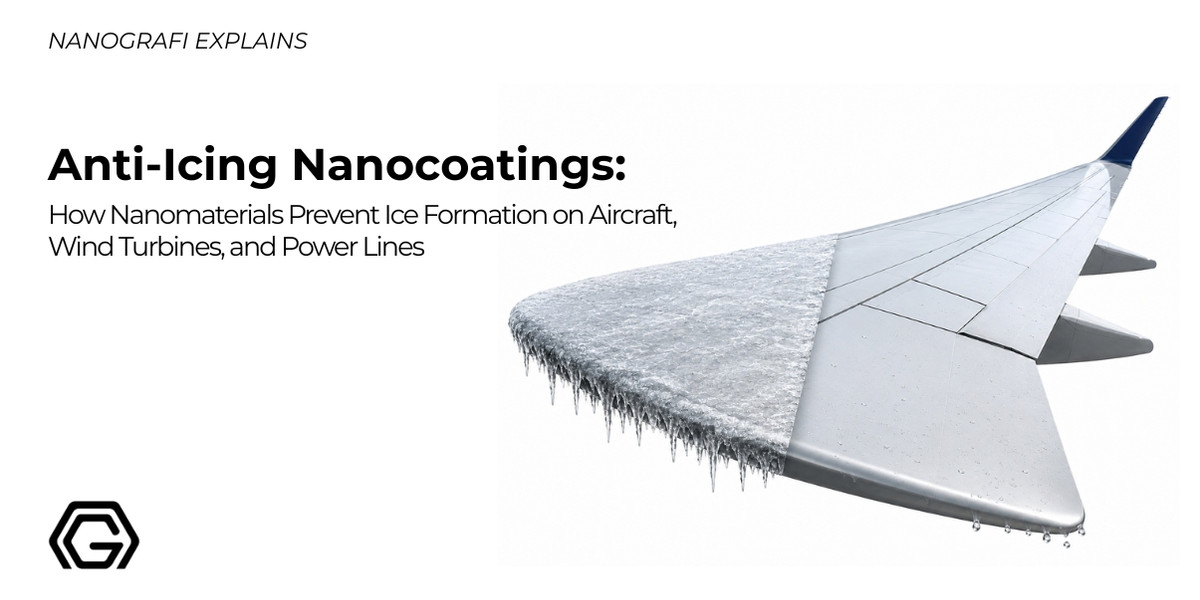
Anti-Icing Nanocoatings: How Nanomaterials Prevent Ice Formation on Aircraft, Wind Turbines, and Power Lines
Ice accretion is not a cosmetic problem for industrial equipment operating in cold climates. On aircraft, even a thin, rough layer of ice on a wing leading edge measurably degrades lift and increases drag, which is why aviation authorities treat in-flight icing as a certified flight hazard rather than an inconvenience. On wind turbines, blade icing distorts aerodynamic profiles, unbalances the rotor, and in documented cases has cut annual energy production by a significant margin at cold-climate sites. On overhead power lines and communication towers, ice loading adds mechanical stress that has caused well-recorded structural failures. Nanomaterials have become central to solving this problem, not as a single silver-bullet coating, but through two distinct engineering strategies that are increasingly combined in the same product.
Two Strategies: Anti-Icing and De-Icing
The literature draws a consistent distinction between anti-icing, which delays or prevents ice from forming in the first place, and de-icing, which actively removes ice that has already accumulated. Passive coatings, built around icephobic or superhydrophobic surface chemistry, fall into the anti-icing category: they don't consume energy, but their protection has practical limits under sustained, severe icing conditions. Active systems, most often based on electrothermal heating, fall into de-icing: they require a power source but can clear ice on demand regardless of how severe the accumulation has become. Modern coating research increasingly blends both approaches into a single layer, since a coating that both resists ice formation and can be electrically heated when conditions exceed the passive coating's capability offers redundancy that neither strategy alone provides.

How Icephobic Coatings Work
Icephobicity isn't simply extreme water repellency, though the two are closely related. A surface is generally classified as hydrophobic once its water contact angle exceeds 90 degrees, and as superhydrophobic above roughly 150 degrees, the same contact-angle framework behind the lotus effect and hydrophobic materials such as SiO2 in nature. A high contact angle reduces the surface area in contact with a supercooled water droplet and can delay ice nucleation, but the property that actually determines whether ice can be removed easily once it does form is ice adhesion strength, measured in kilopascals via standardized shear or tensile/pull-off tests. Untreated metal or composite surfaces typically show ice adhesion strengths well above 300 kPa; well-engineered icephobic coatings have been reported at 60 kPa or lower across repeated icing and de-icing cycles, and silicone-elastomer systems have demonstrated shear strengths in the 19 to 50 kPa range, low enough that wind or vibration alone can shed accumulated ice.
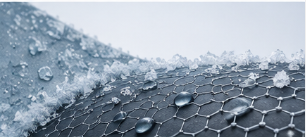
Surface nanotexturing is what makes this possible at a practical level. Introducing nanoscale roughness, typically through embedded or surface-bound nanoparticles, traps a thin air layer beneath water droplets, reducing real contact area between the droplet and the solid surface, the same mechanism behind self-cleaning surfaces inspired by the lotus effect now applied directly to icephobic engineering. Silica nanoparticles surface-modified with silanes or fluoroalkylsilanes are the most widely used nanofiller for this purpose, since the same hydrophobic surface chemistry already established for water- and dirt-repellent textile finishing translates directly onto rigid substrates such as aluminum, steel, and composite laminates. Silane-functionalized silica such as or provide exactly this kind of reactive coupling chemistry, allowing the particles to bond covalently into a polymer matrix rather than remaining unbonded/dispersed within it, which materially affects how long the icephobic effect survives rain erosion, UV exposure, and repeated icing cycles in field conditions. Where a ready-to-use liquid formulation is more practical than dry powder for spray or dip-coating processes, a pre-dispersed removes the dry powder dispersion step directly.
Electrothermal De-Icing: Graphene and Carbon Nanotubes as Heating Elements
Where passive icephobicity isn't enough on its own, most commonly on aircraft surfaces and radomes where certified reliability under all weather conditions is mandatory, the active alternative is a thin, electrically conductive nanomaterial film that generates heat directly through Joule heating when current is passed through it. Graphene is particularly well suited to this role because a coating only tens to hundreds of nanometers thick can carry enough current to generate useful heat while remaining thin enough to stay transparent to radio frequencies, a property specifically valuable for radome de-icing where the coating must minimize attenuation of radar signals. Documented graphene nanoribbon coatings around 100 nanometers thick have demonstrated successful ice removal at temperatures as low as -20°C under laboratory testing, and commercial electrothermal coatings built around carbon nanotubes and graphite have been deployed on curved aerospace surfaces at low, non-hazardous voltages in the 12 to 24 V range.
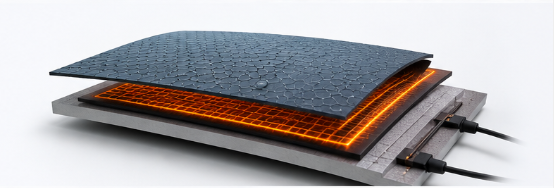
The same conductive-filler logic underpins Nanografi's graphene coating technology for corrosion and wear protection: while graphene's molecular impermeability makes it an effective anti-corrosion barrier layer, its high electrical conductivity is what makes it an effective resistive heating element for de-icing. Graphene nanoplatelets, supplied at high purity with surface areas up to roughly 800 m2/g, form a percolated conductive network at relatively low loading in a polymer matrix, while a pre-formulated graphene dispersion is generally the more practical starting point for spray- or dip-coated conductive films where uniform, thin-layer conductivity matters more than bulk loading. For applications needing a more flexible, fiber-like conductive network rather than a planar one, carbon nanotube-based dispersions offer a comparable electrothermal pathway.
Combined Systems and Field Durability
The most field-durable systems documented in recent aerospace and wind-energy research combine a low-ice-adhesion topcoat with an embedded electrothermal layer, so the coating resists ice formation passively under normal conditions and can be switched on only when icing exceeds what the passive layer can handle, minimizing energy consumption compared with running a heating system continuously. Durability remains the central engineering challenge across both strategies, the same one facing advanced coatings engineered for corrosion and wear resistance more broadly: icephobic coatings must survive rain erosion, UV exposure, and mechanical abrasion from ice shedding itself without losing their nanotextured surfacemorphology and low surface energy, while electrothermal films must maintain a continuous, resistance-stable percolation network despite thermal cycling and flexing.
Verification matters as much in this field as starting material selection, particularly for aerospace and energy customers operating under strict certification requirements. Nanografi's list of scientific publications documents independent, peer-reviewed research conducted using its nanomaterials, a useful reference point when qualifying a coating supplier's raw materials for a regulated application.
Frequently Asked Questions
What's the difference between anti-icing and de-icing coatings? Anti-icing coatings are passive and work by delaying ice nucleation or reducing ice adhesion strength so accumulated ice sheds more easily; de-icing systems are active and use an energy input, typically electrothermal heating, to remove ice that has already formed.
How is ice adhesion strength measured? Most commonly through standardized shear or tensile/pull-off tests that record the stress needed to detach a fixed area of accreted ice from a coated surface, expressed in kilopascals; lower values indicate easier ice removal.
Can graphene coatings both resist ice and remove it? Yes, when engineered as a combined system: graphene's low surface energy and hydrophobic character contribute to passive icephobic behavior, while its electrical conductivity allows the same layer to function as a resistive heating element for active de-icing when needed.
Are icephobic coatings a permanent solution? No single coating currently eliminates reapplication or maintenance entirely. Rain erosion, UV degradation, and mechanical wear from repeated icing/de-icing cycles all reduce icephobic performance over time, which is why durability testing across multiple icing and de-icing cycles is a standard part of coating qualification.
Nanografi is a manufacturer and supplier of the raw nanomaterials behind both strategies described in this article, not a reseller sourcing from third parties. Its production lines cover surface-functionalized silica nanoparticles for icephobic and hydrophobic coating formulations, along with graphene nanoplatelets, graphene dispersions, and carbon nanotube dispersions for electrothermal and conductive coating applications, produced and characterized in-house rather than relabeled from external stock. That distinction matters for buyers qualifying materials for regulated aerospace, energy, or infrastructure use, where traceability back to an actual production source, rather than a distribution intermediary, is often a procurement requirement in its own right. Independent, peer-reviewed studies citing Nanografi materials are indexed in its publication library, and the full range of nanomaterial product lines referenced throughout this article can be browsed from Nanografi's products.
References
Icephobic coating. (n.d.). In ScienceDirect Topics. Retrieved 2026, from https://www.sciencedirect.com/topics/engineering/icephobic-coating
Kumar, A., et al. (2025). Recent trends in icephobic polymer coatings for aerospace applications in cold climates. Polymers for Advanced Technologies. https://doi.org/10.1002/pat.70211
Progress in icephobic coatings for wind turbine protection: Merging chemical innovation with practical implementation. (2025). Coatings, 15(2), 139. https://doi.org/10.3390/coatings15020139
Sarkar, D. K., et al. (2021). Icephobic and anticorrosion coatings deposited by electrospinning on aluminum alloys for aerospace applications. Materials, 14(24). https://www.ncbi.nlm.nih.gov/pmc/articles/PMC8659825/
Wang, Y., Xiong, K., Zhu, C., Zhu, C., Guo, R., & Chen, L. (2023). Research on normal ice adhesion strength in icing wind tunnel. Proceedings of the Institution of Mechanical Engineers, Part G. https://doi.org/10.1177/09544100231189803
Recent Posts
-
ZnO Nanoparticles in OLED and Perovskite Solar Cells
Many printed solar cells and inverted display stacks need a layer that collects electrons and passes …23rd Sep 2026 -
MXene for EMI Shielding: Materials, Mechanisms and Applications
Electromagnetic interference has become a design constraint rather than an afterthought. Densely pac …10th Sep 2026 -
Handling and Storage Best Practices for Metal Oxide Nanopowders
A metal oxide nanopowder is bought for a property that a coarse powder cannot deliver: a specific su …1st Sep 2026