

Energy Harvesting in Carbon Nanotube Yarns
Introduction
Rather than storing and transporting energy through traditional methods, generating it directly within the system through environmental interactions is the fundamental motivation shaping the future of autonomous technologies. At the heart of this objective, carbon nanotubes (CNTs), with their extraordinary sp² hybridized atomic lattice structure, are not merely conductors but also high-performance energy transduction units. This unique microscopic geometry of carbon nanotubes forms the core engine of yarn structures termed "twistrons," which convert mechanical strain into electrical energy. Twistron technology carries this natural capability of carbon into macroscopic fibers, offering unique potential for battery-free sensors and smart textiles. However, this transformation process is not limited solely to the intrinsic properties of the material; the efficiency of the system is strictly dependent on the dynamic interaction the carbon surface enters with its surrounding molecular ecosystem. To overcome the efficiency bottleneck that twistrons experience during low-frequency movements, researchers have developed a new isotopic engineering method that optimizes the electrochemical performance of carbon nanotubes. The key point here is the use of deuterium (D2O - heavy water) instead of hydrogen in the electrolyte system to maximize the potential offered by carbon nanotubes. This approach stabilizes the charge retention capacity of the CNTs—the system's primary engine—by slowing down the ionic discharge rate at the molecular level, defining a new performance threshold such as 9.5% efficiency in energy harvesting.
Capacitive Harvesting in CNT Yarns
The energy-harvesting capability of carbon nanotube yarns relies on changes in electrochemical capacitance. When these fibrous structures, obtained by twisting carbon nanotubes, are immersed in an electrolyte, an electrical double layer (EDL) is established between the nanotube surface and the ions. This layer creates a massive energy storage area on the material's surface. When the yarn is mechanically stretched, the gaps between the nanotubes narrow due to the material's high Poisson's ratio, resulting in yarn densification. This densification reduces the capacitance per unit volume of the yarn and pushes out the ions trapped on the surface; this change enables the transfer of stored charges to the external circuit as an electric current. Figure 1 schematically illustrates the electrical double layer dynamics in H2O and D2O-based electrolytes and the packing behavior of hydrated ions on the nanotube surface.
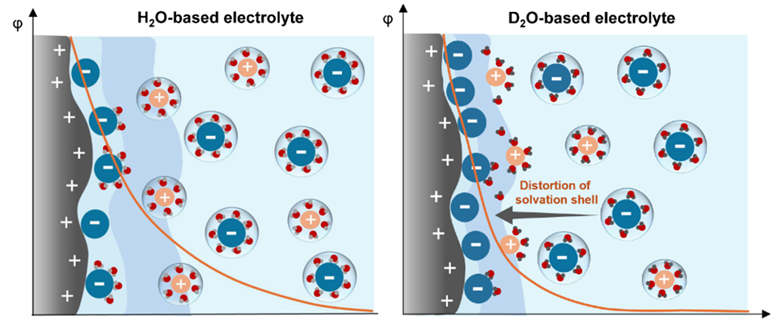
Figure 1. Mechanism of the electrical double layer (EDL) formed on the carbon nanotube surface; comparative representation of ion packing dynamics in normal water H2O) and heavy water (D2O) environments (Ekanayake et al., 2026).
The role of high-purity CNTs in this process is critical for both the mechanical durability and electrical efficiency of the system. The extraordinary tensile strength of carbon nanotubes provides unique structural stability, allowing the yarn to maintain its structural form and high conductivity without forming micro-cracks over millions of stretch cycles. Simultaneously, the large internal and external surface areas of the nanotubes create a charge density that maximizes the amount of ions that can be stored per unit mass, directly driving up the peak power values obtained.
However, the efficiency of the system depends not only on material quality but also on the speed of movement. When the mechanical movement speed decreases—giving ions sufficient time to escape from the nanotube surface—the ions on the carbon surface tend to discharge rather than forming a stable double layer. This situation causes a significant portion of the energy produced by the CNTs to be lost through ionic leakage, leading to inefficiencies particularly in low-frequency harvesting operations below 1 Hz, where human movements are concentrated.
Optimizing CNT Performance with Heavy Water
To prevent this loss of efficiency encountered in carbon nanotube systems, researchers have focused on the kinetic properties of the electrolyte environment. Water enriched with deuterium (D2O), a heavy isotope of hydrogen, possesses different physical and chemical dynamics compared to normal water (H2O). The revolutionary difference here is not that it changes the operating mechanism of the CNT, which is the main component of the system; rather, it allows the carbon's performance to be utilized at full capacity by slowing down the escape rate of charges on the CNT surface. Thanks to this phenomenon, called the Kinetic Isotope Effect (KIE), the movement speed of ions slows down, and the self-discharge rate of charges on the CNT surface decreases. In deuterium-based systems, the water molecules surrounding the ions form a bulky structure by holding on with stronger hydrogen bonds. This state ensures that charge transfer occurs in a much more controlled and lossless manner during every stretch and release cycle of the yarn. As seen in the time-domain measurements in Figure 2, the peak voltage value generated when the twistron yarn is stretched decays much more slowly in heavy water compared to normal water. This slow decay is direct evidence that charges remain trapped on the carbon surface for a longer period and that the system can preserve energy even during low-frequency movements.
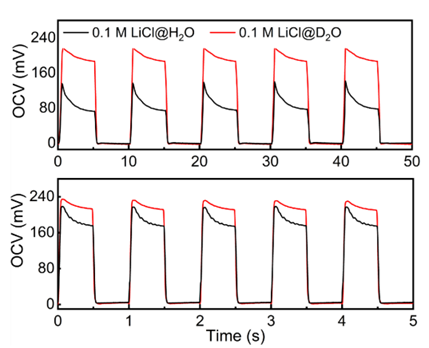
Figure 2. Open-circuit voltage (OCV) graph showing the time-dependent change of voltage after mechanical strain in heavy water (D2O) and normal water (H2O) based electrolytes (Ekanayake et al., 2026).
Study data indicate that this isotopic modification increases the peak power obtained from carbon nanotubes at low frequencies (0.01 - 2 Hz) by 2.5 times and the energy harvested per cycle by 1.8 times. The performance analyses presented in Figures 3a and 3b demonstrate that this method surpasses not only standard electrolytes but also traditional energy harvesting technologies, such as piezoelectric and triboelectric generators, in terms of efficiency.
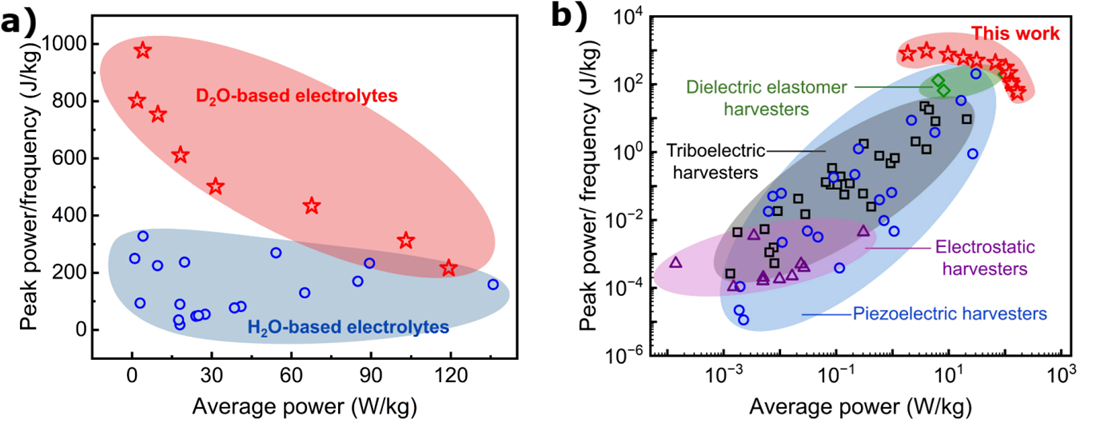
Figure 3. (a) Comparison of average and peak power performance of D2O and H2O-based twistrons at low frequencies below 2 Hz; (b) Comparative performance analysis of D2O-enhanced twistrons against traditional energy harvesting methods such as piezoelectric and triboelectric generators (Ekanayake et al., 2026).
These results represent a revolutionary threshold, demonstrating that carbon nanotubes in neutral environments can even outperform their own performance levels in acidic and hazardous environments.
Smart Textiles and Sustainable Energy Applications
The efficiency gained by CNT twistrons through this next-generation electrolyte optimization opens new horizons in wearable technologies and environmental sensors. Due to their inherent structure, carbon nanotubes can be easily integrated into fabric-like fibers. As shown in Figure 4, a flexible harvesting textile prototype—12 cm long and 9.5 cm wide, containing four twistron harvester units—has been successfully produced. This progress ensures that the clothes of the future will not merely be coverings but also continuous and autonomous energy production centers.
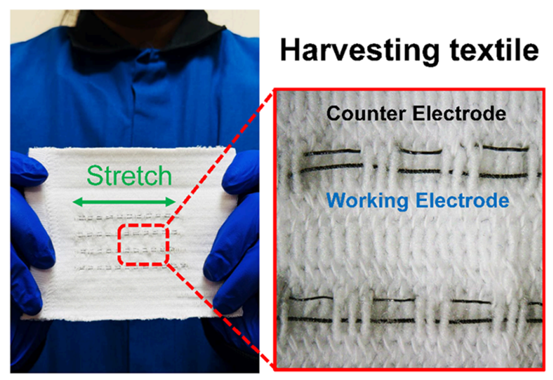
Figure 4. Integration of carbon nanotube twistron yarns into a flexible textile surface and the resulting energy harvesting textile prototype (Ekanayake et al., 2026).
- Energy from Human Motion: The movement frequencies of the human body are generally quite low. By preventing ionic leakage at low frequencies, D2O-optimized CNT yarns can generate sufficient power to sustain smartwatches or critical biomedical sensors with every step or arm movement when integrated into the clothing of an athlete or an astronaut.
- Hybrid Thermal and Mechanical Systems: Studies in the literature have proven that these systems can generate energy not only from motion but also from temperature differences. When combined with artificial muscle structures that change volume with heat, CNT twistrons can be utilized as passive power sources that convert even the slightest change in ambient temperature into mechanical strain and subsequently into electricity.
- Aerospace and Space Exploration: The resistance of CNTs to extreme temperatures and radiation makes these systems ideal candidates for creating battery-free sensor networks in spacesuits and satellite components, operating with a "fit-and-forget" discipline. In particular, the use of D2O extends the system's lifespan by maintaining electrolyte stability in harsh environments such as space.
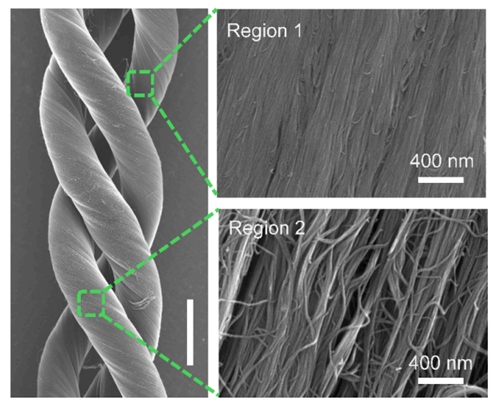
Figure 5. Scanning electron microscope (SEM) image of a three-ply CNT twistron yarn subjected to 40,000 stretch-release cycles in a heavy water (D2O) based electrolyte environment (Ekanayake et al., 2026).
Indeed, as clearly observed in the SEM images in Figure 5, the yarns maintain their structural integrity even after being subjected to a high number of cycles, such as 40,000 stretch-release repetitions, within the heavy water-based electrolyte. The absence of significant deformation or breakage on both the internal contact surfaces (Region 1) and the outer surfaces (Region 2) proves the high mechanical durability and long operational lifespan this technology offers for wearable devices and extreme conditions.
Conclusion
This synergy between the atomic precision of carbon nanotubes and the molecular stability of deuterium is a tangible testament to how the smallest details in materials science can yield immense engineering outcomes. This advancement in twistron technology demonstrates that sustainable energy can be harvested not only through massive wind turbines or solar panels but also via microscopic carbon fibers within our clothing. The most striking data presented—the low-frequency energy harvesting capacity—overcomes the rapid discharge barrier to converting human movements into efficient power sources with an atomic touch.
Reaching a record efficiency of 9.5% in neutral electrolytes and increasing peak power at low frequencies (0.1 Hz) by 2.5 times proves that this technology has surpassed laboratory boundaries. In the future, this technology will appear across a wide range of applications, from autonomous structural health monitoring systems operating under the "fit-and-forget" discipline to battery-free smart textile products. When the conductive legacy of carbon merges with the kinetic balance of deuterium, a smart world—freed from the limitations of batteries and drawing its energy directly from its own motion and environmental interactions—is no longer a theory, but a reality of materials science. The future is hidden within this silent but powerful transformation of carbon.
Discover high-performance Nanografi CNT products, the cornerstone of advanced energy harvesting systems.
References
Ekanayake, I., Cai, W., Fang, S., Zakhidov, A., Huynh, C., Xu, M., Aliev, A., Shrivastava, A., Stefan, M. C., Biewer, M. C., Baughman, R. H., & Zhang, M. (2026). D 2 O-Enhanced Twistron Yarn Harvesters for Low-Frequency Mechanical Energy Harvesting. ACS Nano, 20(7), 5850–5861. https://doi.org/10.1021/acsnano.5c18352
Zhang, X., Lei, X., Jia, X., Sun, T., Luo, J., Xu, S., Li, L., Yan, D., Shao, Y., Yong, Z., Zhang, Y., Wu, X., Gao, E., Jian, M., & Zhang, J. (2024). Carbon nanotube fibers with dynamic strength up to 14 GPa. Science, 384(6702), 1318–1323. https://doi.org/10.1126/science.adj1082
Takakura, A., Beppu, K., Nishihara, T., Fukui, A., Kozeki, T., Namazu, T., Miyauchi, Y., & Itami, K. (2019). Strength of carbon nanotubes depends on their chemical structures. Nature Communications, 10(1). https://doi.org/10.1038/s41467-019-10959-7
Behabtu, N., Young, C. C., Tsentalovich, D. E., Kleinerman, O., Wang, X., Ma, A. W. K., Bengio, E. A., ter Waarbeek, R. F., de Jong, J. J., Hoogerwerf, R. E., Fairchild, S. B., Ferguson, J. B., Maruyama, B., Kono, J., Talmon, Y., Cohen, Y., Otto, M. J., & Pasquali, M. (2013). Strong, Light, Multifunctional Fibers of Carbon Nanotubes with Ultrahigh Conductivity. Science, 339(6116), 182–186. https://doi.org/10.1126/science.1228061
Komatsu, N., Ichinose, Y., Dewey, O. S., Taylor, L. W., Trafford, M. A., Yomogida, Y., Wehmeyer, G., Pasquali, M., Yanagi, K., & Kono, J. (2021). Macroscopic weavable fibers of carbon nanotubes with giant thermoelectric power factor. Nature Communications, 12(1). https://doi.org/10.1038/s41467-021-25208-z
Wu, S., Li, H., Futaba, D. N., Chen, G., Chen, C., Zhou, K., Zhang, Q., Li, M., Ye, Z., & Xu, M. (2022). Structural Design and Fabrication of Multifunctional Nanocarbon Materials for Extreme Environmental Applications. Advanced Materials, 34(52). https://doi.org/10.1002/adma.202201046
Wang, Z., Mun, T. J., Machado, F. M., Moon, J. H., Fang, S., Aliev, A. E., Zhang, M., Cai, W., Mu, J., Hyeon, J. S., Park, J. W., Conlin, P., Cho, K., Gao, E., Wan, G., Huynh, C., Zakhidov, A. A., Kim, S. J., & Baughman, R. H. (2022). More Powerful Twistron Carbon Nanotube Yarn Mechanical Energy Harvesters. Advanced Materials, 34(27). https://doi.org/10.1002/adma.202201826
Zhang, M., Cai, W., Wang, Z., Fang, S., Zhang, R., Lu, H., Aliev, A. E., Zakhidov, A. A., Huynh, C., Gao, E., Oh, J., Moon, J. H., Park, J. W., Kim, S. J., & Baughman, R. H. (2023). Mechanical energy harvesters with tensile efficiency of 17.4% and torsional efficiency of 22.4% based on homochirally plied carbon nanotube yarns. Nature Energy, 8(2), 203–213. https://doi.org/10.1038/s41560-022-01191-7
Recent Posts
-

CNT Paste vs Silver Paste vs Carbon Paste: Which Conductive Adhesive Should You Use?
Conductive pastes quietly hold much of modern electronics together. They bond chips to substrates, d …1st Oct 2026 -

ZnO Nanoparticles in OLED and Perovskite Solar Cells
Many printed solar cells and inverted display stacks need a layer that collects electrons and passes …23rd Sep 2026 -

MXene for EMI Shielding: Materials, Mechanisms and Applications
Electromagnetic interference has become a design constraint rather than an afterthought. Densely pac …10th Sep 2026