
SWCNT vs MWCNT: What Is the Difference and Which Should You Use?
Single-walled carbon nanotubes (SWCNTs) consist of a single rolled graphene layer with a diameter of ~0.8–2 nm, while multi-walled carbon nanotubes (MWCNTs) are built from multiple concentric graphene cylinders with diameters ranging from 2 to over 100 nm. SWCNTs offer superior electronic tunability and flexibility; MWCNTs deliver greater mechanical robustness at a significantly lower cost. The right choice depends entirely on whether your application demands precision or scalability.
Carbon nanotubes are among the most studied materials in modern nanoscience. Their extraordinary mechanical strength, thermal conductivity, and electronic and transport properties make them useful across industries from electronics to biomedicine. But when researchers and engineers talk about "carbon nanotubes," they often mean two structurally distinct materials that behave very differently in practice.
The distinction is not merely academic. Choosing the wrong type can affect everything from device performance to cost-per-gram to regulatory compliance.
This article breaks down the structural, electronic mechanical, and practical differences between SWCNT and MWCNT — so you can identify which one actually fits your application.
Structural Differences: One Wall vs. Many
The fundamental difference between SWCNT and MWCNT lies in how many graphene layers are rolled into the nanotube structure.
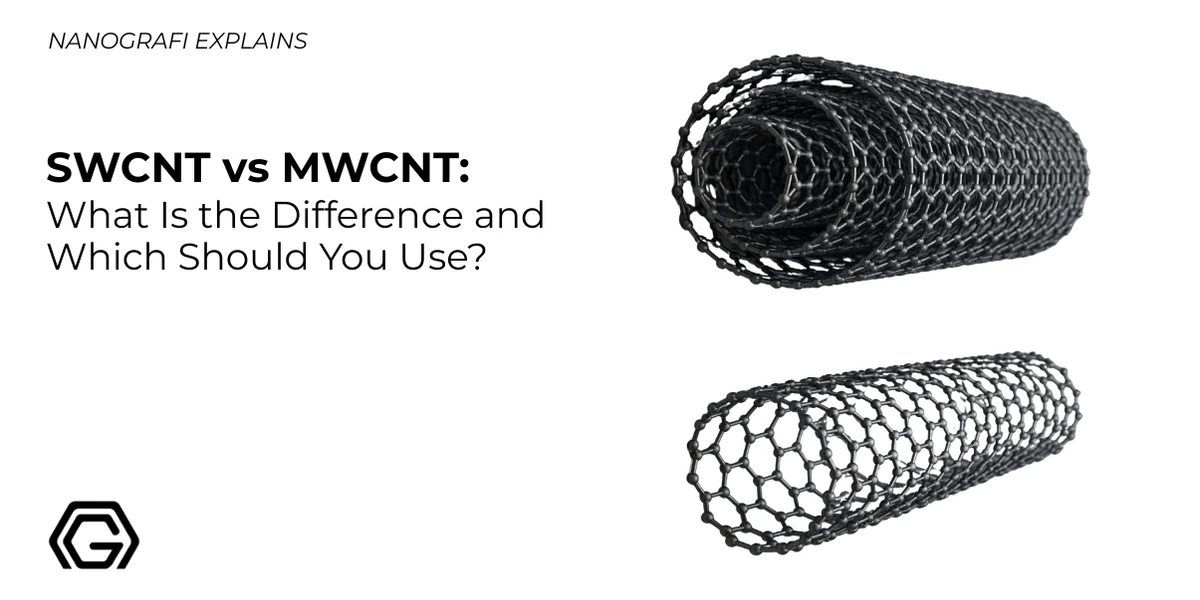
SWCNTs consist of a single graphene sheet rolled seamlessly into a cylinder. Their diameter is typically between 0.8 and 2 nm — roughly 100,000 times thinner than a human hair. This ultrathin, one-dimensional nanostructure gives SWCNTs an exceptionally high aspect ratio and flexibility.
MWCNTs are composed of multiple coaxial graphene cylinders nested within each other. Their diameter ranges from about 2 nm (double-walled) to over 100 nm depending on the number of walls. Two structural models have been proposed to describe MWCNTs: the "Russian Doll" model, where concentric cylinders are stacked, and the "Parchment" model, where a single graphene sheet spirals inward like a rolled newspaper.
A critical subtype worth noting: double-walled CNTs (DWCNTs) bridge the gap between the two. They consist of exactly two concentric tubes, sharing some advantages of both types — better mechanical protection than SWCNTs, with closer-to-SWCNT electronic transport properties.
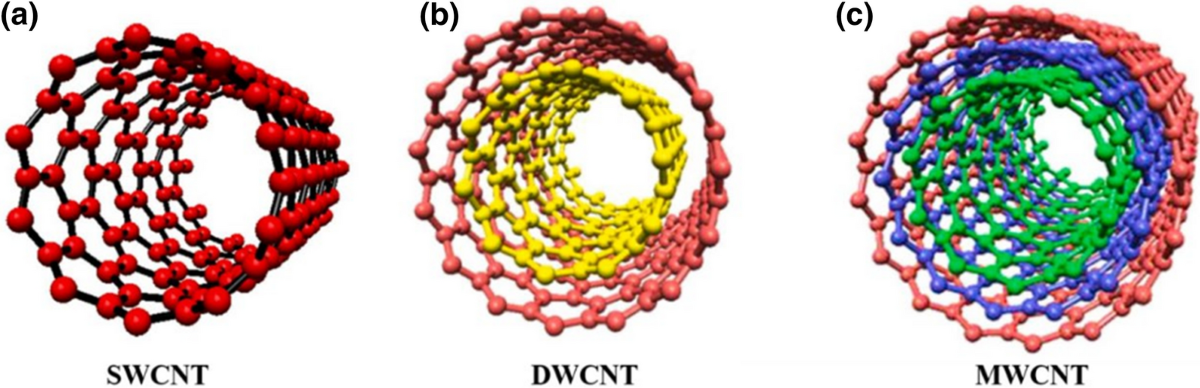
Figure 1. Schematic representations of defect-free carbon nanotube structures: (a) single-walled carbon nanotube (SWCNT), consisting of a single rolled graphene layer; (b) double-walled carbon nanotube (DWCNT), composed of two concentric graphene cylinders; and (c) multi-walled carbon nanotube (MWCNT), formed by multiple nested graphene layers with increasing diameters. These architectures illustrate how wall number influences the structural complexity and intrinsic properties of carbon nanotubes.
Electrical Properties: The Chirality Advantage of SWCNTs
This is where SWCNTs truly stand apart. The electronic natüre of a single-walled nanotube, whether metallic or semiconducting, is determined by its chirality: the angle at which the graphene sheet is rolled.
A 2021 study published in Science demonstrated that chirality can even be altered post-synthesis through thermomechanical processing inside a transmission electron microscope, enabling the fabrication of intramolecular nanotube transistors with channel lengths as short as 2.8 nm (Tang et al., Science, 2021). This level of structural control over electronic behavior has no equivalent in MWCNTs.
MWCNTs, by contrast, exhibit an ensemble average of the electronic states of all their constituent walls. As researchers on ResearchGate summarize, MWCNTs lose the distinct chirality-dependent behavior of individual tubes, making them less suited for precise electronic applications — but this also makes them more predictable and easier to work with in bulk.
For applications requiring semiconducting behavior (transistors, biosensors, NIR imaging), SWCNTs are the clear choice. For applications requiring ohmic conductivity, EMI shielding, conductive composites, MWCNTs perform reliably and at much lower cost.
Mechanical Properties: When Robustness Beats Precision
SWCNTs have higher intrinsic intrinsic tensile strength, but MWCNTs often outperform them in composite applications due to better dispersion. A 2024 study comparing SWCNT and MWCNT elastomer composites (Adu et al., SSRN, 2024) found that MWCNT composites showed superior tensile strength — 10.8 MPa vs. 5.6 MPa at the same filler fraction — attributed to more effective percolation network formation within the nitrile butadiene rubber matrix.
This counterintuitive result highlights an important practical reality: raw material properties don't always translate directly to composite performance. Dispersion quality, interfacial adhesion, and matrix compatibility matter enormously and MWCNTs are often easier to disperse.
Comparison Table: SWCNT vs MWCNT at a Glance
|
Feature |
SWCNT |
MWCNT |
|
Structure |
Single graphene layer |
Multiple concentric layers |
|
Diameter |
0.8 – 2 nm |
2 – 100+ nm |
|
Electrical behavior |
Metallic or semiconducting (chirality-dependent) |
Generally metallic |
|
Tensile strength (intrinsic) |
Higher |
Slightly lower |
|
Flexibility |
Higher |
Lower |
|
Defect sensitivity |
Higher |
Lower (outer walls protect) |
|
Water solubility |
Insoluble, aggregates quickly |
Partially soluble |
|
Synthesis cost |
Higher |
Lower |
|
Scale-up potential |
Limited |
High |
|
Best for |
Electronics, sensors, drug delivery |
Composites, EMI shielding, energy storage |
Application Breakdown: Who Uses What and Why
Electronics & Sensors
SWCNTs dominate this space. Their chirality-controlled semiconducting behavior makes them ideal for field-effect transistors, transparent conductive films, and flexible sensors. Recent studies confirmed that semiconducting SWCNTs with precise chiral separation are enabling next-generation, power-efficient FETs with charge carrier mobility exceeding silicon.
For biosensors specifically, SWCNTs have a tunable Schottky barrier for ultrasensitive biomolecule detection — a property absent in MWCNTs.
Energy Storage
Both types are active in battery research. SWCNTs are used in lithium-ion battery anodes to increase energy density and charge-discharge rates, while MWCNTs are widely used as conductive additives in supercapacitors due to their high surface area and easier processability.
Composite Materials
MWCNTs are the workhorse of the composites industry. Their lower cost, better dispersion, and mechanical robustness make them the preferred additive for automotive, aerospace, and construction applications. Explore Nanografi's MWCNT range for industrial-grade options.
Drug Delivery & Biomedical
SWCNTs have demonstrated superior drug-loading capacity due to their ultra-high surface area. Research shows that SWCNT-anticancer drug complexes achieve longer pharmacokinetic circulation half-life compared to the drug alone, enhancing tumor uptake via the EPR effect. MWCNTs, on the other hand, are more commonly used as biosensors for detecting glucose, cholesterol, and other biomarkers.
It is worth noting that toxicological profiles differ: recent studies found that MWCNTs tended to induce necrotic cell death pathways, while SWCNTs were more associated with apoptotic pathways — a distinction relevant for any biomedical application.
Cost and Scalability: The Practical Reality
MWCNTs can be synthesized at scale using chemical vapor deposition (CVD) with relatively scalable process parameters. SWCNTs require more precise synthesis conditions to control chirality, and post-synthesis separation adds further cost. For large-volume industrial use, MWCNTs are currently the economically viable choice.
For a deeper dive into how these materials are produced, see Nanografi's technical overview: 2 Best Ways to Synthesize Carbon Nanotubes.
How to Choose: A Decision Framework
- Need tunable bandgap? → SWCNT
- Bulk reinforcement of composites or coating? → MWCNT
- Working in drug delivery or bioimaging? → SWCNT (functionalized)
- Building EMI shielding or conductive polymers? → MWCNT
- Budget-constrained research? → MWCNT
- Precision electronics or transistor research? → SWCNT
Conclusion
SWCNT and MWCNT are not competing materials, they are complementary allotropes for different problems. SWCNTs shine where precision matters: chirality- dependent nanoelectronics, sensitive biosensors, and targeted drug delivery. MWCNTs excel where scalability and mechanical reinforcement are priorities: structural composites, EMI shielding, and conductive networks for energy storage. Understanding this distinction early in your research or product development process saves both time and budget. As CNT synthesis and separation techniques continue to advance, the line between the two will only become more strategically important — not less.
About Nanografi: Your Source for Research-Grade Carbon Nanotubes
Nanografi offers an extensive range of high-purity carbon nanotubes for research, development, and industrial applications. Whether you need single-walled tubes for precision electronics or multi-walled variants for composite reinforcement, the catalog covers purities from >65% to >96%, with functionalized options (-OH, -COOH, -NH2) available for improved dispersion and biocompatibility.
Explore the full carbon nanotube collection including single-walled carbon nanotubes and multi-walled carbon nanotubes — with technical datasheets, competitive pricing, and global shipping.
For broader context on CNT science, visit our detailed guide: Carbon Nanotubes: Fundamentals, Properties and Industrial Applications (2025).
References
- Tang, D.M. et al. (2021). Semiconductor nanochannels in metallic carbon nanotubes by thermomechanical chirality alteration. Science. https://doi.org/10.1126/science.abi8884
- Adu, P. et al. (2024). Comparative Study of SWCNT and MWCNT Elastomer Composites: Unveiling the Unexpected Performance Trends. SSRN. https://doi.org/10.2139/ssrn.4677132
- Eatemadi, A. et al. (2014). Carbon nanotubes: properties, synthesis, purification, and medical applications. Nanoscale Research Letters, 9, 393. https://doi.org/10.1186/1556-276X-9-393
- Lahoti, M. et al. (2015). A scientometric comparative study of single-walled and multi-walled carbon nanotubes research. Proceedings of the Association for Information Science and Technology, 52(1). https://doi.org/10.1002/pra2.2015.145052010093
- Khazaei, S. et al. (2016). Interaction of single and multi wall carbon nanotubes with the biological systems: tau protein and PC12 cells as targets. Scientific Reports, 6, 26508. https://doi.org/10.1038/srep26508
- Tu, X. et al. (2022). Recent advances in structure separation of single-wall carbon nanotubes and their application in optics, electronics, and optoelectronics. PMC/NIH. https://www.ncbi.nlm.nih.gov/pmc/articles/PMC9108629/
Recent Posts
-

Advanced Materials for Humanoid Robots: Actuators, Sensors and E-Skin
Humanoid robots are leaving the lab. They now walk warehouse floors, handle parts on assembly lines …23rd Oct 2026 -

What Is Conductive Masterbatch? CNT, Carbon Black and Graphene Compared
A conductive masterbatch is a concentrated blend of a conductive carbon additive and a carrier polym …14th Oct 2026 -

Biomaterials for Implants: Titanium vs Nitinol vs Hydroxyapatite Coatings
Implantable medical devices operate under very different mechanical and biological conditions. A hip …7th Oct 2026