
Boron Doped Graphene Nanopowder (B/G)

- SKU:
- NG01SC0715


Description
Contact us for tailored quotes on larger quantities & experience exceptional solutions from our experts.
Boron Doped Graphene Nanopowder (B/G) is a boron-containing graphene-based composite powder designed to combine the characteristic platelet structure of graphene with a controlled boron component. The material is intended for research and formulation studies in electrochemical, catalytic, sensing and energy-storage applications where boron–graphene interactions may influence surface activity and functional performance. Application-specific properties should be validated under the intended processing and test conditions.
| Size Range | < 10 layers |
| Average Particle Size | 5-10 µm |
| Thickness | 5 nm |
| Morphology | Platelets |
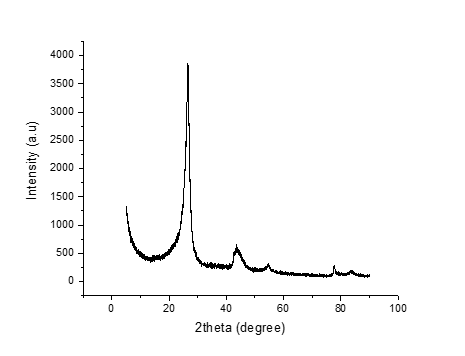
XRD Analysis
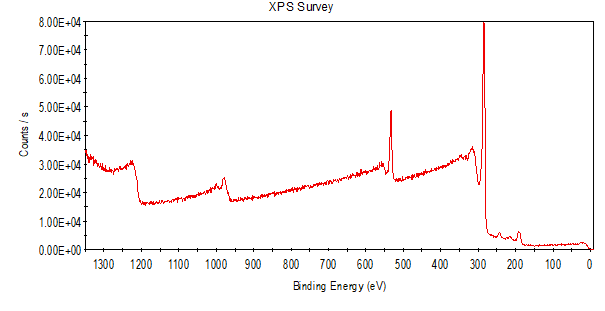
XPS Analysis
|
Peaks |
Peak Position (eV) |
Atomic Contentration (%) |
|
B1s |
195,98 |
11,1 |
|
C1s |
293,48 |
77,52 |
|
O1s |
540,88 |
11,38 |
Applications
- Electro Catalyst: Can be evaluated as a carbon-based functional material for electrode formulations and catalytic-support studies.
- Field-effect Transistors: May be investigated in experimental composite films where boron-containing carbon materials are used to study charge-transport behavior.
- Sensors: Suitable for research into resistive and electrochemical sensing layers due to its graphene-based conductive network and surface interactions.
- Lithium-ion Batteries: Can be assessed as a conductive additive or functional carbon component in experimental electrode formulations.
- Supercapacitors: May be incorporated into electrode composites to support electrical conductivity and electrochemically accessible surface area.
- 2D Materials: Intended for research involving graphene-based platelets, hybrid structures and functional carbon composites.
- Energy Storage & Batteries: Can be studied in conductive networks and composite electrodes developed for various energy-storage systems.
- Fuel Cells: May be evaluated as a conductive carbon component or catalyst-support material in research-stage fuel-cell electrodes.
- Nanomaterials Research: Suitable for investigating the processing, dispersion and functional properties of boron-containing graphene-based composites.
- Semiconductors: Can be explored in research-stage functional films and composites where tunable electrical behavior is of interest.
FAQ
FAQ About Boron Doped Graphene Nanopowder (B/G)
1) What does boron doping change compared with undoped graphene?
Boron substitutes into the carbon lattice and acts as a p-type dopant, raising the hole concentration in the graphene sheet. The practical consequences are higher electrical conductivity and increased catalytic activity, because the electron-deficient boron sites also alter surface chemistry. Undoped graphene nanoplatelets remain the correct choice where a chemically neutral conductive filler is wanted; boron doping is selected when the electronic structure itself must be modified.
2) How much boron is actually in this material?
The XPS analysis published on the product page reports atomic concentrations of 11.1% B1s, 77.52% C1s and 11.38% O1s, with the boron peak at 195.98 eV. That is a substantial doping level rather than a trace substitution, which is why the electronic effect is measurable. The oxygen content at 11.38% should be accounted for in electrochemical work, since it indicates oxygen functionality on the sheet surface alongside the boron.
3) What are the physical dimensions of the platelets?
The material is supplied as platelets with fewer than 10 layers, a thickness of 5 nm and an average particle size of 5–10 µm. That combination keeps the sheets thin enough to retain two-dimensional character while the several-micron lateral size supports flake-to-flake overlap in electrodes and coatings. It is a nanopowder rather than a monolayer product, so applications requiring isolated single sheets need a different form.
4) What characterization data accompany this product?
XRD, XPS, TEM and SEM data are provided on the product page. XPS is the decisive one for a doped material: it confirms that boron is chemically incorporated rather than physically mixed, and it quantifies the doping level. XRD confirms the layered structure and TEM and SEM show platelet morphology and size. That set is more complete than most commercial doped-graphene products carry, and it allows the material to be verified against literature before use.
5) Why is boron-doped graphene used in supercapacitors and batteries?
The added hole density improves charge transport through the sheet, and the boron sites provide additional electrochemically active locations that undoped basal-plane carbon does not offer. In supercapacitors this is reported to raise capacitance relative to undoped graphene at similar surface area, and in lithium-ion anodes it improves conductivity within the electrode. Background on the doping mechanism is given in boron doped graphene particles and its properties.
6) Which other applications does this grade serve?
Reported use areas are electrocatalysis, field-effect transistors, sensors, lithium-ion batteries, supercapacitors, fuel cells and general two-dimensional materials research. The common thread is that all of them exploit the modified electronic structure rather than graphene's mechanical properties alone. For purely mechanical reinforcement or thermal transport, undoped grades in the graphene nanoplatelets range are more economical.
7) In what quantities is it supplied?
Boron doped graphene nanopowder is available in 1 g, 5 g and 10 g quantities, with larger volumes quoted on request. These are research-scale quantities, which suits a material used at low loading in electrode formulations and device fabrication rather than in bulk composites. Studies carried out with Nanografi materials are recorded at Scientific Publications & Research.
Related Products
Related Products


Carbon Nanotubes Doped with 32 wt% Graphene Nanopowder/Nanoparticles

Carbon Nanotubes Doped with 52 wt% Graphene Nanopowder/Nanoparticles
Carbon Nanotubes Doped with 12 wt% Graphene Nanopowder/Nanoparticles

Carbon Nanotubes Doped with 52 wt% Boron Nitride (BN) Nanopowder/Nanoparticles
