
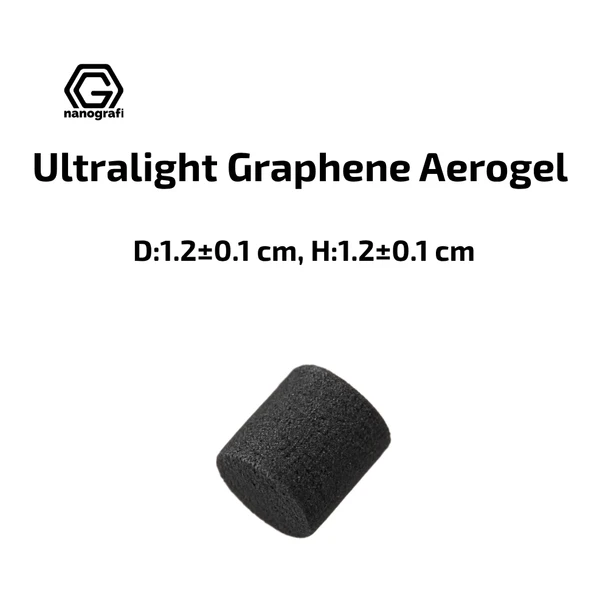
Ultralight Graphene Aerogel, Diameter: 1.2±0.1 cm, Height: 1.2±0.1 cm
- SKU:
- NG01GA0103
- Shipping:
- Calculated at Checkout

Description
1 piece/ 196 €
5 pieces/ 743 €
Contact us for tailored quotes on larger quantities & experience exceptional solutions from our experts.
Product Overview of Ultralight Graphene Aerogel, Diameter: 1.2±0.1 cm, Height: 1.2±0.1 cm
Graphene aerogels are materials which have elasticity and they can easily gain their original form after some compression. In addition, the low density of graphene aerogels enables them to be very absorbent. This material can absorb more than 850 times of its own weight. This property means that it could be useful for environmental clean-ups like oil spills, and the aerogels only need to be picked up later after absorbing the spilled material. Graphene aerogel may also have some applications in both the storage and the transfer of energy by enabling the creation of lighter, higher-energy-density batteries and vigorous research is being done on the matter.
Technical Properties Ultralight Graphene Aerogel, Diameter: 1.2±0.1 cm, Height: 1.2±0.1 cm:
|
Diameter |
1.2 ± 0.1 cm |
|
Height |
1.2 ± 0.1 cm |
|
Density |
1.2-3.2 mg/cm3 |
|
Product State |
Solid |
|
Color |
Black |
Applications of Ultralight Graphene Aerogel, Diameter: 1.2±0.1 cm, Height: 1.2±0.1 cm:
- Oil Spill Cleanup and Environmental Remediation: Investigated as a lightweight absorbent material for oil and organic liquid recovery, supporting research into environmental cleanup technologies.
- Energy Storage Systems: Explored as a porous carbon-based material for lightweight battery electrodes, supercapacitors, and advanced energy storage devices.
- Absorbent Materials: Studied for the absorption of oils and selected organic liquids due to its porous structure and low density.
- Flexible and Compressible Materials: Investigated in lightweight structures requiring compressibility and shape recovery after mechanical deformation.
- Advanced Composites: Explored as a porous carbon framework for developing lightweight multifunctional composite materials.
- Sensors and Functional Materials: Studied as a conductive porous framework for pressure-sensitive devices, strain sensors, and other functional material applications.
FAQ
Frequently Asked Questions About Graphite Micron Powder, 99.9% Purity, 5-10 µm
1. What is high-purity graphite micron powder used for?
Graphite micron powder is used in advanced materials research, energy storage systems, electrically conductive composites, and selected electrode formulations. Its layered crystalline carbon structure provides electrical conductivity, thermal conductivity, and chemical stability under suitable conditions. NANOGRAFi's 99.9% purity, 5-10 µm graphite grade is particularly relevant to research involving lithium-ion battery materials and functional carbon additives. Explore the Graphite Micron Powder collection for related graphite grades.
2. Can 5-10 µm graphite powder be used in lithium-ion battery anodes?
Graphite is widely used as an active anode material in commercial lithium-ion batteries because lithium ions can reversibly intercalate between its carbon layers. This 5-10 µm grade may be investigated in experimental anode formulations, but its suitability depends on crystallinity, particle morphology, surface chemistry, electrode density, and electrochemical performance. Purity and particle size alone do not establish battery-grade performance. Researchers can compare High Capacity and High Purity Graphite for Li-ion Batteries with other graphite materials available from NANOGRAFi.
3. How does the 5-10 µm particle size affect graphite powder performance?
Particle size influences graphite powder packing, surface area, dispersion, and interactions with other electrode or composite constituents. Smaller graphite particles may provide shorter lithium-ion diffusion distances in certain electrode architectures, but they can also increase the relative contribution of surface reactions. Larger particles may exhibit different packing and processing characteristics. The optimal size depends on the intended application. Researchers can compare this grade with Graphite Micron Powder, 5 µm when evaluating particle-size effects.
4. What is the difference between graphite powder and carbon black?
Graphite and carbon black are both carbon-based materials, but their structures and typical functions differ. Graphite has a layered crystalline structure and can serve as an active anode material or conductive additive. Carbon black generally consists of aggregates of smaller carbon particles and is commonly used to establish conductive pathways in electrode and polymer formulations. Their electrical and processing behavior depends on grade and morphology. Compare NANOGRAFi's Carbon Black Powder, 99.99% Purity, 4 µm for related research.
5. What does a specific surface area of 9 m2/g mean for graphite powder?
The reported specific surface area of 9 m2/g describes the accessible surface area per unit mass of this graphite grade. Surface area can influence binder interactions, electrolyte contact, surface reactions, and dispersion behavior. In lithium-ion battery electrodes, a higher accessible surface area may increase interfacial activity but can also affect solid electrolyte interphase formation and irreversible capacity loss. BET surface area should therefore be considered alongside particle morphology, crystallinity, and electrochemical testing results.
6. Can graphite micron powder improve the electrical conductivity of polymer composites?
Graphite powder can be incorporated into selected polymer matrices to modify electrical and thermal properties. Its effectiveness depends on filler concentration, particle orientation, dispersion quality, and compatibility with the host polymer. Conductive pathways may form when sufficient particle-to-particle contact is achieved, although the required loading varies by formulation. Researchers investigating alternative carbon fillers can explore NANOGRAFi's Carbon Micron Powder collection for complementary materials.
7. What is the difference between graphite micron powder and graphene nanoplatelets?
Graphite consists of multiple stacked graphene layers, whereas graphene nanoplatelets are thinner graphitic structures with fewer layers and typically different aspect ratios. These structural differences influence surface area, dispersion, electrical connectivity, and interactions with polymer matrices. Graphene nanoplatelets may be investigated when thin, high-aspect-ratio carbon fillers are required, while graphite powders may be selected for other processing or cost considerations. Explore NANOGRAFi's Graphene Nanoplatelets category for comparative research.
8. How does graphite compare with conductive carbon black in battery electrode formulations?
Graphite and conductive carbon black can perform different functions in lithium-ion battery electrodes. Graphite is commonly used as an active anode material, while specialty conductive carbon blacks help establish electronic pathways between active particles and the current collector. In some formulations, graphite may also function as a conductive additive. The appropriate combination depends on electrode chemistry, binder selection, carbon loading, and processing conditions. Researchers can compare graphite with C-NERGY SUPER C65 Conductive Carbon Black for battery formulation studies.
9. How should high-purity graphite micron powder be stored and handled safely?
Graphite micron powder should be stored in tightly sealed containers under clean, dry conditions to minimize contamination and moisture exposure. Powder handling should reduce airborne dust through appropriate ventilation, containment, and personal protective equipment. Fine carbon powders can present combustible dust hazards under certain conditions, so uncontrolled dust accumulation and ignition sources should be avoided. Researchers should consult the product-specific Safety Data Sheet (SDS) before weighing, mixing, milling, or processing the material. Additional graphite grades are available in NANOGRAFi's Graphite Micron Powder collection.
Related Products
Related Products

Strong Graphene Aerogel, Diameter: 1.2±0.1 cm, Height: 1.2±0.1 cm

Magnetic Graphene Aerogel, Content of Fe3O4: 50%, Diameter: 1±0.1 cm

Magnetic Graphene Aerogel, Content of Fe3O4: 65%, Diameter: 1±0.1 cm
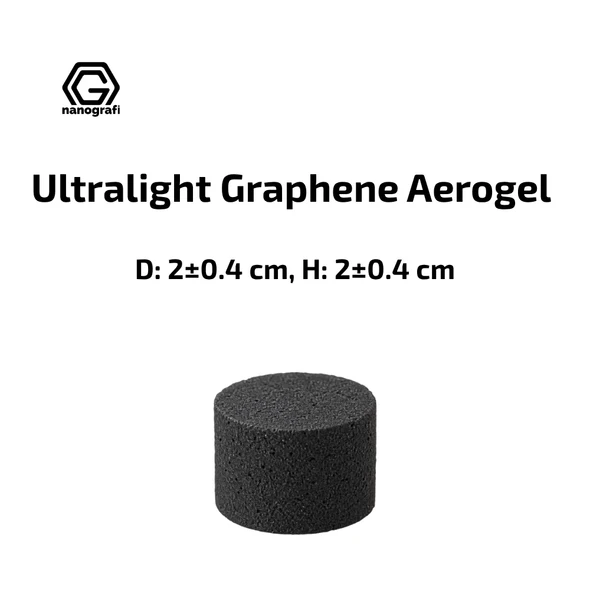
Ultralight Graphene Aerogel, Diameter: 2±0.4 cm, Height: 2±0.4 cm
