KETJENBLACK EC-600JD Conductive Carbon Black

- SKU:
- NG01EM1502
- Shipping:
- Calculated at Checkout


Description
25 gram: 40€
100 gram: 65€
500 gram:175€
1000 gram: 275€
Ketjen Black EC-600JD Conductive Carbon Black
KETJENBLACK is a unique electro-conductive carbon black that has received favorable evaluations for its superior performance and stability of quality. Mixed with plastic, rubber or other materials, KETJENBLACK has garnered high marks for providing the same level of electro-conductivity with a lower loading quantity as conventional carbon black.
PRODUCT PROPERTIES
|
PORE VOLUME, DBP (ml/100) |
480-510 ml/100g |
|
pH |
9.0-10.5 |
|
GRIT (wt%) |
≤30 mg/kg |
|
VOLATILE (wt%) |
≤1.0 % |
|
ASH (wt) |
≤0.1 % |
|
IODIE VALUE |
1000-1100 mg/g |
|
FINE (wt %) |
≤7 % |
|
APPARENT BULK DENSITY (g/L) |
100-120 kg/m³ |
|
MOISTURE (wt%) |
≤0.5 % |
|
APPEARANCE |
Black free-flowing pellets |
Applications of Ketjenblack
EC-600JD is a very pure carbon black extremely suitable for antistatic and electroconductive applications. Due to its unique morphology and the extremely high surface area of approx. 1400 m2/g (BET), only one sixth the amount of Ketjenblack EC600-JD is needed compared to conventional electroconductive blacks in order to achieve the same conductivity. The extreme low loading of Ketjenblack EC600-JD allows easier processing for those compounds sensitive to filler addition, thus minimizing loss in mechanical and rheological properties. Ketjenblack EC-600JD when thoroughly dispersed with the polymer significantly increases the conductivity of the resulting compound. Ketjenblack EC-600JD can be used in all types of polymers, thermoset, thermoplastic as well as elastomers. Due to its unique morphology and structure with very low amounts of Ketjenblack EC-600JD excellent conductive material can be made. The loading needed to obtain a certain conductivity can vary significantly per type of polymer.
Ketjenblack Features
(1) Same level of electro-conductivity as conventional carbon black but with 1/2 to 1/3 of the loading quantity
(2) Effective at a lower loading quantity, has minimal effect on the physical properties of base resins or paint
(3) Minimal reduction in electro-conductivity when mixed with other materials
Electro-Conductive Mechanism
Image of KETJENBLACK's primary particle
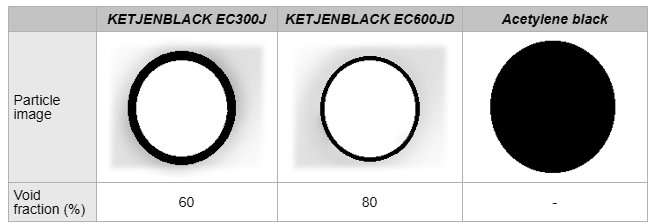
KETJENBLACK's pore structure allows it to perform in a manner that is superior to that of other types of carbon black.
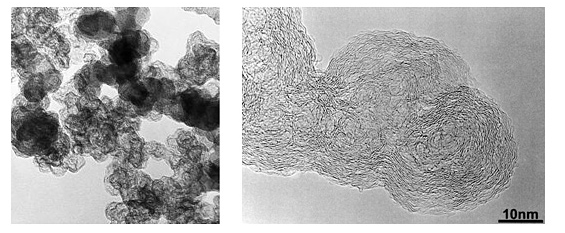
Transmission electron microscopic images of KETJENBLACK EC
Storage
Nanografi recommends to store Ketjenblack EC-600JD in a dry well ventilated place away from direct sunlight. The packaging can be damaged if exposed to direct sunlight for more than 30 minutes.
FAQ
FAQ About Nanografi KETJENBLACK EC-600JD Conductive Carbon Black
1) What are the key specifications of Nanografi KETJENBLACK EC-600JD Conductive Carbon Black?
Nanografi KETJENBLACK EC-600JD, SKU NG01EM1502, is specified with a DBP pore volume of 480-510 ml/100g, a pH of 9.0-10.5, an iodine value of 1000-1100 mg/g, an apparent bulk density of 100-120 kg/m³ and a moisture content of ≤0.5%.
2) What is the BET surface area of KETJENBLACK EC-600JD?
Nanografi KETJENBLACK EC-600JD has an approximate BET surface area of 1400 m²/g. The high surface area is one of the key characteristics associated with its conductive carbon black structure.
3) What is the DBP pore volume of Nanografi KETJENBLACK EC-600JD?
The specified DBP pore volume is 480-510 ml/100g for Nanografi KETJENBLACK EC-600JD Conductive Carbon Black.
4) What is the iodine value of KETJENBLACK EC-600JD?
The iodine value is specified as 1000-1100 mg/g.
5) What is the apparent bulk density of KETJENBLACK EC-600JD?
Nanografi KETJENBLACK EC-600JD has an apparent bulk density of 100-120 kg/m³.
6) What are the moisture, ash and volatile limits of KETJENBLACK EC-600JD?
The specified moisture content is ≤0.5%, ash content is ≤0.1% and volatile content is ≤1.0% for Nanografi KETJENBLACK EC-600JD.
7) What is the physical form of Nanografi KETJENBLACK EC-600JD?
Nanografi KETJENBLACK EC-600JD is supplied as black, free-flowing pellets.
8) Is KETJENBLACK EC-600JD suitable for antistatic and electroconductive applications?
Yes. Nanografi lists KETJENBLACK EC-600JD as a conductive carbon black suitable for antistatic and electroconductive applications.
9) Can KETJENBLACK EC-600JD be used in thermoplastics, thermosets and elastomers?
Yes. Nanografi KETJENBLACK EC-600JD can be used in thermoplastic, thermoset and elastomer systems. According to the product information, thorough dispersion in the polymer significantly increases the conductivity of the resulting compound.
10) Why is KETJENBLACK EC-600JD used at relatively low loading levels?
Nanografi states that the unique morphology and high surface area of KETJENBLACK EC-600JD enable conductive performance at lower loading levels than conventional electroconductive carbon blacks.
11) How does low KETJENBLACK EC-600JD loading affect polymer processing?
Lower loading can simplify processing in compounds that are sensitive to filler addition and can help minimize losses in mechanical and rheological properties.
12) Is there a fixed KETJENBLACK EC-600JD loading level for every polymer system?
No. Nanografi states that the loading required to achieve a specific conductivity can vary significantly depending on the polymer system.
13) What is the pH range of Nanografi KETJENBLACK EC-600JD?
The specified pH range of Nanografi KETJENBLACK EC-600JD Conductive Carbon Black is 9.0-10.5.
14) How should KETJENBLACK EC-600JD be stored?
Nanografi recommends storing KETJENBLACK EC-600JD in a dry, well-ventilated place away from direct sunlight.
Related Products
Related Products

KETJENBLACK EC-300J Conductive Carbon Black

Vulcan XC72 Conductive Carbon Black
Super Conductive Carbon Black Nanopowder and Carbon Nanotube Mixed

C-NERGY Super P Conductive Carbon Black