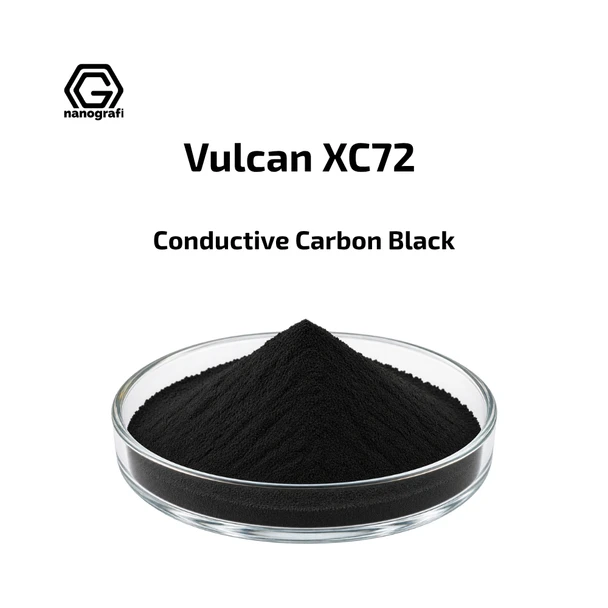
Vulcan XC72 Conductive Carbon Black
- SKU:
- NG10BEW0938
- Shipping:
- Calculated at Checkout

Description
100 grams: 65€
1000 grams: 175€
Product Overview of Vulcan XC72 Conductive Carbon Black
Technical Properties of Vulcan XC72 Conductive Carbon Black
| Average Particle Size | 30 nm |
| Density | 264 kg/m³ |
| OAN | 174 cc/100g |
| Iodine Number | 253 mg/g |
| 325 Mesh Residue | <25 ppm |
| Moisture as Packed | <1.0% |
Applications
- Medium Voltage Power Cables: Heavily utilized as a core functional material in the production of conductor shields and insulation shields for medium voltage cabling systems to maintain long-term electrical reliability.
- Electrostatic Discharge (ESD) Protection: Extensively compounded into polymer trays, packaging pouches, and industrial enclosures used throughout electronic manufacturing lines to insulate sensitive components against ESD.
- Industrial Hoses and Conveyor Belts: Integrated into heavy-duty transmission belts and specialized hoses engineered for the mining, petroleum, and chemical processing industries to safely bleed off dangerous static charges.
- Conductive Plastics and Elastomers: Formulated into broad families of molded or extruded thermoplastic and rubber parts to shift baseline electrical performance from completely insulative to anti-static or dissipative.
- Safe Commercial Environment Supplies: Successfully deployed in safety-critical manufacturing infrastructure such as specialized anti-static hospital flooring, industrial sheeting, and precision printing rolls.
FAQ
Technical FAQ About VULCAN® XC-72 Conductive Carbon Black
1) Which parameters are most relevant when evaluating VULCAN® XC-72 for conductive polymer formulations?
Key parameters include a 30 nm average particle size, OAN of 174 cc/100g, iodine number of 253 mg/g, density of 264 kg/m³ and moisture content below 1.0%. These values help define the structure and handling characteristics of the grade when comparing conductive carbon black options.
2) Why is OAN important when comparing conductive carbon black grades?
OAN is commonly used as an indicator of carbon black structure. Nanografi VULCAN® XC-72 has an OAN of 174 cc/100g, which can be evaluated together with particle size and iodine number when selecting a conductive filler.
3) Can VULCAN® XC-72 be used in conductive plastics and elastomers?
Yes. VULCAN® XC-72 is suitable for conductive and antistatic polymer and elastomer systems where electrical properties need to be introduced into an otherwise insulating matrix.
4) Is VULCAN® XC-72 suitable for ESD protection applications?
Yes. VULCAN® XC-72 can be used in ESD-sensitive applications such as polymer trays, packaging pouches and industrial enclosures where controlled static dissipation is required.
5) Can Nanografi VULCAN® XC-72 be used in medium-voltage cable compounds?
Yes. Nanografi VULCAN® XC-72 can be considered for conductor-shield and insulation-shield compounds used in medium-voltage power cable systems.
6) Why is VULCAN® XC-72 used instead of conventional carbon black in conductive compounds?
Its structured morphology is designed to support conductive network formation at lower filler levels than conventional carbon black grades, helping reduce the amount of conductive filler required in some formulations.
7) How important is dispersion when using VULCAN® XC-72?
Dispersion is critical because conductive performance depends on how effectively the carbon black forms a continuous network within the polymer or elastomer matrix. Poor dispersion can reduce conductivity and negatively affect surface quality and mechanical performance.
8) Can VULCAN® XC-72 be used in industrial hoses and conveyor belts?
Yes. It can be used in industrial rubber applications such as hoses and conveyor belts where static charge dissipation is required, including environments associated with mining, petroleum and chemical processing.
9) Is VULCAN® XC-72 intended only for highly conductive formulations?
No. The grade can also be used in antistatic and dissipative systems. Final electrical behavior depends on filler loading, matrix type, dispersion quality and processing conditions.
10) What should be considered before selecting VULCAN® XC-72 for a new formulation?
Material selection should consider the target electrical performance, polymer or elastomer matrix, processing route, dispersion strategy and acceptable filler loading. Nanografi VULCAN® XC-72 is positioned for ESD protection, cable compounds, conductive plastics, elastomers and other industrial antistatic systems.
Related Products
Related Products
Super Conductive Carbon Black Nanopowder and Carbon Nanotube Mixed

KETJENBLACK EC-600JD Conductive Carbon Black

KETJENBLACK EC-300J Conductive Carbon Black

C-NERGY Super P Conductive Carbon Black