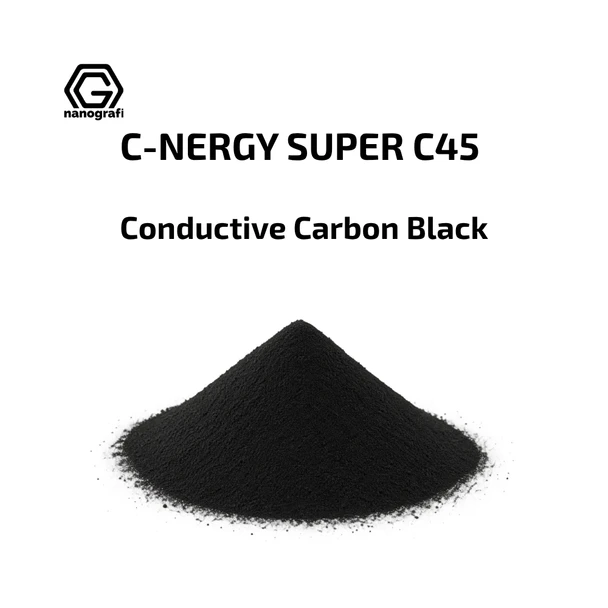
C-NERGY SUPER C45 Conductive Carbon Black
- SKU:
- NG08BE1401
- Shipping:
- Calculated at Checkout


Description
250 grams/ 45€
1000 grams/ 145€
Contact us for tailored quotes on larger quantities & experience exceptional solutions from our experts.
Product Overview of C-NERGY SUPER C45 Conductive Carbon Black as Conductive Additive for Lithium-Ion Batteries EQ-Lib-SuperC45
SUPER C45 is a premium-grade conductive carbon black designed as a high-efficiency performance additive for state-of-the-art electrochemical systems. Manufactured through a proprietary production process, this ultra-high purity material features an optimized combination of high structural integrity and tailored surface area, guaranteeing exceptional distribution and homogeneity within matrix slurries. Its highly graphitic nature ensures outstanding system stability, low moisture pick-up, and minimized chemical degradation. By meeting the most stringent cleanliness and low metal contamination requirements, it ensures long-term process reliability and excellent functional safety in demanding electronic configurations.
Technical Properties of C-NERGY SUPER C45 Conductive Carbon Black as Conductive Additive for Lithium-Ion Batteries EQ-Lib-SuperC45
| Specific Surface Area | 62 m²/g |
| Ash Content | Max. 0.010% |
| Absorption Stiffness Value | 36 ml/5g |
| Moisture (as packed) | 0.1% |
| Grit Content > 45 microns | Max. 5 ppm |
| pH | 7 |
Applications of C-NERGY SUPER C45 Conductive Carbon Black as Conductive Additive for Lithium-Ion Batteries EQ-Lib-SuperC45
- Lithium-Ion Battery Electrodes: Utilized as a premium conductive additive in both cathode and anode formulations to establish a robust electrical network at low loading levels, drastically enhancing electronic conductivity.
- Electrode Slurry Processing: Due to its unique structure and optimal surface properties, it provides exceptional dispersion and distribution qualities in electrode slurries, preventing particle agglomeration during manufacturing.
- Energy Storage Open Circuit Voltage (OCV) Control: Applied to actively reduce the open circuit voltage rejection rate during cell production, improving the long-term safety and efficiency of energy storage devices.
- Conductive Plastics and Composites: Serves as a high-purity electrical modifier in advanced polymer matrices to introduce antistatic, static-dissipative, or conductive capabilities without altering mechanical matrix properties.
- Advanced Supercapacitors: Integrated into premium capacitor formulations to facilitate rapid charge carrier mobility and maximize power density through an optimized internal carbon lattice.
FAQ
Frequently Asked Questions About C-NERGY SUPER C45 Conductive Carbon Black
1. What is C-NERGY SUPER C45 conductive carbon black used for?
C-NERGY SUPER C45 is a conductive carbon black grade relevant to lithium-ion battery electrode formulations and advanced electrochemical materials research. Conductive carbon black is incorporated into electrodes to establish electronic pathways between active material particles and the current collector. Its effectiveness depends on carbon loading, dispersion quality, binder compatibility, and electrode microstructure. Researchers developing electrode formulations can explore Nanografi's Battery Materials collection for complementary active materials and processing components.
2. How does SUPER C45 contribute to electrical conductivity in battery electrodes?
Conductive carbon black particles can form interconnected networks within an electrode, facilitating electron transport between electrochemically active particles. These networks are particularly important when active materials have limited intrinsic electronic conductivity. The effectiveness of SUPER C45 depends on its distribution, aggregate structure, concentration, and interactions with the binder system. The resulting electrode resistance should be evaluated experimentally because conductive additive performance cannot be predicted from the carbon black grade name alone.
3. What is the difference between C-NERGY SUPER C45 and SUPER C65 conductive carbon black?
SUPER C45 and SUPER C65 are different conductive carbon black grades within the C-NERGY product family. Their suitability for a particular electrode formulation should be evaluated using grade-specific technical specifications, including surface area, aggregate characteristics, impurity content, and dispersion behavior. Differences in these properties may influence slurry processing and conductive network formation. Neither grade should be assumed to provide universally superior electrochemical performance. Researchers can compare this product with Nanografi's C-NERGY SUPER C65 Conductive Carbon Black.
4. How does SUPER C45 compare with Super P conductive carbon black?
SUPER C45 and Super P are conductive carbon black grades that can be evaluated for electrochemical electrode formulations. Their performance depends on material characteristics and interactions with the selected active material, binder, and processing system. Important comparison parameters include specific surface area, aggregate morphology, dispersion quality, electrode resistance, and impurity levels. Controlled electrode testing is necessary to determine which material is more appropriate for a particular application. Explore Nanografi's C-NERGY Super P Conductive Carbon Black for comparative research.
5. Can SUPER C45 be used in lithium-ion battery cathodes and anodes?
Conductive carbon black can be incorporated into both cathode and anode formulations to support electronic connectivity. In cathodes, conductive additives are particularly relevant to active materials with limited electrical conductivity. In anodes, they may help maintain electronic pathways within graphite-, silicon-, or other active-material-based systems. The suitability of SUPER C45 for a specific chemistry requires verification of its technical specifications and electrode performance. Researchers can explore Nanografi's Cathode Materials and Anode Materials collections.
6. How does SUPER C45 affect electrode slurry dispersion and coating quality?
Conductive carbon black can influence electrode slurry viscosity, particle distribution, and coating uniformity. Its aggregate structure and interactions with the binder and solvent determine how effectively it disperses within a formulation. Inadequate dispersion can produce nonuniform conductive networks and inconsistent electrode properties. Mixing sequence, shear conditions, solids content, and binder concentration should therefore be optimized for each formulation. Researchers can explore Nanografi's Lithium-Ion Battery Materials collection for related formulation components.
7. What is the difference between SUPER C45 conductive carbon black and graphite powder?
Conductive carbon black and graphite are carbon-based materials with different structures and typical functions in battery electrodes. SUPER C45 is intended to be evaluated as a conductive additive, whereas graphite is widely used as an electrochemically active anode material capable of reversible lithium intercalation. Graphite may also contribute to electronic conduction, depending on its grade and formulation. The two materials are not direct substitutes in every electrode design. Compare Nanografi's Graphite Micron Powder, 99.9% Purity, 5-10 µm for related carbon material research.
8. Can SUPER C45 be combined with PVDF, SBR, or PTFE electrode binders?
Conductive carbon black can be evaluated in electrode formulations containing different binder systems, provided the materials and processing conditions are compatible. PVDF is commonly used in solvent-based electrode processing, while SBR is frequently used in aqueous anode formulations alongside other binder components. PTFE is investigated in selected dry electrode manufacturing processes. Carbon distribution, binder content, and electrode cohesion must be optimized for each system. Researchers can explore Nanografi's PTFE Nanopowder for related binder research.
9. How should C-NERGY SUPER C45 conductive carbon black be stored and handled safely?
C-NERGY SUPER C45 should be stored in tightly sealed containers under the conditions specified in the product-specific Safety Data Sheet (SDS). Handling should minimize airborne dust through appropriate ventilation, containment, and personal protective equipment. Fine carbon powders may present combustible dust hazards under certain conditions, so dust accumulation and ignition sources should be controlled. Researchers should also prevent contamination during weighing, mixing, and electrode fabrication. Storage and handling requirements should always be confirmed against the manufacturer's documentation.
Related Products
Related Products
C-NERGY SUPER C65 Conductive Carbon Black

C-NERGY Super P Conductive Carbon Black
Super Conductive Carbon Black Nanopowder and Carbon Nanotube Mixed

Vulcan XC72 Conductive Carbon Black