
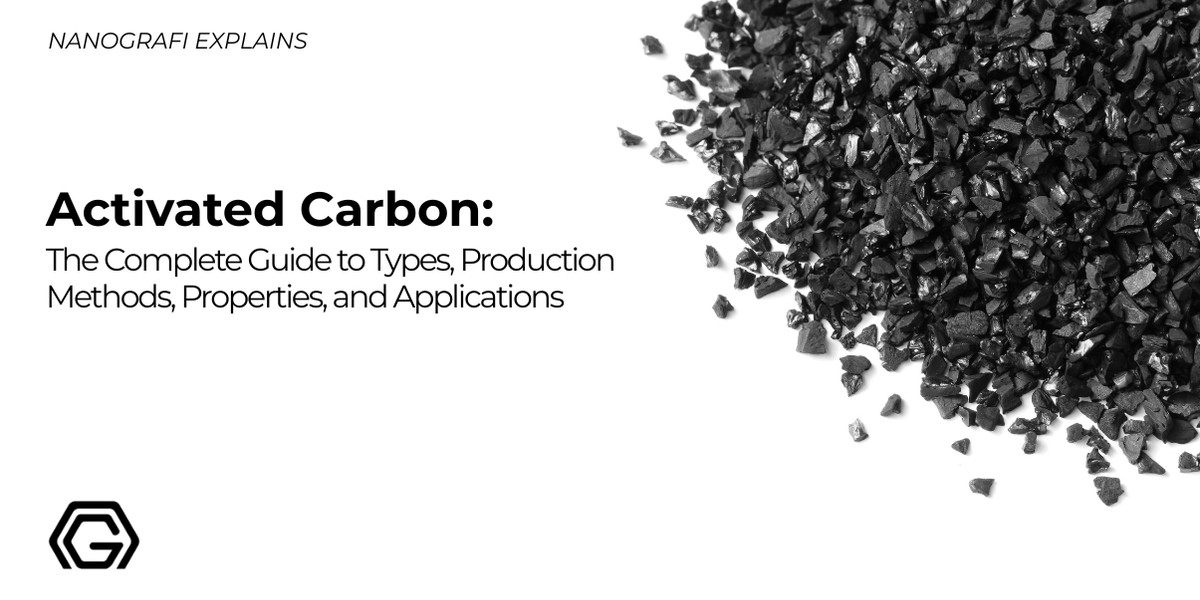
Activated Carbon: The Complete Guide to Types, Production Methods, Properties, and Applications
Activated carbon is ordinary carbon processed to develop an enormous internal pore network, the kind of processing that can push surface area from a few square meters per gram in raw charcoal up past 1,000 m2/g, and in specialty grades past 3,000 m2/g. That almost absurd amount of internal surface packed into a small volume is what makes activated carbon adsorb rather than simply sit inert. Adsorption is worth distinguishing from absorption here: a sponge absorbs water into its bulk structure, while activated carbon adsorbs molecules onto its surface, holding contaminants against the pore walls through van der Waals forces and, for certain species, chemisorption, rather than soaking them up like a liquid. The strength of that attraction, and how much a given carbon can hold at equilibrium, is typically described using Langmuir or Freundlich isotherm models, which is why a proper technical spec sheet usually references one or both rather than a single generic "adsorption capacity" figure.
What Makes a Carbon "Activated"
Any carbon-rich raw material, coconut shell, wood, peat, coal, even rice husk or bamboo, starts out with a relatively closed, low-porosity structure once carbonized at 400 to 700°C in an oxygen-limited environment. Activation is the additional step that opens that structure up, gasifying disordered carbon and widening existing channels into a genuine three-dimensional pore network classified, by IUPAC convention, into micropores (under 2 nm), mesopores (2 to 50 nm), and macropores (above 50 nm). Without activation you have char, with a BET surface area typically under 10 m2/g. With it, depending on raw material and process severity, you get a material whose micropores account for a large share of total pore volume for VOC capture, while its broader pore structure and surface functionality enable the removal of species like heavy metal ions or dissolved chlorine out of a stream of water or air with real efficiency.
Types by Raw Material
The raw material used affects final performance more than most buyers initially assume, mainly because it dictates the pore-size distribution the carbon ends up with, and that distribution is set largely by the precursor's natural cellular architecture rather than by the activation step alone.
- Coconut shell produces a dense, highly microporous carbon, prized for potable water treatment, gas-phase purification, and gold recovery, where its high hardness (commonly 97 to 99%+ on the ASTM D3802 ball-pan scale) also means minimal fines generation over repeated handling.
- Coal (bituminous, sub-bituminous, or lignite) is the dominant feedstock for large-scale water treatment, offering a broader pore-size distribution at a lower cost per ton, typically with 6 to 14% ash content, somewhat higher than coconut shell carbon.
- Wood produces a more mesopore-dominated structure, weaker on small-molecule gas-phase adsorption but genuinely better at decolorization, which is why wood-based powdered carbon remains standard in sugar refining and pharmaceutical purification.
- Peat, bamboo, and agricultural residues (rice husk, coir, corn cob) fill more specialized niches, generally landing between coconut shell and wood in pore character, with BET surface areas commonly in the 800 to 1,200 m2/g range.
Coconut shell in particular tends to dominate applications where iodine number and hardness both matter simultaneously, a combination explored in full, with side-by-side numbers against coal and wood, in a dedicated comparison of coconut shell activated carbon against coal- and wood-based alternatives.
Types by Physical Form
- Powdered (PAC): very fine, typically under 44 micrometers (325 mesh), dosed directly into a liquid stream at rates commonly between 5 and 50 mg/L and removed later by filtration or sedimentation; common during taste-and-odor events and in food decolorization. This is also the format most carbon nanoparticle grades are supplied in when the end use is electrode fabrication rather than bulk filtration.
- Granular (GAC): coarser, standard mesh sizes such as 8x30 or 12x40, suited to fixed-bed columns operated at an empty bed contact time (EBCT) typically between 10 and 20 minutes; the standard format for drinking water plants and home filtration.
- Extruded pellets: cylindrical, usually physically activated coal or wood, chosen for solvent recovery and respirator cartridges where low pressure drop and mechanical strength both matter.
- Bead and cloth/fiber forms: used respectively in fluidized-bed reactors and in filtration media where a thin, high-surface-area textile format is preferred over loose granules.
How Activated Carbon Is Produced
Physical and chemical activation remain the two dominant industrial routes, and the choice between them shapes almost every downstream property discussed in this guide.
- Physical (steam or gas) activation: raw material is first carbonized, then activated at 800 to 1,100°C using steam or CO2, which selectively gasifies disordered carbon atoms and opens the pore network through steam or CO2 gasification reactions. This is the dominant route for coconut shell and coal-based carbons and generally yields a more microporous product.
- Chemical activation: the raw material is impregnated withdehydrating agents like phosphoric acid or zinc chloride, then carbonized at a lower temperature, typically 450 to 700°C. This route is favored for wood-based powdered carbon and tends to produce a more mesopore-rich structure with higher overall BET surface area, though usually at higher production cost and with more residual chemical content that must be washed out before use.
Once in service, a carbon's working life ends when its adsorption sites saturate, at which point thermal reactivation, effectively a second activation step run at 800 to 900°C, can restore a large share of the original capacity, though with a small, cumulative loss in performance across repeated cycles.
Key Properties and How to Read a Spec Sheet
- BET surface area (m2/g): measured by nitrogen gas adsorption at 77 K, this captures total pore surface across micro-, meso-, and macropores; typical commercial grades run 500 to 1,800 m2/g, with specialty research-grade carbons reported as high as 3,000 to 3,500m2/g.
- Iodine number (mg/g): a faster, simpler proxy for microporosity specifically, commonly 700 to 1,200 mg/g for commercial carbons; correlates well with small-molecule adsorption capacity but should never be the sole selection criterion, since two carbons with identical iodine numbers can behave very differently if their pore size distributions differ.
- CTC (carbon tetrachloride) activity: an older but still-used vapor-phase benchmark for microporosity, expressed as a percentage of adsorbed CTC relative to carbon weight, commonly 50 to 70% for commercial gas-phase grades.
- Methylene blue number: a complementary measure that tracks mesopore capacity, more relevant for decolorization and larger-molecule removal than the iodine number is.
- Ash content: lower is generally better, since ash is inert, non-adsorbing mineral matter, mostly silica and alumina; coconut shell carbon typically runs 2 to 4%, coal-based carbon commonly 6 to 14%.
- Hardness or abrasion resistance: measured by ball-pan hardness (ASTM D3802) or Ro-Tap methods, important anywhere carbon is handled, backwashed, or transported repeatedly, since a softer carbon generates more fines and needs more frequent replacement.
- Apparent density, moisture content, and particle size distribution: govern how much carbon fits in a given vessel, how the bed behaves hydraulically under flow, and how much dead weight is being paid for as residual water rather than usable carbon.
- pHzpc (point of zero charge): the pH at which the carbon surface carries no net electrical charge, a parameter that strongly affects how well the carbon adsorbs ionic species and is often overlooked outside specialized water treatment specifications.
Kinetics matter as much as equilibrium capacity in practice: most systems are modeled with pseudo-first-order or pseudo-second-order rate equations, and a carbon that looks excellent on a static isotherm test can still underperform in a fast-flow column if its intraparticle diffusion rate is too slow for the contact time available.
Applications
- Drinking water and municipal treatment: catalytically reducing chlorine and chloramines, taste-and-odor compounds, and trace organic contaminants
- Industrial wastewater treatment: adsorbing dissolved organics and dyes, while capturing heavy metal species via surface functional groups and ion exchange before discharge
- Air and gas purification: VOC capture in industrial exhaust, respirator and gas mask cartridges, automotive fuel vapor (EVAP) canisters
- Gold recovery: carbon-in-pulp and carbon-in-leach processes rely on activated carbon's affinity for gold-cyanide complexes
- Food, beverage, and pharmaceutical processing: decolorization of sugar syrups and edible oils, purification of active pharmaceutical ingredients
- Medicine: activated charcoal adsorbs certain ingested toxins and overdosed medications in emergency settings
- Energy storage: high-surface-area activated carbon serves as an electrode material in electric double-layer capacitors, where specific capacitance in the 100 to 250 F/g range is typical for commercial grades
In energy storage specifically, plain activated carbon is increasingly blended directly with conductive carbon nanotubes rather than used on its own, since the combination adds real electrical conductivity and mechanical resilience on top of the base material's charge storage capacity.
Choosing the Right Type and Grade
There's no single "best" activated carbon, only the best match for a given contaminant, format, and budget. Removing chlorine or trace VOCs from drinking water calls for a highly microporous, hard carbon, which is exactly where coconut shell-based grades tend to win. Decolorizing a sugar syrup or edible oil calls for a mesopore-rich carbon, which usually means wood-based powdered carbon. Large-scale municipal treatment, where cost per pound matters more than squeezing out the last few percent of performance, is where coal-based carbon remains genuinely competitive. In most real projects the practical approach is to specify performance requirements, iodine number, BET surface area, ash content, particle size, pHzpc where relevant, rather than a raw material name, and let those numbers point toward the right feedstock and production route. Independent verification matters here too: Nanografi's own list of scientific publications is a reasonable way to check that a given carbon's stated surface area and purity data hold up under third-party scrutiny rather than resting on marketing claims alone.
Frequently Asked Questions
What is the difference between activated carbon and regular charcoal? Charcoal is simply carbonized organic material with a BET surface area typically under 10 m2/g; activated carbon has gone through an additional activation step, physical or chemical, that dramatically increases internal surface area and adsorption capacity.
Which type of activated carbon is best for drinking water? Coconut shell-based granular activated carbon is generally preferred because its microporous structure matches chlorine, chloramines, and many trace organic contaminants well, and its hardness keeps fines generation low in fixed-bed filters.
Can activated carbon be reused after it's exhausted? Yes, in industrial settings. Thermal reactivation at 800 to 900°C can restore much of the original adsorption capacity, though usually with a small, cumulative loss of performance over repeated cycles.
Why does BET surface area sometimes not match iodine number rankings? Because BET measures total pore surface across all pore sizes, while iodine number reflects microporosity specifically. A wood-based carbon can have a higher BET surface area than a coconut shell carbon while still adsorbing small molecules (or iodine) less effectively, since its extra surface area sits mostly in mesopores rather than micropores.
References
- Bansal, R. C., & Goyal, M. (2005). Activated carbon adsorption. CRC Press.
- Marsh, H., & Rodríguez-Reinoso, F. (2006). Activated carbon. Elsevier.
- Danish, M., & Ahmad, T. (2018). A review on utilization of wood biomass as a sustainable precursor for activated carbon production and application. Renewable and Sustainable Energy Reviews, 87, 1-21.
- Yahya, M. A., Al-Qodah, Z., & Ngah, C. W. Z. (2015). Agricultural bio-waste materials as potential sustainable precursors used for activated carbon production: A review. Renewable and Sustainable Energy Reviews, 46, 218-235.
- Western Carbon. (2026). Iodine number vs BET surface area: How to technically evaluate activated carbon quality. https://www.westerncarbon.com/iodine-number-vs-bet-surface-area-activated-carbon-quality/
Recent Posts
-
ZnO Nanoparticles in OLED and Perovskite Solar Cells
Many printed solar cells and inverted display stacks need a layer that collects electrons and passes …23rd Sep 2026 -
MXene for EMI Shielding: Materials, Mechanisms and Applications
Electromagnetic interference has become a design constraint rather than an afterthought. Densely pac …10th Sep 2026 -
Handling and Storage Best Practices for Metal Oxide Nanopowders
A metal oxide nanopowder is bought for a property that a coarse powder cannot deliver: a specific su …1st Sep 2026