
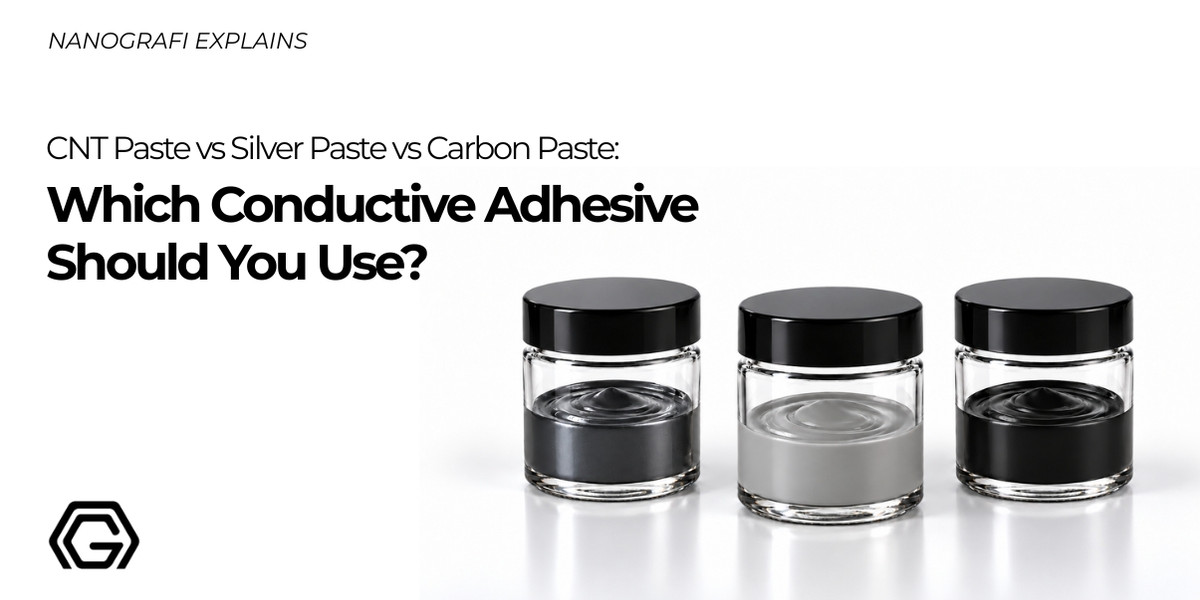
CNT Paste vs Silver Paste vs Carbon Paste: Which Conductive Adhesive Should You Use?
Conductive pastes quietly hold much of modern electronics together. They bond chips to substrates, draw circuits on flexible films, form the working electrodes of disposable sensors and connect solar cell contacts without solder. Three families are most commonly used in this space: silver paste, carbon paste and carbon nanotube (CNT) paste. They share the same basic recipe, yet they behave very differently once they are printed, cured and put into service.
In practice, silver paste is chosen when a joint or trace needs the lowest possible electrical resistance. Carbon paste wins when low cost and chemical stability matter more than raw conductivity. CNT paste stands out when a layer must stay conductive at low filler loading, on flexible substrates or on an electrochemical sensor surface. As a supplier of all three conductive adhesive pastes and of the carbon and silver nanomaterials behind them, Nanografi sees this choice come up in research labs and production lines alike. This guide explains the physics behind each option and how to match it to your application.
How Does a Conductive Paste Carry Current?
Most conductive pastes combine conductive particles, a polymer binder and, in many formulations, a solvent. After printing or dispensing, the solvent evaporates or the binder cures, and the particles are pulled into contact. Current flows once they form a continuous path through the layer. The filler content where this path first appears is called the percolation threshold.
Particle shape decides how early that threshold arrives. Silver flakes overlap like roof tiles, so they conduct well but need high loading. Near-spherical carbon black particles also need a crowded structure before they connect. Carbon nanotubes are different: their length is hundreds or thousands of times their diameter, so they reach each other easily. A widely cited review of CNT polymer composites reports percolation thresholds well below 0.1 wt% in many systems, far lower than what spherical fillers require.
Silver Paste: The Conductivity Benchmark for Electronics Assembly
Silver has the lowest electrical resistivity of all metals at room temperature, and its surface oxide impairs conduction far less than the oxides of most other metals. This is why silver paste became the reference material for electrically conductive adhesives. Silver-filled adhesives were developed as a lead-free alternative to tin-lead solder, offering lower processing temperatures and finer pitch capability.
Low-temperature curing is one of their biggest advantages. A silver conductive paste that cures at about 80 °C lets you bond components to plastic films, sensors or temperature-sensitive modules that would not survive a reflow oven. Research on silver nanoparticles has gone even further: printed nanosilver patterns have been made highly conductive at room temperature by chemically triggering particle sintering instead of heating them.
The trade-offs are cost and reliability in harsh conditions. Silver is a precious metal, and under humidity and electrical bias its ions can migrate between closely spaced conductors, which may cause short circuits. Typical uses include die attach, SMD component repair, electrode contacts and SEM sample mounting. Our guide to silver conductive adhesive paste types and curing behavior covers these points in more detail.

Carbon Paste: Low Cost, Chemical Stability and Strong Electrochemistry
Carbon paste is usually built on graphite and conductive carbon black in a polymer binder. Its resistance is clearly higher than that of silver paste, but it offers three strong advantages: it is inexpensive, it does not corrode or migrate, and it is electrochemically well behaved over a wide potential range.
These properties explain why carbon inks form the backbone of screen-printed electrochemical sensors, from glucose test strips to disposable environmental probes. Carbon has also moved into energy devices. One well-known study built fully printable perovskite solar cells with a carbon counter electrode in place of gold and lowered production cost. For a closer look at formulation and uses, see what conductive carbon paste is and where it works best.
CNT Paste: Conductive Networks at Low Loading and Under Strain
Carbon nanotube paste offers an intermediate profile between the two. It does not match silver in bulk conductivity, yet its long, flexible tubes build a connected network with very little filler. This keeps more of the binder free to provide adhesion and elasticity, which helps printed layers survive bending and repeated strain.
CNT pastes also shine in electrochemistry. The first carbon nanotube paste electrode, a mineral-oil-bound laboratory electrode reported in 2003, gave lower overpotentials and better-defined signals for biologically relevant molecules than a conventional graphite paste. In stretchable electronics, researchers combined nanotubes with silver to print films that stayed conductive under large deformation, with CNTs bridging the gaps between metal particles.
The main challenge is dispersion. Nanotubes tend to bundle, and poorly dispersed tubes lose most of their advantage. The choice between single-walled and multi-walled nanotubes also matters: industrial-grade MWCNTs are the cost-effective route for most pastes, while ready-to-use CNT dispersions simplify custom formulation.
CNT Paste vs Silver Paste vs Carbon Paste at a Glance
|
Property |
Silver Paste |
Carbon Paste |
CNT Paste |
|
Electrical conductivity |
Highest |
Moderate to low |
Moderate, network forms at low loading |
|
Material cost |
High |
Low |
Medium |
|
Flexibility |
Good, limited by high filler content |
Good |
Very good |
|
Electrochemical use |
Limited, silver can react |
Excellent |
Excellent, high surface area |
|
Main risk |
Silver migration, cost |
Higher resistance |
Dispersion quality |
|
Typical uses |
Die attach, contacts, repairs |
Sensors, resistors, heaters |
Flexible circuits, biosensors, antistatic layers |

How to Choose the Right Conductive Adhesive for Your Application
The best paste is the one that meets the electrical target without compromising the substrate, the process or long-term reliability. Five questions narrow the choice quickly.
- Resistance budget: if the trace or joint carries current to an active component, start with silver paste. Compare datasheets by volume resistivity, and confirm the result on your own prints with a four-point probe, since layer thickness and cure conditions change the final value.
- Substrate and cure window: the curing temperature must stay below the softening point of the substrate. For PET, PEN or other polymer films, low-temperature curing grades protect the part from warping, while ceramic and glass substrates tolerate higher cure profiles that usually give lower resistance.
- Process method: screen printing needs a paste with the right viscosity and shear-thinning behavior, while dispensing and stencil work favor pastes that hold their shape after deposition. Check pot life and shelf conditions before scaling up.
- Operating environment: in humid, biased or chemically aggressive conditions, carbon or CNT paste is the safer option because neither is prone to silver-type ion migration or corrosion.
- Mechanical and electrochemical demands: for bending or stretching, CNT paste or a CNT and silver hybrid is often the better-suited choice. For sensor electrodes, carbon paste is the standard, and CNT paste is the upgrade when higher sensitivity is needed.
Many real devices combine materials rather than choosing one. A common design prints silver traces for low resistance and covers the contact areas with carbon paste to protect them from corrosion and migration. The same layer-by-layer logic appears across printed electronics materials, where each layer is selected for one job. Before scaling up, test adhesion, resistance drift after humidity exposure and performance after repeated bending under your own conditions. The peer-reviewed studies that use Nanografi materials are also a useful reference for how other research groups have processed and characterized similar formulations.
Frequently Asked Questions
Is CNT paste more conductive than silver paste?
No. Silver paste has clearly higher bulk conductivity because it relies on a dense network of metal flakes. CNT paste is chosen for other reasons: it forms a conductive network at very low filler loading, stays conductive under bending and offers a large, electrochemically active surface.
Can carbon paste replace silver paste?
Only in low-current tasks such as sensor electrodes, resistive traces, heaters and protective overlayers. It is not suitable for component bonding or interconnects where low resistance is critical. In those cases, a silver layer covered by carbon often gives the best balance.
Which conductive paste is best for electrochemical sensors?
Carbon paste is the standard choice for screen-printed working and counter electrodes because it is relatively inert, inexpensive and stable over a wide potential range. CNT paste is preferred when faster electron transfer, lower overpotentials and higher sensitivity are needed.
Can silver paste be used on flexible substrates?
Yes, if the curing temperature suits the film. Low-temperature silver pastes are widely used on polymer films. Because of their high filler content, however, they can crack under repeated bending, so flexible designs may add CNTs, use more elastic binders or limit the bending radius.
How can silver migration be prevented?
Silver migration needs moisture, an electric field and closely spaced conductors. Wider spacing between traces, encapsulation, a carbon overcoat on exposed contacts and good humidity control all reduce the risk.
What is the difference between conductive paste and conductive ink?
Both contain conductive fillers in a carrier, but pastes have higher viscosity and solid content. Pastes suit screen printing, stencil printing and dispensing, while inks are generally lower in viscosity and solid content and are formulated for inkjet, flexographic or spray processes; screen-printable formulations are called either pastes or inks in practice.
References
- Li, Y., Wong, C.P. Recent advances of conductive adhesives as a lead-free alternative in electronic packaging: Materials, processing, reliability and applications. Materials Science and Engineering: R: Reports, 51, 1-35 (2006). doi:10.1016/j.mser.2006.01.001
- Bauhofer, W., Kovacs, J.Z. A review and analysis of electrical percolation in carbon nanotube polymer composites. Composites Science and Technology, 69, 1486-1498 (2009). doi:10.1016/j.compscitech.2008.06.018
- Magdassi, S., Grouchko, M., Berezin, O., Kamyshny, A. Triggering the sintering of silver nanoparticles at room temperature. ACS Nano, 4(4), 1943-1948 (2010). doi:10.1021/nn901868t
- Metters, J.P., Kadara, R.O., Banks, C.E. New directions in screen printed electroanalytical sensors: an overview of recent developments. Analyst, 136, 1067-1076 (2011). doi:10.1039/c0an00894j
- Ku, Z., Rong, Y., Xu, M., Liu, T., Han, H. Full printable processed mesoscopic CH3NH3PbI3/TiO2 heterojunction solar cells with carbon counter electrode. Scientific Reports, 3, 3132 (2013). doi:10.1038/srep03132
- Rubianes, M.D., Rivas, G.A. Carbon nanotubes paste electrode. Electrochemistry Communications, 5(8), 689-694 (2003). doi:10.1016/S1388-2481(03)00168-1
- Chun, K.Y., Oh, Y., Rho, J., Ahn, J.H., Kim, Y.J., Choi, H.R., Baik, S. Highly conductive, printable and stretchable composite films of carbon nanotubes and silver. Nature Nanotechnology, 5, 853-857 (2010). doi:10.1038/nnano.2010.232
Recent Posts
-
CNT Paste vs Silver Paste vs Carbon Paste: Which Conductive Adhesive Should You Use?
Conductive pastes quietly hold much of modern electronics together. They bond chips to substrates, d …1st Oct 2026 -

ZnO Nanoparticles in OLED and Perovskite Solar Cells
Many printed solar cells and inverted display stacks need a layer that collects electrons and passes …23rd Sep 2026 -
MXene for EMI Shielding: Materials, Mechanisms and Applications
Electromagnetic interference has become a design constraint rather than an afterthought. Densely pac …10th Sep 2026