
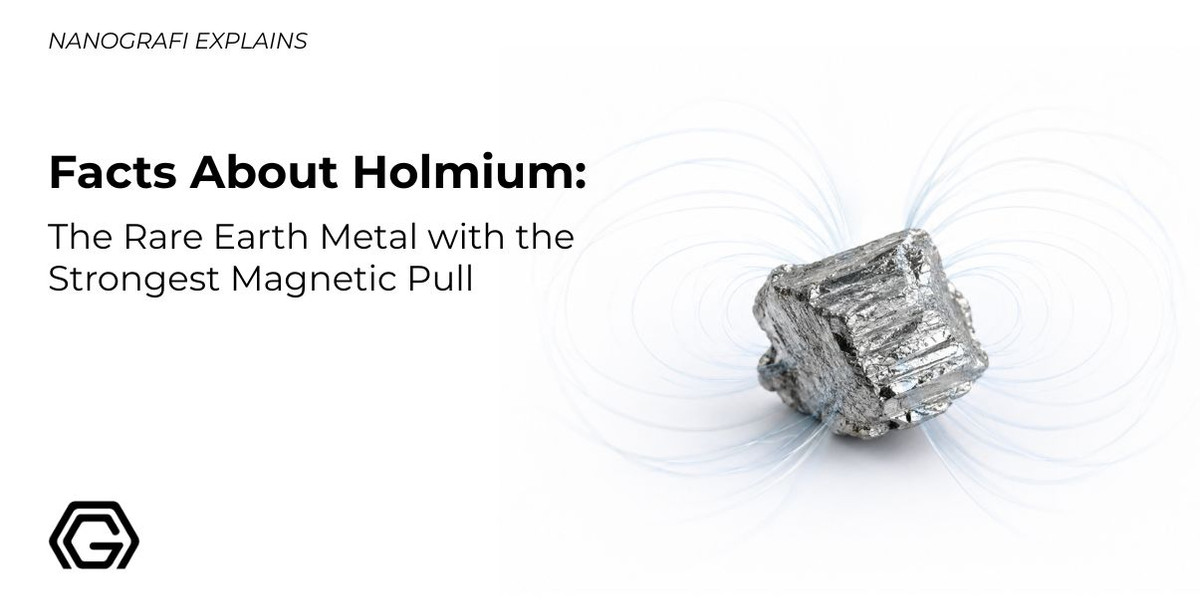
Facts About Holmium: The Rare Earth Metal With the Strongest Magnetic Pull
Holmium doesn't get talked about nearly as much as neodymium or dysprosium, but it quietly does something none of its neighbors on the periodic table can match: no naturally occurring element has a stronger magnetic moment. That single fact, 10.6 μB per Ho3+ ion, is why holmium shows up in places you wouldn't expect a soft, silvery-white metal to matter much: inside high-field electromagnets, in kidney stone lasers, and lately in nuclear reactor control rods and even early quantum computing research.
What Holmium Actually Is
Holmium (symbol Ho, atomic number 67) sits in the lanthanide row, the block of elements most people lump together as "rare earths" without knowing much beyond that. It's a heavy metal, malleable and soft enough to cut with a knife in its pure form, and it exists in two crystal structures, alpha and beta holmium, depending on temperature and pressure. Melting point sits around 1,474 degrees Celsius, boiling point close to 2,700 degrees Celsius, and density is about 8.8 g/cm3, roughly similar to lead. Chemically, holmium is almost boringly consistent: it forms compounds almost exclusively in the +3 oxidation state, losing two 6s electrons and one 4f electron to become Ho3+. That ion configuration, ten electrons left in the 4f subshell, happens to be the sweet spot that gives holmium its record-setting magnetic behavior in the first place.
Left exposed to moist air, holmium slowly forms a yellowish oxide layer, which is a fairly normal lanthanide trait. In water it reacts slowly to form the hydroxide, and in acid it dissolves with hydrogen gas released, forming holmium salts. None of this is dramatic chemistry, but it's the reason holmium is almost always handled, stored, and sold as an oxide or a stable compound rather than bare metal.
A Short, Slightly Odd Discovery Story
Holmium's discovery is a good example of how messy 19th-century rare earth chemistry actually was. In 1878, the Swiss researchers Jacques-Louis Soret and Marc Delafontaine noticed unexplained absorption bands while studying the spectrum of erbia, a mixture that, unknown to them at the time, was hiding more than one element. It took the Swedish chemist Per Teodor Cleve until 1879 to actually separate and isolate the new element, and he named it after Stockholm, holmium comes from "Holmia," the Latin name for the city. It's a small footnote, but it explains why so many rare earths were discovered inside each other rather than found on their own: they're chemically so similar that separating them was, for decades, close to torturous. Terbium and erbium share almost the same origin story, two more lanthanides pulled apart from the same messy 19th-century mineral samples through years of patient, incremental separation work.
Where Holmium Is Found
Like the rest of the lanthanide series, holmium doesn't occur as a standalone deposit anywhere on Earth. It shows up in trace amounts inside minerals such as monazite, gadolinite, bastnasite, and xenotime, always mixed in with a whole cocktail of other rare earth elements that have to be separated out through solvent extraction or ion exchange. This is part of why holmium is officially listed as a critical mineral in the United States as of 2025, and why China's decision in October 2025 to extend export licensing requirements to several heavy rare earths, holmium included, has been closely watched by manufacturers who depend on it. Global holmium production is genuinely small in dollar terms compared to, say, neodymium, but the applications built around it are disproportionately important for how little material they actually consume.
The Magnetic Story: Why Holmium Matters More Than Its Size Suggests
At room temperature, holmium is only weakly magnetic, technically paramagnetic. Cool it down below roughly 19 to 20 Kelvin, and it turns strongly ferromagnetic, developing a helical magnetic ordering that physicists studying magnetism in solids still use as something close to a model system. What makes holmium genuinely useful, though, isn't just that low-temperature behavior. Its raw magnetic moment, the highest of any naturally occurring element, means holmium concentrates and shapes magnetic field lines better than almost anything else available. That's why holmium pole pieces turn up inside the highest-field electromagnets used in research labs, and why it plays a supporting role in some of the highest-performance permanent magnets, usually alongside neodymium and dysprosium rather than on its own. The same magnetic character is being explored in magnetocaloric materials for magnetic refrigeration, and, more speculatively, in molecular spin qubits, where individual holmium ions are being studied as candidates for quantum information storage.
Holmium in Medicine: The Ho:YAG Laser
If there's one application that keeps holmium commercially relevant, it's the Ho:YAG laser, holmium-doped yttrium aluminum garnet. It emits pulsed infrared light around 2.1 micrometers, a wavelength that water absorbs extremely well, which happens to make it close to ideal for cutting soft tissue with very little thermal damage to whatever's next to it. That property is why Ho:YAG lasers have become a standard tool in urology, most notably for laser lithotripsy, breaking up kidney stones, and for treating benign prostatic hyperplasia, and why they're also used in some ophthalmic procedures for conditions like glaucoma. It's a fairly rare case of a rare earth element doing something in an operating room that most patients will never realize involves a lanthanide at all. Rare earth elements more broadly have quietly built up a track record in medical diagnostics and cancer treatment, where gadolinium, holmium's neighbor two spots over, is far better known thanks to its role in MRI contrast agents.
Nuclear and Optical Applications
Because holmium absorbs neutrons efficiently, it's used in nuclear reactor control rods and burnable poison systems, where the goal is to soak up excess neutrons and keep a fission reaction stable rather than let it run away. On the optical side, holmium oxide (Ho2O3) has a long-standing use as a calibration standard for spectrophotometers, precisely because it produces very sharp, well-defined absorption peaks across the visible spectrum. That same oxide is also used as a glass and ceramic colorant, and it's a genuinely strange one to look at: under normal daylight it reads as a pale yellow or tan, but under trichromatic lighting the same material shifts to a fiery orange-red, almost identical to how erbium oxide behaves under the same light. In research settings, holmium oxide has also found a niche as a catalyst, particularly in the dehydration of alcohols and in oxidative methane coupling reactions.
Buying Holmium: Metal, Oxide, and Purity Considerations
For most industrial and research purposes, holmium is sold either as elemental metal powder or as the oxide, and the right choice depends entirely on what property you're actually after. If magnetic behavior or alloying is the goal, elemental holmium micron powder, typically supplied around 99.5% purity, is the more direct route. If the application is optical, catalytic, or ceramic in nature, holmium oxide micron powder, usually offered at 99.99% purity and a 325 mesh particle size, is the more common starting material, and it sits within a broader lineup of rare earth oxide powders that also includes gadolinium, cerium, and praseodymium oxides for side-by-side comparison. Purity matters more here than in a lot of other metals categories, since even small contamination from a neighboring lanthanide can measurably shift optical absorption behavior or magnetic performance. Nanografi's own materials show up in a growing body of independent research, something reflected directly in its list of scientific publications citing work done with its rare earth and nanomaterial products, which is a reasonably good way to gauge whether a supplier's stated purity and characterization data actually hold up under third-party scrutiny.
Holmium rarely gets discussed on its own for long, mostly because its story only really makes sense next to the rest of the lanthanide series. Gadolinium oxide in nano and micron powder form sits right next to holmium on the periodic table and shares a lot of its magnetic relevance, while lutetium and samarium round out the heavier end of the series with their own, quite different, industrial niches.
Frequently Asked Questions
What is holmium primarily used for? Its two biggest practical roles are as the active laser medium in Ho:YAG medical lasers, mainly for kidney stone treatment, and as a component in high-field magnets and neutron-absorbing nuclear reactor control rods.
Why does holmium have such a strong magnetic moment? The Ho3+ ion retains ten electrons in its 4f subshell, an electron configuration that happens to maximize unpaired spin and orbital magnetic contributions, giving it a magnetic moment of 10.6 μB, the highest of any naturally occurring element.
Is holmium radioactive? No. Holmium-165 is the only stable isotope and makes up essentially all naturally occurring holmium; a few synthetic radioactive isotopes exist but have no commercial relevance.
Why is holmium considered a critical mineral? Because it's produced in very small volumes, is only ever mined as a byproduct of other rare earths, and has no practical substitute in some of its key uses, such as Ho:YAG lasers and high-field magnet pole pieces, supply disruptions are considered a real risk for manufacturers who depend on it.
References
Gaita-Ariño, A., Luis, F., Hill, S., & Coronado, E. (2019). Molecular spins for quantum computation. Nature Chemistry, 11(4), 301-309. https://doi.org/10.1038/s41557-019-0232-y
Gschneidner, K. A., & Eyring, L. (Eds.). (1978-1996). Handbook on the physics and chemistry of rare earths (Vols. 1-26). North-Holland Publishing.
Journal of Rare Earths. (2024). Elemental properties and industrial applications of holmium, 42(5), 890-898.
Marks, A. J., & Teichman, J. M. H. (2007). Lasers in clinical urology: State of the art and new horizons. World Journal of Urology, 25(3), 227-233.
Rare Earth Mining. (2026). What is holmium? Uses, properties & key applications. https://rare-earth-mining.com/what-is-holmium/
U.S. Geological Survey. (2025). 2025 list of critical minerals. https://www.usgs.gov/
Recent Posts
-

MXene for EMI Shielding: Materials, Mechanisms and Applications
Electromagnetic interference has become a design constraint rather than an afterthought. Densely pac …10th Sep 2026 -
Handling and Storage Best Practices for Metal Oxide Nanopowders
A metal oxide nanopowder is bought for a property that a coarse powder cannot deliver: a specific su …1st Sep 2026 -

Activated Carbon vs Zeolites vs MOFs: Which Adsorbent Material Should You Choose?
Activated carbon, zeolites and metal-organic frameworks (MOFs) represent three distinct adsorbent cl …20th Aug 2026