
From Filler to Function: Graphite as a Next-Gen Catalyst
What if the future of fuel cells did not depend on rare and expensive metals like platinum? As the demand for clean and scalable energy solutions continues to grow, the limitations of traditional catalysts have become increasingly evident. High costs, limited availability, and long-term stability challenges are pushing researchers and industry leaders to rethink the materials used in electrochemical systems.
Fuel cells are widely recognized as one of the most promising clean energy technologies; however, their commercialization still depends on the development of cost-effective and durable catalytic materials. In particular, the oxygen reduction reaction (ORR) is kinetically slow and traditionally relies on platinum-based catalysts, which significantly increases system costs.
Advanced carbon materials such as graphene, carbon nanotubes, and graphitic carbon materials are increasingly being explored for their role in next-generation catalytic systems. For this reason, carbon-based materials have gained attention as potential alternatives. Among them, graphitic structures stand out due to their electrical conductivity, tunable surface chemistry, and economic advantages (Ma et al., 2019). These materials are increasingly considered not only as catalyst supports but also as catalytic platforms when appropriately engineered.
Structure and Properties of Graphite
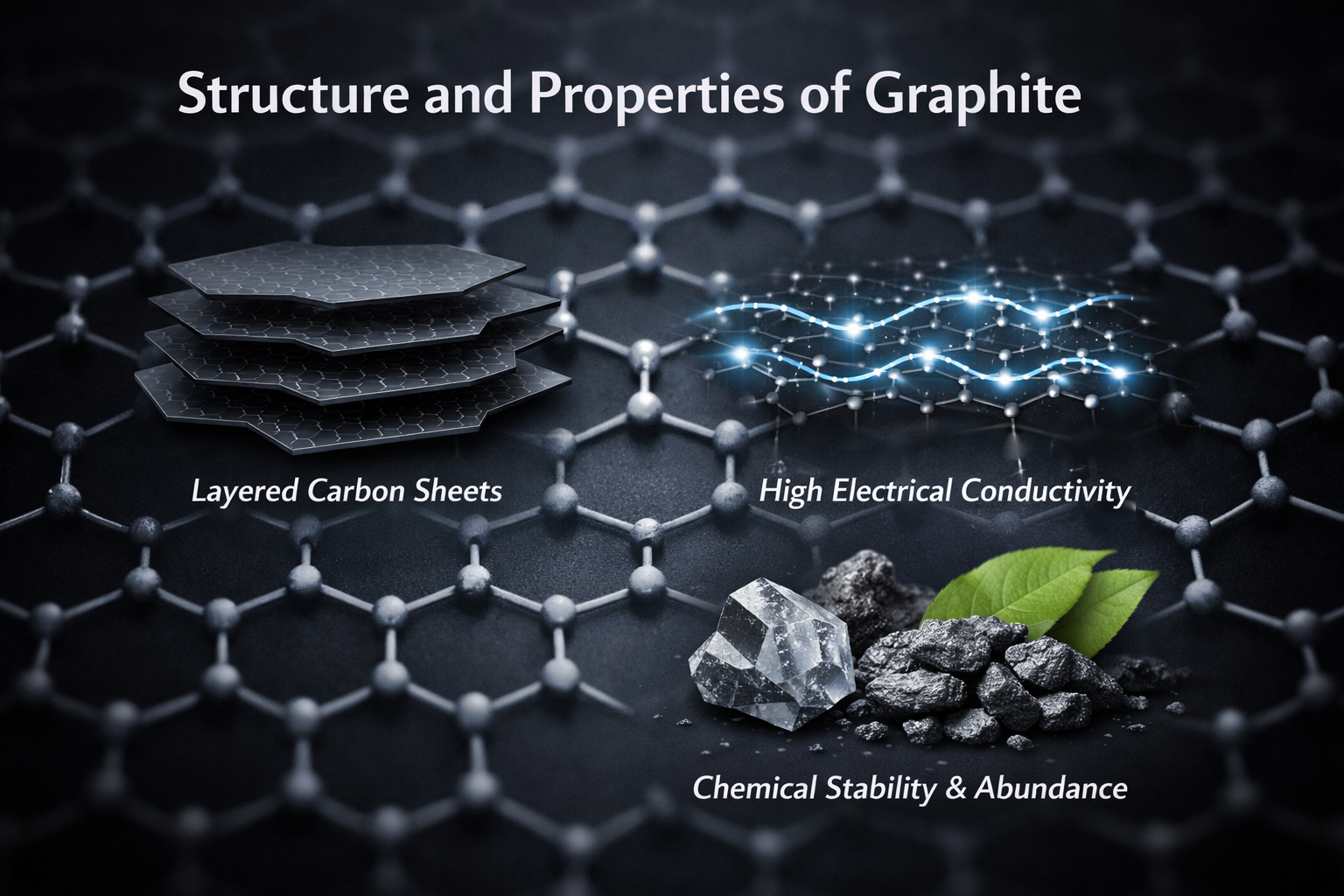
Graphite consists of layered carbon sheets arranged in a hexagonal lattice, enabling efficient electron transport and high chemical stability. These properties make it particularly suitable for electrochemical systems such as fuel cells.
In addition, graphite is abundant, low-cost, and more sustainable compared to noble metals. Its surface can be engineered through doping and defect creation, which significantly enhances its catalytic potential.
Graphite as a Catalyst Support
One of the most established applications of graphite in fuel cells is as a catalyst support. Its conductive structure improves electron transfer while providing a stable platform for active materials.
Graphitized carbon has been shown to offer higher stability than conventional carbon black, although this often comes with a trade-off in reduced surface area and catalyst dispersion. This improved durability helps mitigate common degradation issues such as carbon corrosion and catalyst detachment.
In addition, optimized carbon supports can improve catalyst dispersion and overall system performance when combined with tailored surface chemistry.
Graphitic Carbon as an Active Catalyst
Graphitic carbon materials can exhibit catalytic activity when their structure is appropriately engineered, such as through heteroatom doping or defect creation; pristine graphite itself shows very limited catalytic activity.This is typically achieved through heteroatom doping or the introduction of structural defects.
Nitrogen-doped carbon materials, for example, have demonstrated strong electrocatalytic activity for the oxygen reduction reaction, particularly in alkaline environments. This highlights the transition of carbon materials from passive supports to active catalytic components.
More recent findings show that edge-rich and defect-engineered graphitic structures can further enhance catalytic performance, achieving high ORR activity and stability (Cheng et al., 2025).
Cost Advantage and Scalability
A key advantage of graphite lies in its cost efficiency and availability. Unlike platinum-group metals, graphite is widely accessible and suitable for large-scale production.
The economic feasibility of carbon-based catalysts is a major factor driving their adoption in energy technologies, especially where scalability is critical.
Challenges and Limitations
Despite its advantages, graphite still has limitations. In its pristine form, its intrinsic catalytic activity is significantly lower than that of platinum, particularly in acidic environments where reaction kinetics are more demanding..
As a result, high-performance applications often rely on modified graphitic structures. Approaches such as doping, defect engineering, and hybrid material design are essential to achieving competitive performance.
Conclusion
Graphite is emerging as a promising low-cost component in catalyst systems due to its combination of conductivity, stability, and abundance. Graphitized carbon improves catalyst durability, while engineered graphitic structures can deliver strong catalytic performance in fuel cell reactions.
Rather than fully replacing platinum in all cases, graphite is increasingly used to reduce reliance on expensive materials and to enable more sustainable catalyst systems. With continued advancements in material engineering, graphite-based solutions are expected to play an important role in future energy technologies.
To explore how carbon-based materials enhance fuel cell performance, check out our blog post: Carbon Nanotube Composite Electrodes for Fuel Cell Applications.
Optimize system performance while improving cost efficiency with Nanografi’s graphite solutions.
References
- Ma, R., Lin, G., Zhou, Y. et al. A review of oxygen reduction mechanisms for metal-free carbon-based electrocatalysts. npj Comput Mater 5, 78 (2019). https://doi.org/10.1038/s41524-019-0210-3
- Islam MN, Mansoor Basha AB, Kollath VO, Soleymani AP, Jankovic J, Karan K. Designing fuel cell catalyst support for superior catalytic activity and low mass-transport resistance. Nat Commun. 2022 Oct 18;13(1):6157. doi: 10.1038/s41467-022-33892-8.
- Gong K, Du F, Xia Z, Durstock M, Dai L. Nitrogen-doped carbon nanotube arrays with high electrocatalytic activity for oxygen reduction. Science. 2009 Feb 6;323(5915):760-4. doi: 10.1126/science.1168049. PMID: 19197058.
- Cheng, X., Wang, Y., Hao, Z., Zheng, Y., Li, Z., Huang, Y., Han, X., Dong, L., & Zang, J. (2025). Graphite edge-sites induced by porosity engineering for high active oxygen reduction reaction. International Journal of Hydrogen Energy, 192, 152259. https://doi.org/10.1016/j.ijhydene.2025.152259.
Recent Posts
-

What Is Conductive Masterbatch? CNT, Carbon Black and Graphene Compared
A conductive masterbatch is a concentrated blend of a conductive carbon additive and a carrier polym …14th Oct 2026 -

Biomaterials for Implants: Titanium vs Nitinol vs Hydroxyapatite Coatings
Implantable medical devices operate under very different mechanical and biological conditions. A hip …7th Oct 2026 -

CNT Paste vs Silver Paste vs Carbon Paste: Which Conductive Adhesive Should You Use?
Conductive pastes quietly hold much of modern electronics together. They bond chips to substrates, d …1st Oct 2026