
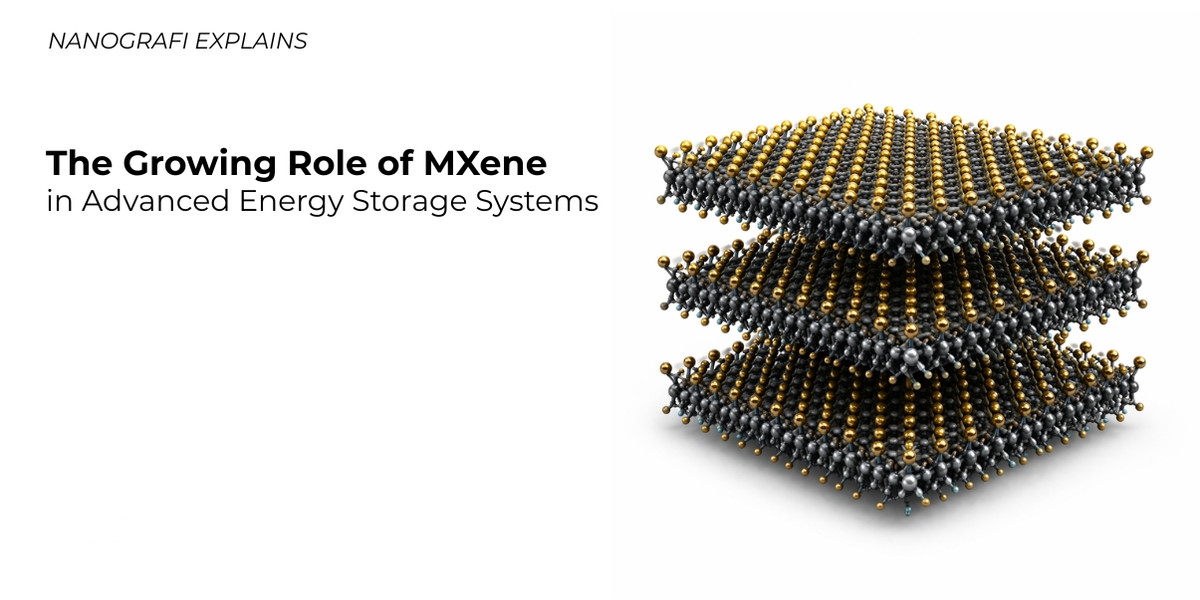
The Growing Role of MXene in Advanced Energy Storage Systems
Fast charging alone is no longer enough. Today’s energy storage systems are expected to combine high conductivity, rapid ion transport, structural stability, and long-term cyclic stability within a single system architecture. That is one reason MXene materials continue to attract strong interest in battery and supercapacitor research. Their layered structure, conductive surfaces, and tunable surface chemistry make them highly relevant for applications where both electrochemical efficiency and device-level performance matter. Recent review papers position MXene as a serious material platform for next-generation energy storage rather than simply another emerging nanomaterial.
Why MXene Stands Out in Energy Storage
What makes MXene materials distinctive is the way they combine several performance advantages within one structure. Across the literature, three features appear repeatedly: high electrical conductivity, a layered morphology that supports ion transport, and surface functional groups that can be tuned for improved electrochemical behavior. In practice, this means MXene can accelerate charge transfer while also improving access to active sites during repeated charge–discharge cycles.
The growing interest is also supported by performance data. Recent reviews report that MXene-based electrodes can exceed 700 F g⁻¹ specific capacitance in supercapacitor configurations and maintain more than 90% capacitance retention after 10,000 cycles under optimized conditions. For lithium-ion batteries, reported theoretical capacities commonly fall within the 390–600 mAh g⁻¹ spesific capacity range, while experimental reversible capacities often surpass 400 mAh g⁻¹ depending on composition and electrode design (Jussambayev et al., 2025).
Another reason MXene has gained attention is its design flexibility. It can function as a standalone active material, a conductive scaffold, or part of a composite with polymers, carbon materials, or metal oxides. That versatility is especially important in energy storage, where performance depends not only on intrinsic material properties but also on how efficiently the electrode architecture manages İnterfacial ion diffusion, electron transport, and structural durability.
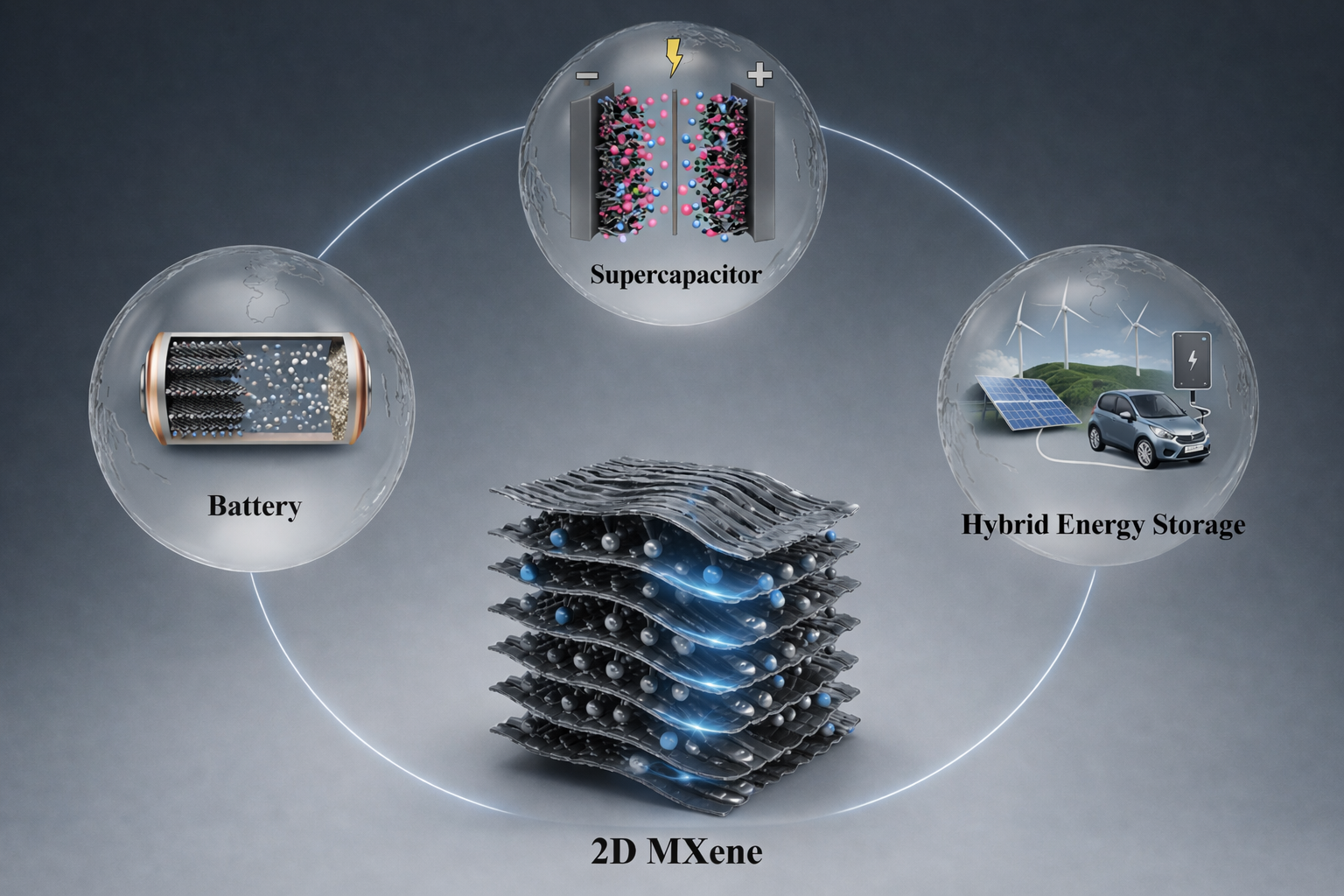
Figure 1. Schematic illustration of 2D MXene materials in battery, supercapacitor, and hybrid energy storage systems.
MXene in Batteries
In battery research, MXene is widely studied for its ability to support rapid electron transport and improve interfacial charge-transfer kinetics within the electrode. Its value goes beyond conductivity alone. The layered architecture can facilitate ion diffusion, while its surface chemistry can be tailored to improve interaction with electrolytes and adjacent active materials. This is why MXene is now explored in lithium-ion, sodium-ion, lithium-sulfur, and hybrid battery systems.
Recent studies also show that MXene often performs best in composite battery electrodes rather than in pristine form. In these systems, it acts as a conductive scaffold that reduces charge-transfer resistance and helps stabilize the electrode during cycling. Review literature points to theoretical capacities in the 390–600 mAh g⁻¹ range for different MXene chemistries, while advanced composite systems have achieved much higher application-specific values. Some recent reviews highlight Si/MXene heterostructures reaching specific capacities of up to 3500 mAh g⁻¹, while certain engineered systems maintain around 90% capacity retention over 2000 cycles depending on the design strategy (Jussambayev et al., 2025; Jiang, 2025).
This shift toward hybrid structures matters because it shows that MXene’s role in batteries is often strongest as a structural and interfacial component. Rather than serving only as a high-performing standalone active material, MXene can reinforce electrode structural integrity
, improve charge transport, and enable more efficient electrochemical pathways.
MXene in Supercapacitors
If batteries represent one major direction for MXene, supercapacitors represent another. This is where the material’s fast charge transport, high surface accessibility, and pseudocapacitive behavior become especially relevant. Current reviews position MXene among the most promising electrode classes for high-rate capability, particularly in systems where spesific capacitance, power delivery, and cycling durability need to be balanced in compact device formats.
One of the most frequently cited reference points in this area is the volumetric performance of MXene films. Earlier high-impact work on titanium carbide MXene reported volumetric capacitance values of up to 900 F cm⁻³, helping establish MXene as a strong electrode platform for high-performance and volume-efficient supercapacitors (Wang et al., 2015; Dall’Agnese et al., 2016). More recent studies have pushed that benchmark further, with some advanced MXene-based architectures exceeding 1000 F cm⁻³ in optimized configurations (Jiang, 2025).
A major theme in current MXene-supercapacitor research is structural engineering. Pure MXene sheets tend to undergo restacking, which can limit electrolyte penetration and reduce electrochemically active surface area. To address this, researchers increasingly focus on porous architectures, polymer-assisted structures, and composite electrode designs that preserve the layered network while improving ion accessibility. These strategies are central to improving capacitance retention, energy density, and long-term cycling stability in practical device formats.
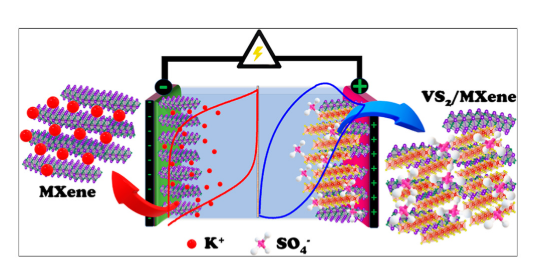
Figure 2. Schematic comparison of the electrochemical response of pristine MXene and VS₂/MXene electrodes, highlighting improved ion transport and charge storage in the VS₂/MXene structure. (Abraham and George, 2025).
The Real Challenge: Stability and Restacking
For all its advantages, MXene still comes with clear technical challenges. The two issues that appear most consistently across the literature are oxidation and restacking. Oxidation can gradually degrade conductivity and electrochemical performance, while restacking reduces the open layered structure that makes MXene attractive for ion transport in the first place. These are not minor issues; they directly influence long-term cyclic stability, rate capability, and reproducibility.
That is why the strongest MXene studies focus not only on high initial electrochemical values, but on how well the structural integrity can be preserved over time. Composite design, porous network engineering, interface control, and safer synthesis routes have become standard research directions because they address the real barriers to application rather than only the headline performance numbers. Recent reviews also emphasize that scalability and batch-to-batch consistency remain major obstacles for broader commercial adoption.
MXene materials for energy storage systems remain one of the most active and technically relevant areas in advanced materials research. Their value comes from a rare combination of conductivity, tailorable surface chemistry, layered morphology, and strong compatibility with heterostructured electrode design. At the same time, the most useful recent studies make one point very clear: performance depends not only on the material itself, but on how effectively its structure, interfaces, and long-term stability are engineered for the target application. That is what will shape the next phase of MXene development in batteries, supercapacitors, and related electrochemical systems (Jussambayev et al., 2025; Jiang, 2025).
Discover Nanografi MXene materials including MXene suspensions, MXene powders, for advanced energy storage research, battery development, and supercapacitor design.
More on MXene materials:
References
- Ampong, D. N., Agyekum, E., Agyemang, F. O., Mensah-Darkwa, K., Andrews, A., Kumar, A., & Gupta, R. K. (2023). MXene: fundamentals to applications in electrochemical energy storage. Discover nano, 18(1), 3. https://doi.org/10.1186/s11671-023-03786-9.
- Jiang, Y. (2025). Applications and perspectives of Ti3C2Tx MXene in electrochemical energy storage systems. International Journal of Electrochemical Energy Systems.International Journal of Electrochemical Science. https://doi.org/10.1016/j.ijoes.2025.100948.
- Jussambayev, M., et al. (2025). MXenes for sustainable energy: A comprehensive review on conservation and storage applications. Carbon Trends. https://doi.org/10.1016/j.cartre.2025.100471.
- Wang, X., Kajiyama, S., Iinuma, H. et al. Pseudocapacitance of MXene nanosheets for high-power sodium-ion hybrid capacitors. Nat Commun 6, 6544 (2015). https://doi.org/10.1038/ncomms7544
Recent Posts
-

Advanced Materials for Humanoid Robots: Actuators, Sensors and E-Skin
Humanoid robots are leaving the lab. They now walk warehouse floors, handle parts on assembly lines …23rd Oct 2026 -
What Is Conductive Masterbatch? CNT, Carbon Black and Graphene Compared
A conductive masterbatch is a concentrated blend of a conductive carbon additive and a carrier polym …14th Oct 2026 -

Biomaterials for Implants: Titanium vs Nitinol vs Hydroxyapatite Coatings
Implantable medical devices operate under very different mechanical and biological conditions. A hip …7th Oct 2026